 Back
Comprehensive GOB Chemistry Exam Review Guidance
Study Guide - Smart Notes
 Tailored notes based on your materials, expanded with key definitions, examples, and context.
Q1. A pediatric patient weighs 43.5 lb. The dose for ibuprofen for this age group is 8.50 mg/kg. How many mg of ibuprofen should this patient receive?
Background
Topic: Unit Conversions and Dosage Calculations
This question tests your ability to convert between units (pounds to kilograms) and apply dosage calculations using dimensional analysis.
Key Terms and Formulas
1 kg = 2.205 lb
Dosage (mg) = Patient mass (kg) × Dose (mg/kg)
Step-by-Step Guidance
Convert the patient's weight from pounds to kilograms using the conversion factor: .
Set up the dimensional analysis to cancel out pounds and solve for kilograms.
Multiply the patient's mass in kilograms by the dosage (8.50 mg/kg) to find the total milligrams needed.
Set up the multiplication but do not calculate the final value yet.
Try solving on your own before revealing the answer!
Final Answer: 168 mg
First, convert 43.5 lb to kg: (rounded to 3 sig figs).
Then, .
The patient should receive 168 mg of ibuprofen.
Q2. Children’s Tylenol Oral Suspension is sold as a solution with a concentration of 160 mg/5.0 mL. For a patient of four to five years, the dose for a fever is 7.5 mL. How many milligrams of Tylenol is the patient receiving with this dose?
Background
Topic: Solution Concentration and Dosage Calculations
This question tests your ability to use solution concentration to determine the amount of solute (Tylenol) in a given volume.
Key Terms and Formulas
Concentration:
Amount (mg) = Volume (mL) × Concentration (mg/mL)
Step-by-Step Guidance
Set up the ratio to find the amount of Tylenol per 1 mL: .
Multiply the prescribed dose (7.5 mL) by the concentration (mg/mL).
Set up the multiplication but do not calculate the final value yet.
Try solving on your own before revealing the answer!
Final Answer: 240 mg
First, .
Then, .
The patient receives 240 mg of Tylenol.
Q3. A patient has a measured temperature of 38.2 °C. Convert this temperature to Fahrenheit and state whether or not this is considered to be a fever.
Background
Topic: Temperature Conversions
This question tests your ability to convert between Celsius and Fahrenheit and apply clinical knowledge about fever thresholds.
Key Terms and Formulas
Temperature conversion:
Normal body temperature: ~37 °C (98.6 °F); fever is typically > 38 °C (100.4 °F)
Step-by-Step Guidance
Plug the Celsius temperature into the conversion formula: .
Calculate first.
Add 32 to the result from step 2 to get the Fahrenheit temperature.
Compare the result to the fever threshold (100.4 °F) to determine if it is a fever.
Try solving on your own before revealing the answer!
Final Answer: 100.8 °F, yes
; °F.
Since 100.8 °F is above the fever threshold, this is considered a fever.
Q4. An athlete runs a 5K. How many meters is this? Report your answer to 3 significant figures.
Background
Topic: Metric Conversions and Significant Figures
This question tests your ability to convert kilometers to meters and report the answer with the correct number of significant figures.
Key Terms and Formulas
1 kilometer (km) = 1000 meters (m)
Significant figures: Report to 3 significant digits
Step-by-Step Guidance
Recognize that 5K means 5 kilometers.
Multiply 5 kilometers by 1000 to convert to meters.
Express the answer in scientific notation with 3 significant figures.
Try solving on your own before revealing the answer!
Final Answer: m
5 km × 1000 = 5000 m, which is m (3 significant figures).
Q5. A solution has a density of 1.06 g/mL. What is the volume of a 25 g sample of this solution?
Background
Topic: Density Calculations
This question tests your ability to use the density formula to solve for volume.
Key Terms and Formulas
Density formula:
Rearranged:
Step-by-Step Guidance
Identify the given values: mass = 25 g, density = 1.06 g/mL.
Rearrange the density formula to solve for volume.
Set up the calculation: .
Do not calculate the final value yet.
Try solving on your own before revealing the answer!
Final Answer: 24 mL
mL, rounded to 2 significant figures is 24 mL.
Q6. Complete the following table (naming ionic compounds):
Background
Topic: Nomenclature of Ionic Compounds
This question tests your ability to write names and formulas for ionic compounds, including those with polyatomic ions and transition metals.
Key Terms and Formulas
Binary ionic compounds: Metal + Nonmetal (ending in -ide)
Polyatomic ions: Use the name of the ion as is
Transition metals: Indicate charge with Roman numerals
Step-by-Step Guidance
For each formula, identify the cation and anion.
Write the name using the rules for ionic compounds.
For each name, write the correct chemical formula.
Be sure to use Roman numerals for transition metals as needed.
Try solving on your own before revealing the answer!
Final Answer:
Formula | Name |
|---|---|
MgCl2 | magnesium chloride |
Li3P | lithium phosphide |
Na3N | sodium nitride |
Mg3(PO4)2 | magnesium phosphate |
Cu3N | copper (I) nitride |
FeO | iron (II) oxide |
NaNO3 | sodium nitrate |
Cu(OH)2 | copper (II) hydroxide |
Q7. Complete the following table (molecular compounds):
Background
Topic: Molecular Compounds, Lewis Structures, Molecular Geometry, Polarity, and Intermolecular Forces
This question tests your ability to name molecular compounds, draw their Lewis structures, determine geometry, and identify polarity and intermolecular forces.
Key Terms and Formulas
Lewis structure: Shows bonding and lone pairs
Electron pair geometry: Arrangement of electron groups
Molecular shape: Arrangement of atoms
Polarity: Distribution of charge
IMF: Intermolecular forces (dispersion, dipole-dipole, hydrogen bonding)
Step-by-Step Guidance
Name each compound using prefixes (e.g., di-, tetra-).
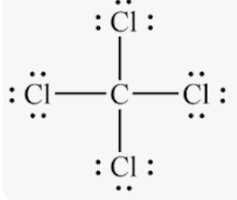
Draw the Lewis structure for each molecule.
Determine the electron pair geometry and molecular shape using VSEPR theory.
Assess whether the molecule is polar or nonpolar.
Identify the most prevalent intermolecular force.
Try solving on your own before revealing the answer!
Final Answer:
Compound | Name | Draw the molecule | Electron pair geometry | Molecular shape | Polar or nonpolar | Most prevalent IMF |
|---|---|---|---|---|---|---|
SBr2 | Sulfur dibromide | Bent structure | Tetrahedral | Bent | Polar | Dipole-dipole |
CCl4 | Carbon tetrachloride |
| Tetrahedral | Tetrahedral | Nonpolar | Dispersion |
Q8. Draw the expanded structure for the following molecule. State the molecular formula and calculate the molar mass. Show molar mass calculation.
Background
Topic: Organic Structure Drawing, Molecular Formula, and Molar Mass Calculation
This question tests your ability to interpret and draw organic structures, determine the molecular formula, and calculate molar mass using atomic weights.
Key Terms and Formulas
Molecular formula: Count each atom in the structure
Molar mass: Sum of (number of atoms × atomic mass) for each element
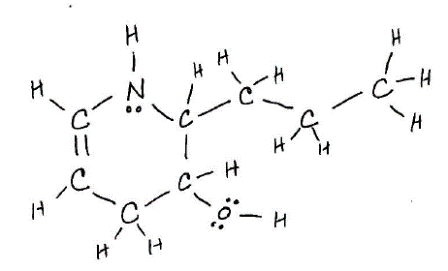
Step-by-Step Guidance
Carefully count the number of each type of atom (C, H, N, O) in the expanded structure.
Write the molecular formula based on your count.
List the atomic masses: C = 12.01 g/mol, H = 1.008 g/mol, N = 14.01 g/mol, O = 16.00 g/mol.
Multiply the number of each atom by its atomic mass and sum the results to get the molar mass.
Set up the calculation but do not compute the final value yet.
Try solving on your own before revealing the answer!
Final Answer: C8H15NO, 141.21 g/mol
Counted atoms: 8 C, 15 H, 1 N, 1 O.
Molar mass: g/mol.
