 Back
BackCovalent Compounds: Bonding, Structure, and Properties 4
Study Guide - Smart Notes
 Tailored notes based on your materials, expanded with key definitions, examples, and context.
Chapter 4: Covalent Compounds
4.1 Introduction to Covalent Bonding
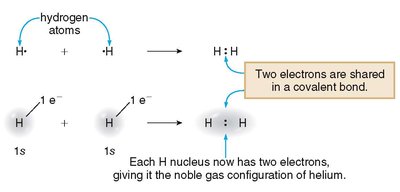
Covalent bonds are fundamental to the structure of molecules, resulting from the sharing of electrons between two atoms. This type of bonding is essential for the formation of most nonmetal compounds and underlies the structure of organic and biological molecules.
Covalent bond: A two-electron bond in which the bonding atoms share electrons.
Molecule: A discrete group of atoms held together by covalent bonds.
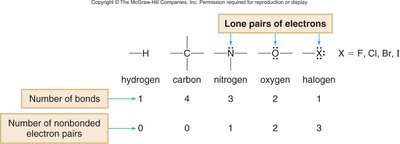
Lone pairs (nonbonded electron pairs): Electrons not involved in bonding, localized on a single atom.
Atoms share electrons to attain the electronic configuration of the nearest noble gas (the octet rule), except hydrogen, which attains a duet (2 electrons).
4.1A Covalent Bonding and the Periodic Table
Covalent bonds are typically formed between nonmetals or between a metalloid and a nonmetal. The number of covalent bonds an atom forms is related to its number of valence electrons.
Atoms with one, two, or three valence electrons form one, two, or three bonds, respectively.
Atoms with four or more valence electrons form enough bonds to complete an octet.
Formula: Predicted number of bonds = 8 – number of valence electrons
4.2 Lewis Structures
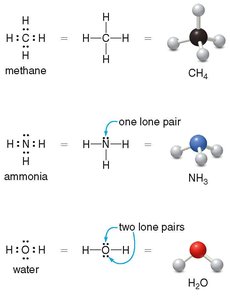
Lewis structures are electron-dot diagrams that show the arrangement of valence electrons among atoms in a molecule. They are essential for visualizing bonding and lone pairs.
Molecular formula: Shows the number and identity of all atoms in a compound.
Lewis structure: Shows connectivity and the location of all bonding and nonbonding valence electrons.
How to Draw a Lewis Structure
Arrange the atoms: Place the central atom (usually the least electronegative) in the center. Hydrogen and halogens are placed on the periphery.
Count valence electrons: Sum the valence electrons from all atoms.
Distribute electrons: Place single bonds between atoms, then distribute remaining electrons to complete octets (or duets for H).
Form multiple bonds if needed: If an atom lacks an octet, convert lone pairs from adjacent atoms into bonding pairs to form double or triple bonds.

Multiple Bonds
Double bond: Contains four electrons (two pairs) shared between two atoms.
Triple bond: Contains six electrons (three pairs) shared between two atoms.
4.3 Exceptions to the Octet Rule
While most main group elements follow the octet rule, there are important exceptions:
Hydrogen: Only needs two electrons (duet rule).
Group 3A elements (e.g., B): May have fewer than eight electrons.
Elements in period 3 and beyond (e.g., P, S): Can have expanded octets due to available d orbitals.
4.3 Polyatomic Ions
When drawing Lewis structures for polyatomic ions, adjust the total number of electrons for the charge:
Add one electron for each negative charge.
Subtract one electron for each positive charge.
4.4 Resonance
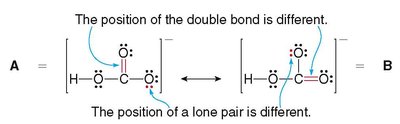
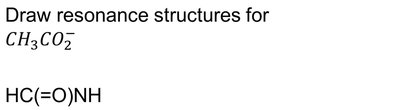
Some molecules cannot be adequately represented by a single Lewis structure. Resonance structures are used to depict delocalized electrons.
Resonance structures: Two or more valid Lewis structures for the same arrangement of atoms but different electron arrangements.
The true structure is a resonance hybrid, which is an average of the resonance forms.
Resonance stabilizes molecules by delocalizing electrons.
4.5 Naming Covalent Compounds
Covalent compounds are named using a systematic approach based on the number and type of atoms present.
Name the first nonmetal by its element name; name the second nonmetal with the suffix "-ide."
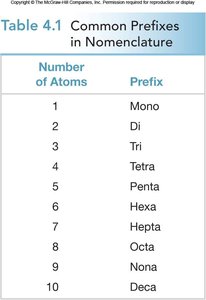
Add prefixes to indicate the number of each atom (see Table 4.1). The prefix "mono-" is usually omitted for the first element.
If two vowels are adjacent, omit the first vowel (e.g., monoxide, not monooxide).
4.6 Molecular Shape (VSEPR Theory)
The shape of a molecule is determined by the number of groups (atoms or lone pairs) around a central atom. The Valence Shell Electron Pair Repulsion (VSEPR) theory predicts molecular geometry by minimizing repulsion between electron groups.
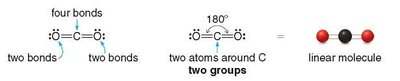
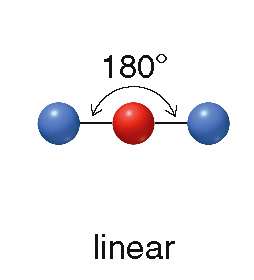
Two Groups: Linear Geometry
Bond angle: 180°
Example: CO2
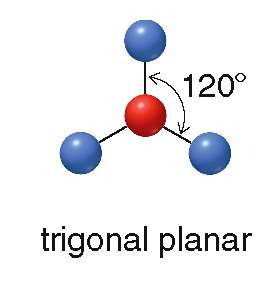
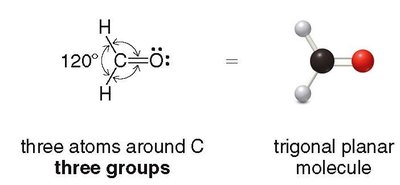
Three Groups: Trigonal Planar Geometry
Bond angle: 120°
Example: H2CO
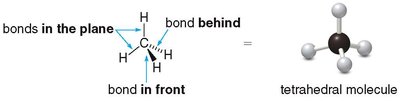
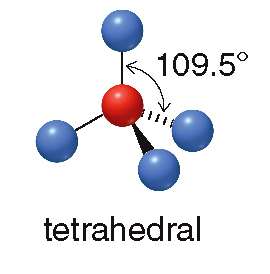
Four Groups: Tetrahedral Geometry
Bond angle: 109.5°
Example: CH4
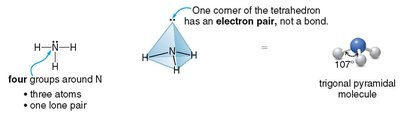
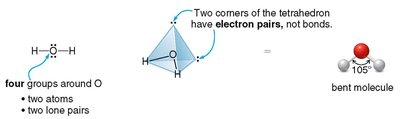
Four Groups (with Lone Pairs)
One lone pair: Trigonal pyramidal (e.g., NH3), bond angle ~107°
Two lone pairs: Bent (e.g., H2O), bond angle ~105°
4.7 Electronegativity and Bond Polarity
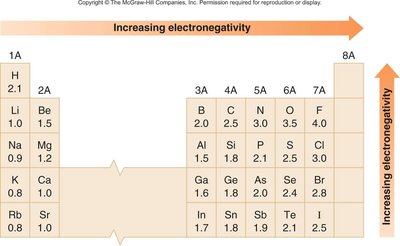
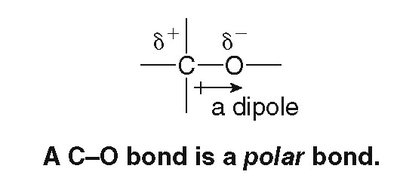
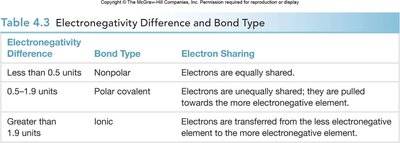
Electronegativity is a measure of an atom's ability to attract electrons in a bond. The difference in electronegativity between two atoms determines the bond type.
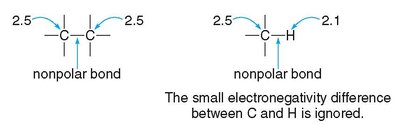
Nonpolar covalent bond: Electrons are shared equally (electronegativity difference < 0.5).
Polar covalent bond: Electrons are shared unequally (difference 0.5–1.9).
Ionic bond: Electrons are transferred (difference > 1.9).
4.8 Polarity of Molecules
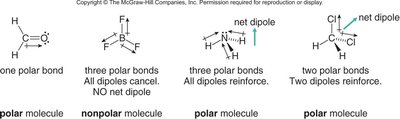
The overall polarity of a molecule depends on both the polarity of its bonds and its molecular shape. A molecule is polar if it contains polar bonds arranged asymmetrically, resulting in a net dipole moment.
Nonpolar molecules: No polar bonds or bond dipoles cancel out.
Polar molecules: Contain polar bonds and bond dipoles do not cancel.
Summary Table: Common Bonding Patterns
Element | Number of Bonds | Number of Lone Pairs |
|---|---|---|
Hydrogen | 1 | 0 |
Carbon | 4 | 0 |
Nitrogen | 3 | 1 |
Oxygen | 2 | 2 |
Halogen (F, Cl, Br, I) | 1 | 3 |
Summary Table: Electronegativity Difference and Bond Type
Electronegativity Difference | Bond Type | Electron Sharing |
|---|---|---|
Less than 0.5 units | Nonpolar | Electrons are equally shared. |
0.5–1.9 units | Polar covalent | Electrons are unequally shared; pulled toward the more electronegative element. |
Greater than 1.9 units | Ionic | Electrons are transferred from the less electronegative element to the more electronegative element. |
Additional info: These notes cover the core concepts of covalent bonding, Lewis structures, resonance, molecular geometry, electronegativity, and molecular polarity, as outlined in a typical introductory chemistry curriculum.
