 Back
Edexcel International Advanced Level Chemistry: Core Data Booklet and Reference Tables
Study Guide - Smart Notes
 Tailored notes based on your materials, expanded with key definitions, examples, and context.
Reference Data and Tables for GOB Chemistry
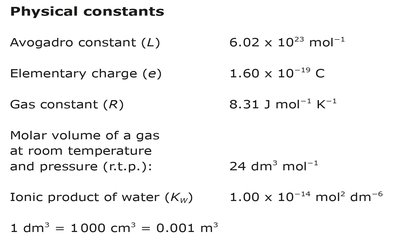
Physical Constants
Physical constants are essential for calculations in chemistry, including stoichiometry, gas laws, and solution chemistry. The following constants are commonly used:
Avogadro constant (L):
Elementary charge (e):
Gas constant (R):
Molar volume of a gas at r.t.p.:
Ionic product of water (K_w):
Unit conversions:
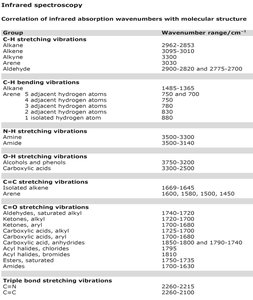
Infrared Spectroscopy Reference Table
Infrared (IR) spectroscopy is used to identify functional groups in organic molecules by their characteristic absorption bands. The table below correlates IR absorption wavenumbers with molecular structures:
Group | Wavenumber range (cm-1) |
|---|---|
C-H stretching (alkane) | 2962–2853 |
C-H stretching (alkene) | 3100–3020 |
C-H stretching (alkyne) | 3300 |
C-H stretching (arene) | 3095–3020 |
C-H stretching (aldehyde) | 2900–2820 and 2775–2700 |
N-H stretching (amine) | 3500–3300 |
O-H stretching (alcohols, acids) | 3700–3200 |
C=O stretching (carbonyls) | 1760–1660 |
C=C stretching (alkenes, arenes) | 1680–1620 |
Triple bond stretching (C≡C, C≡N) | 2260–2100 |
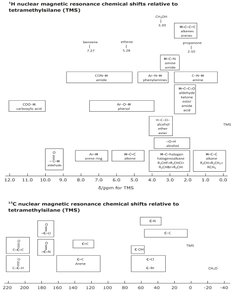
NMR Chemical Shifts Reference
Nuclear Magnetic Resonance (NMR) spectroscopy provides information about the chemical environment of hydrogen and carbon atoms in organic molecules. The chemical shift (δ, in ppm) is measured relative to tetramethylsilane (TMS):
1H NMR: Chemical shifts for different proton environments (e.g., alkyl, alkene, aromatic, aldehyde, carboxylic acid, etc.)
13C NMR: Chemical shifts for different carbon environments (e.g., alkyl, alkene, aromatic, carbonyl, etc.)
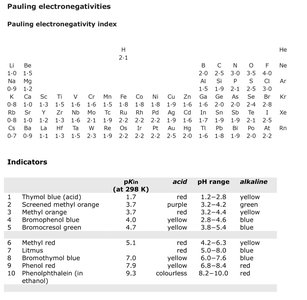
Electronegativity and Indicators
Electronegativity values (Pauling scale) are used to predict bond polarity and reactivity. Acid-base indicators are used to determine the endpoint of titrations and the pH of solutions.
Electronegativity: Values range from 0.7 (Cs) to 4.0 (F). Higher values indicate stronger attraction for electrons in a bond.
Indicators: Each indicator has a characteristic pKin and color change range. For example, phenolphthalein changes from colorless to pink over pH 8.2–10.0.
Standard Electrode Potentials
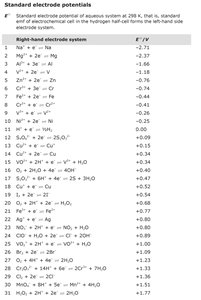
Standard electrode potentials (E⦵) are used to predict the direction of redox reactions and calculate cell potentials. The more positive the E⦵, the greater the tendency to be reduced.
Example: , V
Example: , V
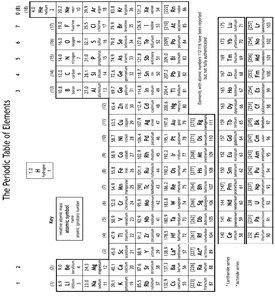
The Periodic Table of Elements
The periodic table organizes elements by increasing atomic number and groups elements with similar chemical properties. It is fundamental for understanding atomic structure, periodic trends, and chemical reactivity.
Additional info:
These tables and reference data are essential for laboratory calculations, interpreting spectra, and solving quantitative problems in GOB Chemistry.
Students should be familiar with using these tables during exams and practical work.
