 Back
Electronic Structure of Atoms: Quantum Numbers, Orbitals, and Electron Configurations
Study Guide - Smart Notes
 Tailored notes based on your materials, expanded with key definitions, examples, and context.
Electronic Structure of Atoms
Introduction to Electronic Structure
The electronic structure of atoms describes the arrangement and energy of electrons within an atom. Understanding this structure is essential for explaining chemical properties and behaviors. The study of electronic structure involves concepts from both classical and quantum physics, as extremely small particles like electrons exhibit both wave-like and particle-like properties.
Atomic Emissions and Spectra
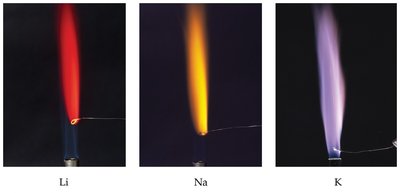
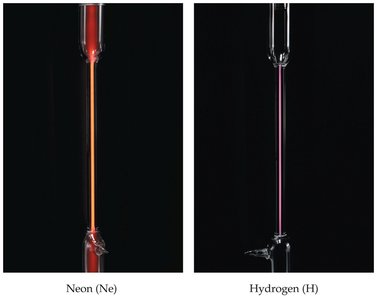
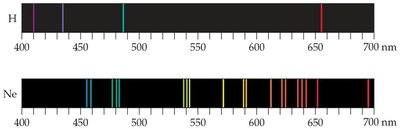
When atoms and molecules emit energy, they produce characteristic emission spectra. Unlike a continuous spectrum (such as a rainbow from white light), atoms emit only specific wavelengths, resulting in a line spectrum unique to each element. This phenomenon provided early evidence for quantized energy levels in atoms.

The Bohr Model of the Atom
Bohr's Postulates
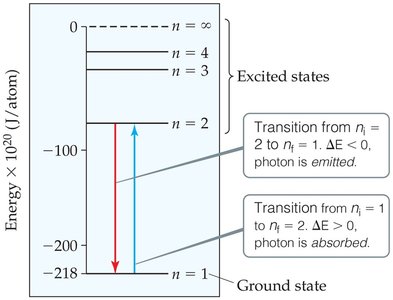
Niels Bohr proposed a model to explain atomic emission spectra, particularly for hydrogen. His key postulates were:
Electrons move in specific, quantized orbits around the nucleus, each with a fixed energy.
Electrons in allowed orbits do not radiate energy and thus do not spiral into the nucleus.
Energy is absorbed or emitted only when an electron transitions between orbits, with the energy change given by .
Limitations and Legacy of the Bohr Model
The Bohr model successfully explained the hydrogen spectrum but failed for atoms with more than one electron. However, it introduced the concept of quantized energy levels, which remains fundamental in modern atomic theory.
Quantum Mechanics and Atomic Orbitals
Wave-Particle Duality and Schrödinger Equation
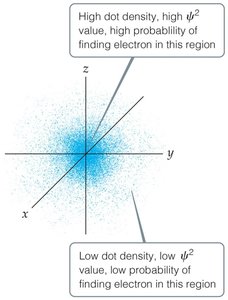
Quantum mechanics, developed by Erwin Schrödinger and others, incorporates both the wave and particle nature of electrons. The Schrödinger equation yields wave functions (orbitals) that describe the probability distribution of electrons in an atom.
Quantum Numbers
Each atomic orbital is defined by a set of quantum numbers:
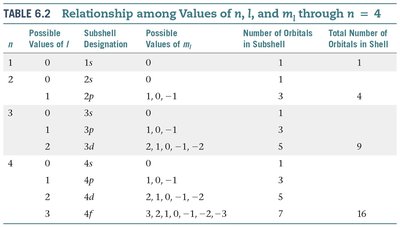
Principal quantum number (n): Indicates the energy level and size of the orbital (n = 1, 2, 3, ...).
Angular momentum quantum number (l): Defines the shape of the orbital (l = 0 to n-1). The values correspond to s, p, d, and f orbitals.
Magnetic quantum number (m_l): Specifies the orientation of the orbital in space (m_l = -l to +l).
Spin quantum number (m_s): Describes the spin of the electron (+1/2 or -1/2).
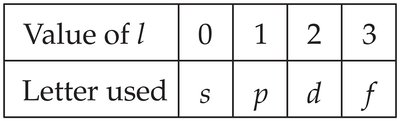
Value of l | 0 | 1 | 2 | 3 |
|---|---|---|---|---|
Letter used | s | p | d | f |
Relationship Among Quantum Numbers
The combination of n, l, and m_l determines the number and types of orbitals in each shell. The table below summarizes these relationships for n = 1 to 4.
Shapes of Atomic Orbitals
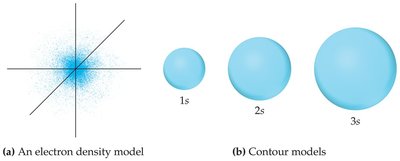
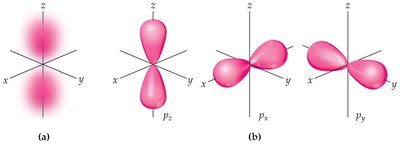
s orbitals (l = 0): Spherical in shape; size increases with n.
p orbitals (l = 1): Dumbbell-shaped with two lobes and a node at the nucleus.
d orbitals (l = 2): Four have cloverleaf shapes; one resembles a p orbital with a doughnut.
f orbitals (l = 3): More complex shapes, not shown here.
Energy Levels and Degeneracy
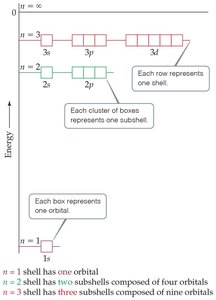
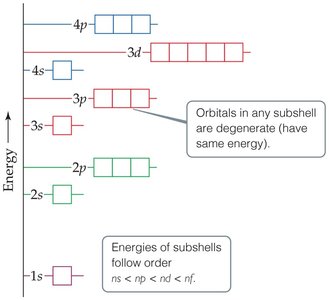
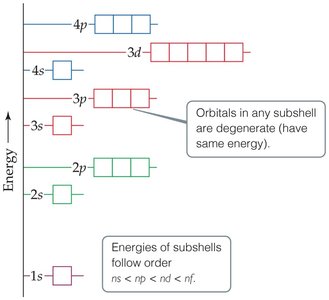
In hydrogen (a one-electron atom), all orbitals with the same n have the same energy (they are degenerate). In multi-electron atoms, electron-electron repulsions cause energy splitting among orbitals of the same n but different l values.
Electron Spin and the Pauli Exclusion Principle
Spin Quantum Number (m_s)
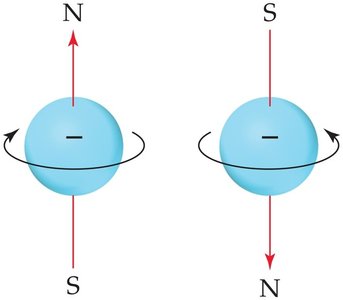
Electrons possess an intrinsic property called spin, which can be +1/2 or -1/2. This property gives rise to magnetic behavior and is essential for understanding electron arrangements in orbitals.
Pauli Exclusion Principle
No two electrons in the same atom can have the same set of four quantum numbers (n, l, m_l, m_s). This means each orbital can hold a maximum of two electrons with opposite spins.
Electron Configurations and Orbital Diagrams
Writing Electron Configurations
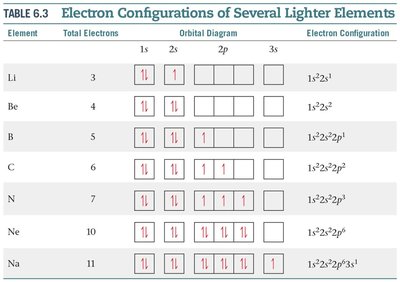
The electron configuration of an atom describes the distribution of electrons among orbitals. The notation consists of:
A number for the energy level (n)
A letter for the type of orbital (s, p, d, f)
A superscript for the number of electrons in that subshell
Example: 4p5
Orbital Diagrams
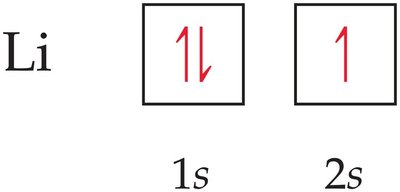
Orbital diagrams use boxes to represent orbitals and arrows to represent electrons. The direction of the arrow indicates the electron's spin.
Hund's Rule
When filling degenerate orbitals (orbitals of the same energy), electrons fill them singly first, with parallel spins, to maximize total spin. Pairing occurs only after each orbital in a subshell has one electron.
Condensed Electron Configurations
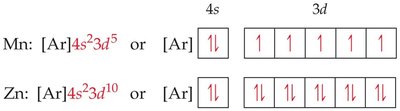
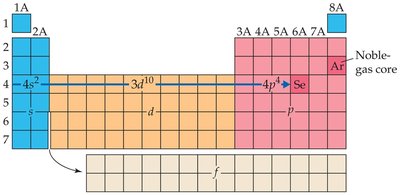
To simplify electron configurations, inner (core) electrons are represented by the symbol of the preceding noble gas in brackets. Only the valence electrons are written explicitly.

Transition Metals, Lanthanides, and Actinides
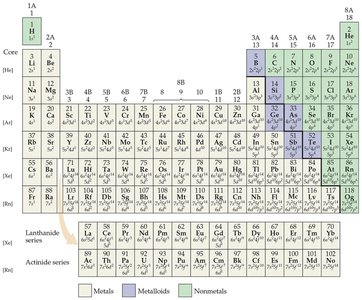
Transition metals fill d orbitals after the s orbital of the next higher shell. Lanthanides and actinides fill f orbitals. The order of filling is determined by the relative energies of the orbitals.
Periodic Table and Electron Configuration
Periodic Table Organization
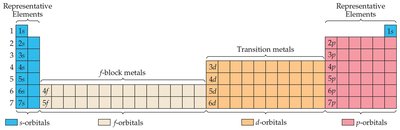
The periodic table is structured so that elements in the same group have similar valence electron configurations. The table is divided into blocks (s, p, d, f) corresponding to the type of orbital being filled.
Electron Configuration Anomalies
Some elements, especially transition metals, exhibit irregular electron configurations due to the similar energies of s and d (or f and d) orbitals. For example, chromium has the configuration [Ar] 4s1 3d5 instead of the expected [Ar] 4s2 3d4.
Additional info: The quantum mechanical model of the atom provides the foundation for understanding chemical bonding, periodic trends, and the reactivity of elements. Mastery of electron configurations is essential for predicting the chemical behavior of atoms and ions.
