Back
BackEnergy Changes, Reaction Rates, and Chemical Equilibrium6
Study Guide - Smart Notes
 Tailored notes based on your materials, expanded with key definitions, examples, and context.
Energy Changes, Reaction Rates, and Equilibrium
Energy in Chemical Systems
Energy is a fundamental concept in chemistry, describing the capacity to do work. Chemical reactions involve changes in energy, which can be stored (potential energy) or associated with motion (kinetic energy). The law of conservation of energy states that energy cannot be created or destroyed, only transformed.
Potential energy: Stored energy, often in chemical bonds.
Kinetic energy: Energy of motion.
Chemical bonds: Store potential energy; reactions favor products with lower potential energy (greater stability).
Energy is measured in calories (cal) and joules (J):
1 cal = 4.184 J
1 kcal = 1000 cal = 4.184 kJ
Energy Changes in Chemical Reactions
During chemical reactions, bonds in reactants are broken and new bonds are formed in products. The energy required to break a bond is called the bond dissociation energy, and the energy change for the reaction is denoted as ΔH (enthalpy change).
Bond breaking: Always requires energy (endothermic, ΔH > 0).
Bond formation: Always releases energy (exothermic, ΔH < 0).
For example, breaking a Cl–Cl bond requires +58 kcal/mol, while forming it releases –58 kcal/mol.
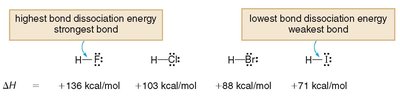
Bond Dissociation Energy
Stronger bonds have higher bond dissociation energies.
Bond dissociation energies generally decrease down a group in the periodic table.
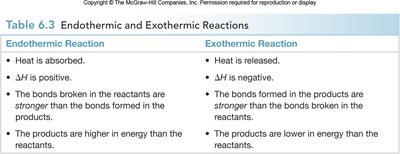
Endothermic vs. Exothermic Reactions
Endothermic Reaction | Exothermic Reaction |
|---|---|
Heat is absorbed. ΔH is positive. Bonds broken in reactants are stronger than bonds formed in products. Products are higher in energy than reactants. | Heat is released. ΔH is negative. Bonds formed in products are stronger than bonds broken in reactants. Products are lower in energy than reactants. |
Energy Diagrams and Activation Energy
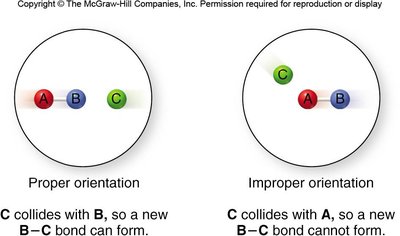
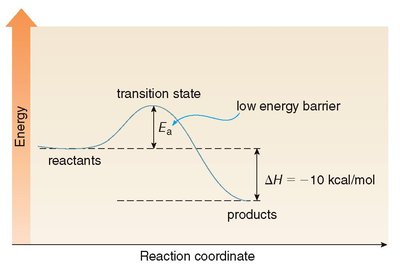
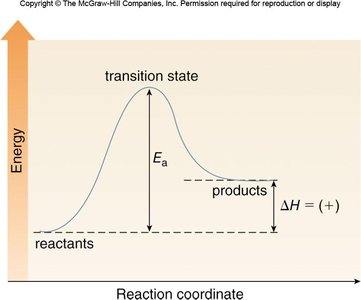
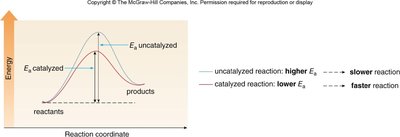
For a reaction to occur, molecules must collide with sufficient kinetic energy and proper orientation. The activation energy (Ea) is the minimum energy required for a reaction to proceed.
High Ea: Slow reaction (few molecules have enough energy).
Low Ea: Fast reaction (many molecules have enough energy).

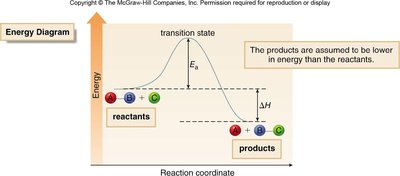
Exothermic and Endothermic Energy Diagrams
Exothermic: Products are lower in energy than reactants (ΔH < 0).
Endothermic: Products are higher in energy than reactants (ΔH > 0).
Reaction Rates
The rate of a chemical reaction depends on several factors:
Concentration: Higher concentration increases collision frequency and reaction rate.
Temperature: Higher temperature increases kinetic energy and reaction rate.
Catalysts: Substances that speed up reactions by lowering Ea without being consumed.
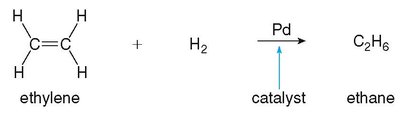
Biological Catalysts: Enzymes
Enzymes are protein catalysts with specific three-dimensional shapes.
They bind reactants (substrates) at the active site and increase reaction rates.
Example: Lactase converts lactose into glucose and galactose.
Chemical Equilibrium
A reversible reaction can proceed in both forward and reverse directions. At equilibrium, the rates of the forward and reverse reactions are equal, and the concentrations of reactants and products remain constant.


The Equilibrium Constant (K)
The equilibrium constant, K, expresses the ratio of product concentrations to reactant concentrations at equilibrium, each raised to the power of their coefficients:
Brackets [ ] indicate concentration in mol/L.
Coefficients become exponents in the expression.
Magnitude of K and Position of Equilibrium
Value of K | Position of Equilibrium |
|---|---|
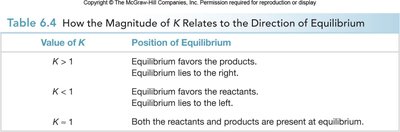
K > 1 | Equilibrium favors products (lies to the right). |
K < 1 | Equilibrium favors reactants (lies to the left). |
K ≈ 1 | Both reactants and products are present in similar amounts. |
Calculating the Equilibrium Constant
For a reaction: A2 + B2 ⇌ 2 AB, with equilibrium concentrations [A2] = 0.25 M, [B2] = 0.25 M, [AB] = 0.50 M:

Le Châtelier’s Principle
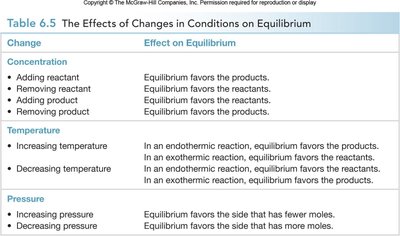
If a system at equilibrium is disturbed, it will shift to counteract the disturbance. Disturbances include changes in concentration, temperature, or pressure.
Concentration Changes
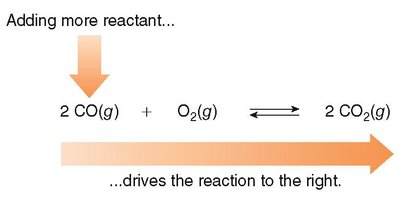
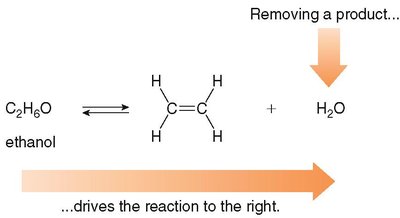
Adding reactant: Shifts equilibrium to the right (toward products).
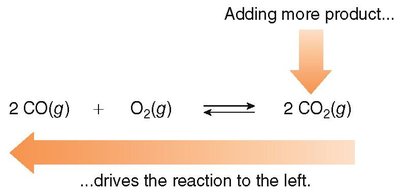
Adding product: Shifts equilibrium to the left (toward reactants).
Removing product: Shifts equilibrium to the right.
Temperature Changes
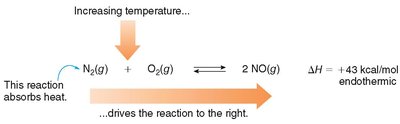
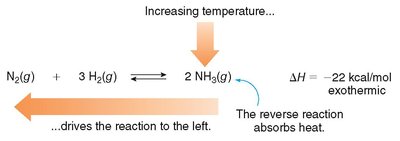
Increasing temperature favors the endothermic direction (absorbs heat).
Decreasing temperature favors the exothermic direction (releases heat).
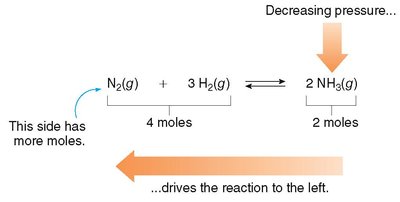
Pressure Changes
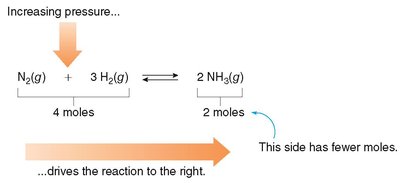
Increasing pressure: Shifts equilibrium toward the side with fewer moles of gas.
Decreasing pressure: Shifts equilibrium toward the side with more moles of gas.
Summary Table: Effects of Changes on Equilibrium
Change | Effect on Equilibrium |
|---|---|
Adding reactant | Favors products |
Removing reactant | Favors reactants |
Adding product | Favors reactants |
Removing product | Favors products |
Increasing temperature | Favors products in endothermic, reactants in exothermic |
Decreasing temperature | Favors reactants in endothermic, products in exothermic |
Increasing pressure | Favors side with fewer moles |
Decreasing pressure | Favors side with more moles |