 Back
BackEsters and Hydrolysis
Study Guide - Smart Notes
 Tailored notes based on your materials, expanded with key definitions, examples, and context.
Esters and Hydrolysis
Introduction to Esters
Esters are a class of organic compounds derived from the reaction between a carboxylic acid and an alcohol. They are widely found in nature, especially in fats, oils, and as the source of many fruit aromas and flavors. Understanding their structure, nomenclature, and reactions is essential in organic and biological chemistry.
Definition: An ester is an organic compound with the functional group –COO–, formed by replacing the hydrogen in the –OH group of a carboxylic acid with an alkyl group from an alcohol.
Occurrence: Esters are present in natural products such as fats, oils, and the fragrances of fruits like bananas, oranges, and strawberries.
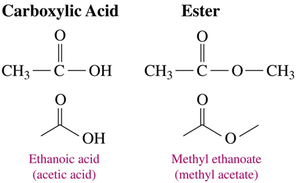
Esterification: Formation of Esters
Esterification is the chemical reaction in which a carboxylic acid reacts with an alcohol in the presence of an acid catalyst and heat to form an ester and water. This process is a key method for synthesizing esters in the laboratory and industry.
General Reaction:
Mechanism: The –OH group from the acid and the H from the alcohol combine to form water, while the remaining parts join to form the ester.

Example: Synthesis of Propyl Ethanoate
When ethanoic acid reacts with 1-propanol in the presence of an acid catalyst and heat, propyl ethanoate (responsible for the smell of pears) and water are produced.
Balanced Equation:

Naming Esters
The nomenclature of esters follows a systematic approach based on the parent alcohol and carboxylic acid. The name consists of two parts:
First word: The alkyl group derived from the alcohol.
Second word: The carboxylate name derived from the acid (replace "-ic acid" with "-ate").
For example, the ester formed from ethanol and acetic acid is called ethyl acetate (IUPAC: ethyl ethanoate).

Biologically Important Esters
Acetylsalicylic Acid (Aspirin)
Aspirin is an ester formed from the reaction of salicylic acid and acetic acid. It is less irritating to the stomach than salicylic acid and is widely used as an analgesic and anti-inflammatory drug.
Reaction:
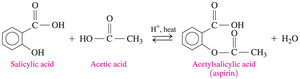
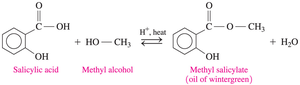
Methyl Salicylate (Oil of Wintergreen)
Methyl salicylate is an ester with a minty odor, used in topical ointments for its counter-irritant properties. It is formed from salicylic acid and methanol.
Reaction:
Hydrolysis of Esters
Esters can be broken down (hydrolyzed) into their parent carboxylic acid and alcohol by reaction with water. This process can be catalyzed by acid or base.
Acid Hydrolysis
In acid hydrolysis, an ester reacts with water in the presence of an acid catalyst and heat to produce a carboxylic acid and an alcohol. This is the reverse of esterification.
General Reaction:

Base Hydrolysis (Saponification)
Base hydrolysis, also known as saponification, involves the reaction of an ester with a strong base (such as NaOH) to produce the salt of the carboxylic acid and an alcohol. This reaction is important in soap making.
General Reaction:

Summary Table: Key Reactions of Esters
Reaction Type | Reactants | Products | Conditions |
|---|---|---|---|
Esterification | Carboxylic acid + Alcohol | Ester + Water | Acid catalyst, heat |
Acid Hydrolysis | Ester + Water | Carboxylic acid + Alcohol | Acid catalyst, heat |
Base Hydrolysis (Saponification) | Ester + Base (e.g., NaOH) | Carboxylate salt + Alcohol | Heat |
Practice Problems
Write the balanced equation for the esterification of propanoic acid and methanol.
Name the ester formed from ethanol and propanoic acid. Answer: Ethyl propanoate
Draw the condensed structural formula for ethyl propanoate. Answer: CH3CH2COOCH2CH3
Write the balanced equation for the acid hydrolysis of methyl acetate.
Write the balanced equation for the base hydrolysis of methyl acetate with NaOH.
