 Back
BackExam 2 Practice Problems – Step-by-Step Guidance
Study Guide - Smart Notes
 Tailored notes based on your materials, expanded with key definitions, examples, and context.
Q1. The density of mercury is 13.6 g/cm³. What is that density in pounds per cubic inch?
Background
Topic: Unit Conversion (Dimensional Analysis)
This question tests your ability to convert between different units of measurement using dimensional analysis, a key skill in general chemistry and GOB courses.
Key Terms and Formulas
Density: mass per unit volume
Conversion factors: 1 in = 2.54 cm; 1 lb = 454 g
Step-by-Step Guidance
Start with the given density: .
Set up the conversion to pounds per cubic inch (). You need to convert grams to pounds and cubic centimeters to cubic inches.
Convert grams to pounds using .
Convert cubic centimeters to cubic inches. Remember , so .
Set up your dimensional analysis so that all units cancel except for .
Try solving on your own before revealing the answer!
Q2. Calculate the atomic mass of silicon given the isotopic masses and abundances of 28Si, 29Si, and 30Si.
Background
Topic: Atomic Mass Calculation
This question tests your understanding of how to calculate the weighted average atomic mass of an element based on its isotopic composition.
Key Terms and Formulas
Isotopic Mass: The mass of a specific isotope (in amu).
Abundance: The percentage of each isotope in nature.
Weighted Average Formula:
Step-by-Step Guidance
Convert the percent abundance of each isotope to a decimal (fractional abundance).
Multiply each isotopic mass by its fractional abundance.
Add the results for all isotopes to get the weighted average atomic mass.
Try solving on your own before revealing the answer!
Q3. Lithium has two isotopes, 6Li and 7Li. Given their masses and the atomic mass of lithium, what is the percent abundance of lithium-6?
Background
Topic: Isotopic Abundance Calculation
This question tests your ability to use the average atomic mass and isotopic masses to determine the percent abundance of one isotope.
Key Terms and Formulas
Let be the fractional abundance of , and for .
Weighted Average Formula:
Step-by-Step Guidance
Set up the equation using the given atomic mass and isotopic masses.
Let be the fractional abundance of and for .
Plug in the values and solve for (the fractional abundance of ).
Convert to a percentage by multiplying by 100.
Try solving on your own before revealing the answer!
Q4. For the isotope bromine-81 (81Br), select the correct atomic number, number of neutrons, and mass number.
Background
Topic: Isotope Notation and Atomic Structure
This question tests your understanding of how to determine the atomic number, number of neutrons, and mass number for a given isotope.
Key Terms and Formulas
Atomic Number (): Number of protons (for Br, ).
Mass Number (): Total number of protons and neutrons ( for ).
Number of Neutrons:
Step-by-Step Guidance
Identify the atomic number of bromine from the periodic table.
Subtract the atomic number from the mass number to find the number of neutrons.
List the values in the order: atomic number, number of neutrons, mass number.
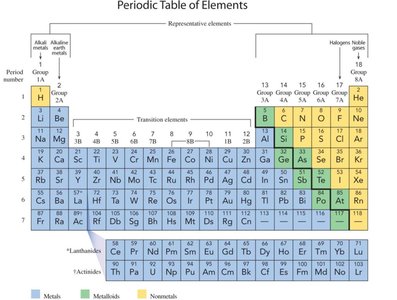
Try solving on your own before revealing the answer!
Q5. Which of the following does not have a uniform composition throughout?
Background
Topic: Classification of Matter
This question tests your understanding of the differences between elements, compounds, homogeneous mixtures, and heterogeneous mixtures.
Key Terms
Homogeneous mixture: Uniform composition throughout.
Heterogeneous mixture: Non-uniform composition.
Element: Pure substance, one type of atom.
Compound: Pure substance, two or more elements chemically combined.
Solvent: The dissolving medium in a solution.
Step-by-Step Guidance
Review the definitions of each term.
Identify which option describes a sample that is not the same throughout.
Try solving on your own before revealing the answer!
Q6. How many micrograms are in 65.3 kg?
Background
Topic: Metric Conversions
This question tests your ability to convert between different metric units, specifically from kilograms to micrograms.
Key Terms and Formulas
1 kg = g
1 g = µg
Step-by-Step Guidance
Convert kilograms to grams by multiplying by .
Convert grams to micrograms by multiplying by .
Combine the conversion factors to find the total number of micrograms.
Try solving on your own before revealing the answer!
Q7. Express 122.0°F in °C.
Background
Topic: Temperature Conversion
This question tests your ability to convert temperatures from Fahrenheit to Celsius.
Key Formula
Step-by-Step Guidance
Subtract 32 from the Fahrenheit temperature.
Multiply the result by to convert to Celsius.
Try solving on your own before revealing the answer!
Q8. If the temperature is 38.0°F, what is the temperature in kelvins?
Background
Topic: Temperature Conversion (Fahrenheit to Kelvin)
This question tests your ability to convert temperatures from Fahrenheit to Kelvin, using both the Fahrenheit-to-Celsius and Celsius-to-Kelvin conversions.
Key Formulas
Step-by-Step Guidance
Convert 38.0°F to Celsius using the formula above.
Add 273.15 to the Celsius value to convert to Kelvin.
Try solving on your own before revealing the answer!
Q9. How many kilometers will radio messages travel in exactly one year at the speed of light (3.00 × 10⁸ m/s)?
Background
Topic: Speed, Distance, and Time Calculations
This question tests your ability to use the relationship between speed, distance, and time, and to convert units appropriately.
Key Formula
1 km = 1000 m
1 year = 365.24 days
Step-by-Step Guidance
Calculate the total number of seconds in one year.
Multiply the speed of light by the total number of seconds to get the distance in meters.
Convert the distance from meters to kilometers.
Try solving on your own before revealing the answer!
Q10. If a graduated cylinder's volume changes from 15.5 mL to 95.2 mL after a metal with a mass of 7.95 g is added, what is the density of the metal?
Background
Topic: Density Calculation (Using Water Displacement)
This question tests your ability to calculate density using mass and volume, where the volume is determined by water displacement.
Key Formula
Density:
Volume of metal = Final volume - Initial volume
Step-by-Step Guidance
Calculate the volume of the metal by subtracting the initial volume from the final volume.
Divide the mass of the metal by the volume you just calculated to find the density.
Try solving on your own before revealing the answer!
