 Back
BackExam 2 Study Guide: Chemistry Concepts and Problem-Solving
Study Guide - Smart Notes
 Tailored notes based on your materials, expanded with key definitions, examples, and context.
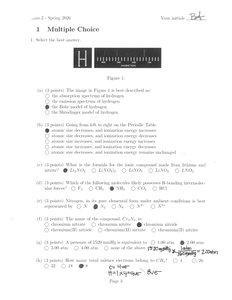
Q1. The image in Figure 1 is best described as:
Background
Topic: Atomic Spectra
This question tests your understanding of atomic emission and absorption spectra, specifically for hydrogen.
Key Terms:
Emission spectrum: Light emitted by atoms when electrons drop to lower energy levels.
Absorption spectrum: Light absorbed by atoms when electrons move to higher energy levels.
Hydrogen spectrum: Characteristic lines produced by hydrogen atoms.
Step-by-Step Guidance
Examine Figure 1 and note the pattern of lines shown.
Recall the difference between emission and absorption spectra: emission spectra show bright lines on a dark background, while absorption spectra show dark lines on a bright background.
Consider whether the lines in Figure 1 are bright or dark, and what that indicates about the type of spectrum.
Try solving on your own before revealing the answer!
Final Answer: The emission spectrum of hydrogen
Figure 1 shows bright lines on a dark background, which is characteristic of an emission spectrum.
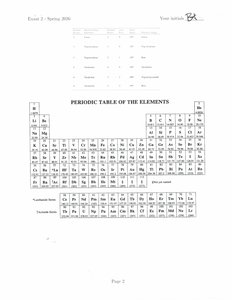
Q2. Group trends and order on the Periodic Table
Background
Topic: Periodic Table Trends
This question tests your knowledge of how atomic radius, ionization energy, and electronegativity change across periods and groups.
Key Terms:
Atomic radius: Size of an atom.
Ionization energy: Energy required to remove an electron.
Electronegativity: Ability of an atom to attract electrons.
Step-by-Step Guidance
Recall that atomic radius increases down a group and decreases across a period.
Ionization energy and electronegativity generally increase across a period and decrease down a group.
Use the periodic table to compare elements in the same group or period.
Try solving on your own before revealing the answer!
Final Answer: Atomic radius increases down a group, decreases across a period; ionization energy and electronegativity increase across a period, decrease down a group.
These trends are due to changes in electron shielding and nuclear charge.
Q3. The products in the complete combustion of octane (C8H18) are:
Background
Topic: Combustion Reactions
This question tests your ability to identify the products of a hydrocarbon combustion reaction.
Key Terms:
Complete combustion: Reaction with oxygen producing carbon dioxide and water.
Hydrocarbon: Compound made of hydrogen and carbon.
Step-by-Step Guidance
Write the general equation for complete combustion of a hydrocarbon:
Identify the products: carbon dioxide and water.
Balance the equation if needed, but focus on the products for this question.
Try solving on your own before revealing the answer!
Final Answer: Carbon dioxide (CO2) and water (H2O)
Complete combustion always produces CO2 and H2O as products.
Q4. The specific heat of water is 4.18 J/g·K and iron is 0.45 J/g·K. If equal masses of water and iron are heated, which substance will experience the greater temperature change?
Background
Topic: Specific Heat and Temperature Change
This question tests your understanding of how specific heat affects temperature change when equal masses are heated.
Key Terms and Formula:
Specific heat (): Amount of heat required to raise the temperature of 1 gram of a substance by 1 K.
Formula:
Step-by-Step Guidance
Recall that is the heat added, is mass, is specific heat, and is temperature change.
For equal masses and equal heat added, the substance with lower specific heat will have a greater .
Compare the specific heat values for water and iron.
Try solving on your own before revealing the answer!
Final Answer: Iron will experience the greater temperature change.
Because iron has a lower specific heat, it heats up more for the same amount of energy.
Q5. A balloon with initial volume of 1.0 L at 300 K and 1.0 atm is heated to 340 K and expanded to a final pressure of 1.5 atm. What is the final volume?
Background
Topic: Combined Gas Law
This question tests your ability to use the combined gas law to solve for the final volume of a gas when temperature and pressure change.
Key Formula:
Combined Gas Law:
, , = initial pressure, volume, temperature
, , = final pressure, volume, temperature
Step-by-Step Guidance
Identify the known values: atm, L, K, atm, K.
Plug these values into the combined gas law formula.
Rearrange the formula to solve for :
Check that all units are consistent (atm, L, K).
Try solving on your own before revealing the answer!
Final Answer: L
Using the combined gas law and plugging in the values, you find the final volume is less than the initial volume due to increased pressure.
