 Back
Gas Laws and Properties: Kinetic Molecular Theory and Fundamental Gas Laws
Study Guide - Smart Notes
 Tailored notes based on your materials, expanded with key definitions, examples, and context.
Gas Laws and Properties
Kinetic Molecular Theory of Gases
The Kinetic Molecular Theory provides a model for understanding the behavior of gases. It explains how gas particles move and interact, and forms the basis for the gas laws.
Random Motion: Gas particles move randomly with high velocity, resulting in no definite shape.
Weak Attractive Forces: The forces between gas particles are minimal, so particles are far apart.
Volume: The actual volume occupied by gas molecules is very small compared to the space the gas fills; gases expand to fill any container and are easily compressed.
Constant Motion: Gas particles move rapidly in straight paths and exert pressure when they collide with container walls.
Kinetic Energy: The average kinetic energy of gas molecules is proportional to the Kelvin temperature; higher temperature means faster movement and greater pressure.

Four Basic Properties of Gases
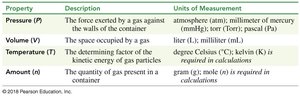
Gases are described by four fundamental properties: pressure, volume, temperature, and amount (moles).
Pressure (P): The force exerted by gas particles against the walls of the container. Measured in atmosphere (atm), millimeters of mercury (mmHg), torr, pascal (Pa), and pounds per square inch (psi).
Volume (V): The space occupied by the gas, measured in liters (L) or milliliters (mL).
Temperature (T): Determines the kinetic energy of gas particles. Measured in degrees Celsius (°C) or Kelvin (K); Kelvin is required for calculations.
Amount (n): The quantity of gas present, measured in grams (g) or moles (n); moles are required for calculations.
Atmospheric Pressure
Atmospheric pressure is the pressure exerted by a column of air from the atmosphere to the Earth's surface. At sea level, it is about 1 atm. Atmospheric pressure decreases with altitude due to fewer air particles.
Pressure Units: 1 atm = 760 mmHg = 760 Torr = 101.325 kPa = 14.7 psi
Measurement: Atmospheric pressure is measured with a barometer.
Volume and Temperature
The volume of a gas equals the size of its container. The temperature of a gas is directly related to the kinetic energy of its particles. All gas law calculations use the Kelvin scale.
Kelvin Conversion: 0 °C = 273 K
Effect of Temperature: Doubling the temperature (in Kelvin) doubles the kinetic energy and pressure (if volume and amount are constant).
Amount of Gas (n)
The amount of gas is usually measured by mass, but gas law calculations require moles (n).
Measuring Gas Pressure
Pressure in a container is calculated as:
Barometer: Used to measure atmospheric pressure.
Pressure Equalities: 1 atm = 760 mmHg = 760 Torr = 101.325 kPa = 14.7 psi
Gas Laws
Boyle’s Law: Pressure & Volume
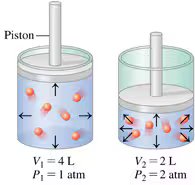
Boyle’s Law describes the inverse relationship between the pressure and volume of a gas, when temperature and amount are constant. As pressure increases, volume decreases, and vice versa.
Formula:
Inverse Relationship: The product of pressure and volume remains constant.
Example: If a gas sample has a volume of 12.0 L at 600 mmHg, and the volume changes to 36.0 L, the final pressure is:
Charles’ Law: Temperature & Volume
Charles’s Law states that the volume of a gas is directly proportional to its temperature (in Kelvin), when pressure and amount are constant. As temperature increases, volume increases.
Formula:
Direct Relationship: Both properties increase or decrease together.
Example: If a gas has a volume of 420 mL at 18°C (291 K), and the volume changes to 640 mL, the final temperature is:
Gay-Lussac’s Law: Temperature & Pressure
Gay-Lussac’s Law describes the direct relationship between the pressure and temperature (in Kelvin) of a gas, when volume and amount are constant. As temperature increases, pressure increases.
Formula:
Direct Relationship: Both properties increase or decrease together.
Example: If a gas has a pressure of 645 Torr at 128°C (401 K), and the pressure increases to 824 Torr, the final temperature is:
Boiling Point and Atmospheric Pressure
Water boils when its vapor pressure equals atmospheric pressure. At higher altitudes, atmospheric pressure is lower, so water boils at a lower temperature.
Application: Cooking at high altitudes requires adjustments due to lower boiling points.

References: Timberlake, K. (2018). Chemistry: Introduction to general, organic and biological chemistry (13th ed.). Pearson Education.
