 Back
Gases: Properties, Laws, and Behavior
Study Guide - Smart Notes
 Tailored notes based on your materials, expanded with key definitions, examples, and context.
Gases
Characteristics of Gases
Gases are a state of matter characterized by their ability to expand to fill any container, high compressibility, and extremely low densities compared to solids and liquids. Most gases are composed of nonmetallic elements with simple formulas and low molar masses. When mixed, gases form homogeneous mixtures regardless of their identities.
Expansion: Gases expand to fill the volume of their container.
Compressibility: Gases can be compressed much more easily than solids or liquids.
Low Density: The density of gases is much lower than that of solids or liquids.
Homogeneous Mixtures: Two or more gases will always mix evenly and completely.
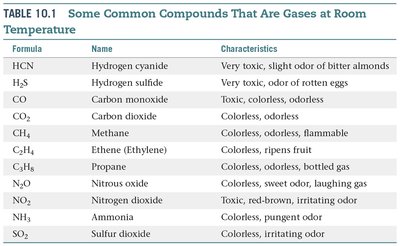
Table 10.1 lists common compounds that are gases at room temperature, including their formulas, names, and key characteristics.
Properties That Define the State of a Gas Sample
The state of a gas is defined by four measurable properties:
Temperature (T)
Pressure (P)
Volume (V)
Amount of gas (n), usually expressed in moles
Pressure is a key property that requires further definition.
Pressure
Pressure (P) is defined as the amount of force (F) applied per unit area (A):
Atmospheric pressure is the force exerted by the weight of air above a given area on Earth's surface.
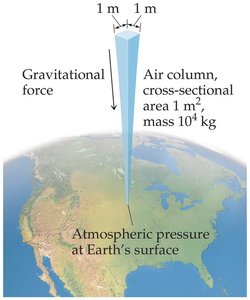
This diagram illustrates how atmospheric pressure results from the weight of a column of air above a unit area at Earth's surface.
Units of Pressure
Pascals (Pa): (SI unit)
Bar:
Millimeters of mercury (mm Hg) or Torr: Based on the height difference in a mercury column
Atmosphere (atm):
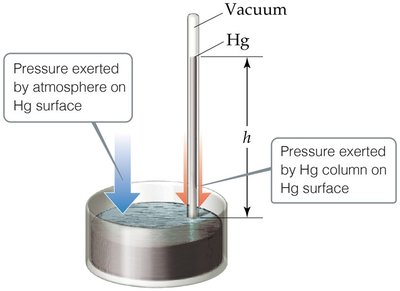
A barometer measures atmospheric pressure using a column of mercury.
Manometer
A manometer is used to measure the pressure of a gas in a vessel relative to atmospheric pressure. It consists of a U-shaped tube containing mercury or another liquid.
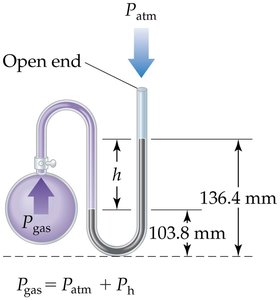
The difference in mercury levels (h) indicates the pressure difference between the gas and the atmosphere.
Standard Pressure
Standard atmospheric pressure at sea level is defined as:
1 atm
760 torr (or mm Hg)
101.325 kPa
Gas Laws
Boyle’s Law
Boyle’s Law states that the volume of a fixed quantity of gas at constant temperature is inversely proportional to the pressure:
A plot of volume (V) versus pressure (P) is not linear, but a plot of V versus is linear.
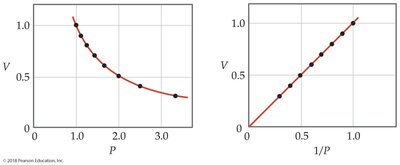
These graphs show the inverse and linear relationships described by Boyle's Law.
Charles’s Law
Charles’s Law states that the volume of a fixed amount of gas at constant pressure is directly proportional to its absolute temperature (in Kelvin):
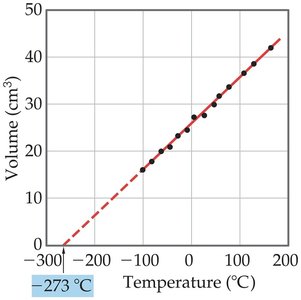
The graph shows a linear relationship between volume and temperature.
Avogadro’s Law
Avogadro’s Law states that the volume of a gas at constant temperature and pressure is directly proportional to the number of moles (n) of the gas:
At standard temperature and pressure (STP), one mole of any gas occupies 22.4 L.
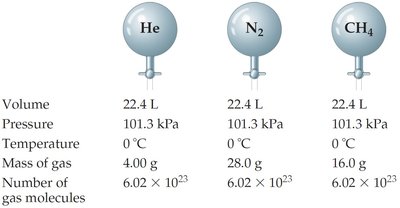
At STP, different gases with the same number of moles occupy the same volume.
Ideal Gas Law
The ideal gas law combines Boyle’s, Charles’s, and Avogadro’s laws into a single equation:
Where R is the ideal gas constant. The value of R depends on the units used:
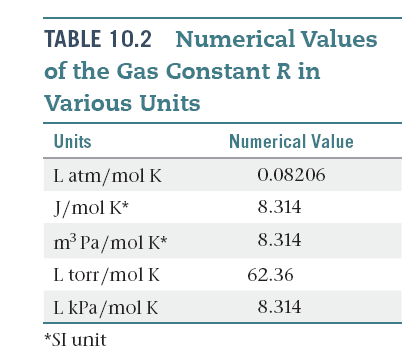
Table 10.2 lists the values of R in various units.
Density and Molar Mass of Gases
The density (d) of a gas can be derived from the ideal gas law:
Where M is the molar mass. If the mass (m), volume (V), and temperature (T) of a gas are known, its molar mass can be calculated:
Mixtures of Gases
Dalton’s Law of Partial Pressures
Dalton’s Law states that the total pressure of a mixture of non-reacting gases is equal to the sum of the partial pressures of each individual gas:
Mole Fraction and Partial Pressure
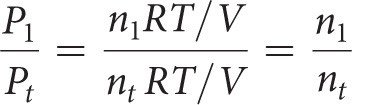
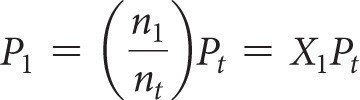
The mole fraction (χ) of a component in a gas mixture is the ratio of the number of moles of that component to the total number of moles:
The partial pressure of a gas is related to its mole fraction:
Kinetic-Molecular Theory
Main Tenets of Kinetic-Molecular Theory
The kinetic-molecular theory explains the behavior of gases based on the motion of their particles:
Gases consist of large numbers of molecules in continuous, random motion.
The combined volume of all molecules is negligible compared to the total volume.
Attractive and repulsive forces between molecules are negligible.
Energy can be transferred during collisions, but the average kinetic energy remains constant at constant temperature.
The average kinetic energy is proportional to the absolute temperature.
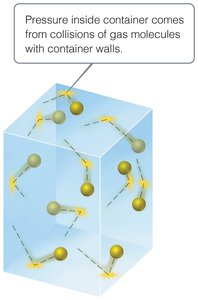
Pressure results from collisions of gas molecules with the walls of their container.
Molecular Speeds and Temperature
At a given temperature, gas molecules have a distribution of speeds. The most probable speed (ump), average speed (uav), and root-mean-square speed (urms) are key measures:
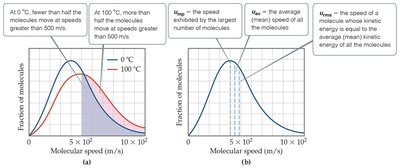
As temperature increases, the distribution broadens and shifts to higher speeds.
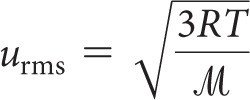
The root-mean-square speed is given by:
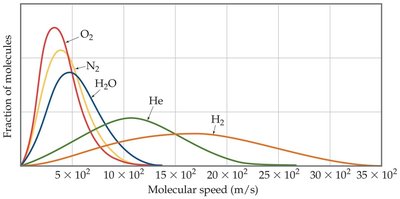
Lighter gases have higher average speeds at the same temperature.
Effusion and Diffusion
Effusion and Diffusion
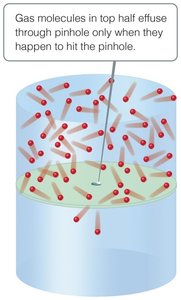
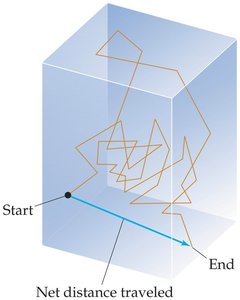
Effusion is the process by which gas molecules escape through a tiny hole into a vacuum. Diffusion is the spread of one substance throughout another.
Graham’s Law of Effusion
Graham’s Law relates the rates of effusion of two gases to their molar masses:
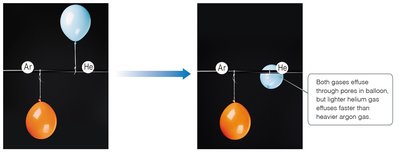
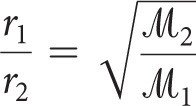
Lighter gases effuse faster than heavier gases.
Real Gases and Deviations from Ideal Behavior
Real Gases
Real gases deviate from ideal behavior at high pressures and low temperatures. The assumptions of the kinetic-molecular theory (negligible volume and no intermolecular forces) break down under these conditions.
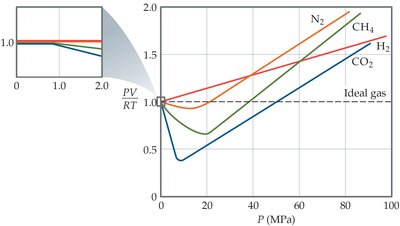
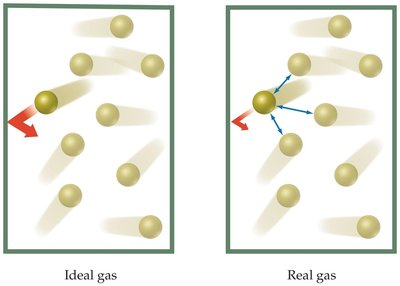
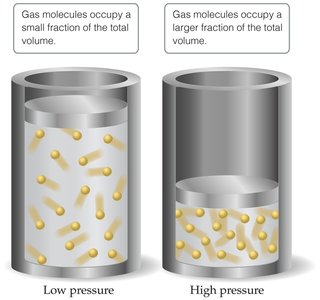
At high pressure, the volume occupied by gas molecules becomes significant, and intermolecular forces affect behavior.
Corrections for Nonideal Behavior
The ideal gas equation can be modified to account for the volume of gas molecules and intermolecular forces. These corrections are important for accurately describing real gases under non-ideal conditions.
