 Back
BackGeneral, Organic, and Biological Chemistry (GOB) Exam Study Guide: Atomic Structure, Periodic Table, and Chemical Bonding
Study Guide - Smart Notes
 Tailored notes based on your materials, expanded with key definitions, examples, and context.
Q1. Which statement best describes Group 8A (18) elements?
Background
Topic: Periodic Table – Noble Gases
This question tests your understanding of the properties of noble gases, which are found in Group 8A (18) of the periodic table.
Key Terms:
Noble gases: Elements in Group 8A (18), known for their lack of reactivity.
Reactivity: The tendency of an element to engage in chemical reactions.
Step-by-Step Guidance
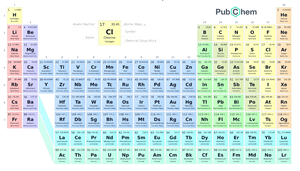
Locate Group 8A (18) on the periodic table. These elements include helium, neon, argon, krypton, xenon, and radon.
Recall the general properties of noble gases: they have full valence electron shells, making them stable and unreactive under normal conditions.
Consider the answer choices and eliminate those that do not match the known properties of noble gases (e.g., high reactivity, being liquids at room temperature, etc.).
Try solving on your own before revealing the answer!
Q2. Which of the following elements is a nonmetal?
Background
Topic: Periodic Table – Metals vs. Nonmetals
This question tests your ability to identify nonmetals based on their position in the periodic table.
Key Terms:
Nonmetal: An element that typically lacks metallic properties and is found on the right side of the periodic table (except hydrogen).
Step-by-Step Guidance
Review the periodic table and locate each element listed in the answer choices.
Recall that nonmetals are generally found on the right side of the periodic table (except for hydrogen, which is on the left).
Identify which of the listed elements is a nonmetal by its position and typical properties (e.g., poor conductor, not shiny, brittle if solid).
Try solving on your own before revealing the answer!
Q3. What is the symbol of the element in Period 4 and Group 2A (2)?
Background
Topic: Periodic Table – Element Location
This question tests your ability to read the periodic table and identify elements based on their period (row) and group (column).
Key Terms:
Period: A horizontal row in the periodic table.
Group: A vertical column in the periodic table.
Step-by-Step Guidance
Find Period 4 (the fourth row from the top) on the periodic table.
Locate Group 2A (2), which is the second column from the left (alkaline earth metals).
Identify the element at the intersection of Period 4 and Group 2A (2).
Try solving on your own before revealing the answer!
Q4. Which of the following descriptions of a subatomic particle is correct?
Background
Topic: Atomic Structure – Subatomic Particles
This question tests your knowledge of the properties (charge and mass) of protons, neutrons, and electrons.
Key Terms:
Proton: Positively charged particle, mass ≈ 1 amu.
Neutron: Neutral particle, mass ≈ 1 amu.
Electron: Negatively charged particle, mass ≈ 0.0005 amu (negligible compared to protons/neutrons).
Step-by-Step Guidance
Recall the charge and approximate mass of each subatomic particle.
Compare each answer choice to the known properties of protons, neutrons, and electrons.
Eliminate choices that incorrectly describe the charge or mass of the particles.
Try solving on your own before revealing the answer!
Q5. In an atom, the nucleus contains:
Background
Topic: Atomic Structure – Nucleus Composition
This question tests your understanding of what particles are found in the nucleus of an atom.
Key Terms:
Nucleus: The dense center of an atom containing protons and neutrons.
Proton: Positively charged particle in the nucleus.
Neutron: Neutral particle in the nucleus.
Step-by-Step Guidance
Recall that the nucleus is made up of protons and neutrons only.
Electrons are found outside the nucleus in electron shells.
Identify the answer choice that correctly lists the particles found in the nucleus.
Try solving on your own before revealing the answer!
Q6. What is the mass number of an atom of potassium that has 20 neutrons?
Background
Topic: Atomic Structure – Mass Number
This question tests your ability to calculate the mass number of an atom given the number of protons and neutrons.
Key Formula:
Mass number = Number of protons + Number of neutrons
Step-by-Step Guidance
Find the atomic number of potassium (K) on the periodic table. This gives the number of protons.
Add the number of neutrons (given in the question) to the number of protons to get the mass number.
Try solving on your own before revealing the answer!
Q7. Isotopes are atoms of the same element that have:
Background
Topic: Atomic Structure – Isotopes
This question tests your understanding of what makes isotopes different from each other.
Key Terms:
Isotope: Atoms of the same element (same number of protons) with different numbers of neutrons.
Step-by-Step Guidance
Recall that isotopes have the same atomic number (protons) but different mass numbers due to varying numbers of neutrons.
Eliminate answer choices that suggest differences in protons or electrons.
Try solving on your own before revealing the answer!
Q8. The electron configuration of an atom shows:
Background
Topic: Electron Configuration
This question tests your understanding of what information is provided by an atom's electron configuration.
Key Terms:
Electron configuration: The arrangement of electrons in an atom's energy levels and sublevels.
Step-by-Step Guidance
Recall that electron configuration tells you how many electrons are in each energy level and sublevel.
Review the answer choices and select the one that best matches this definition.
Try solving on your own before revealing the answer!
Q9. What is the electron configuration for aluminum?
Background
Topic: Electron Configuration
This question tests your ability to write the electron configuration for a specific element.
Key Terms:
Electron configuration: The distribution of electrons among the orbitals of an atom.
Step-by-Step Guidance
Find the atomic number of aluminum (Al) on the periodic table to determine the number of electrons.
Fill the orbitals in order of increasing energy (1s, 2s, 2p, 3s, 3p, etc.) until all electrons are placed.
Match your configuration to the answer choices.
Try solving on your own before revealing the answer!
Q10. What element has the electron configuration 1s22s22p63s23p2?
Background
Topic: Electron Configuration
This question tests your ability to identify an element based on its electron configuration.
Key Terms:
Electron configuration: The arrangement of electrons in an atom.
Step-by-Step Guidance
Add up the total number of electrons in the configuration to find the atomic number.
Use the periodic table to identify the element with that atomic number.
Try solving on your own before revealing the answer!
Q11. What is the abbreviated electron configuration for nickel (atomic number 28)?
Background
Topic: Electron Configuration – Abbreviated Notation
This question tests your ability to write the abbreviated (noble gas) electron configuration for a transition metal.
Key Terms:
Abbreviated electron configuration: Uses the symbol of the previous noble gas in brackets, followed by the remaining configuration.
Step-by-Step Guidance
Find nickel (Ni) on the periodic table and note its atomic number (28).
Identify the noble gas that comes before nickel (argon, [Ar]).
Write the configuration starting with [Ar], then add the electrons in the 4s and 3d subshells to reach 28 electrons.
Try solving on your own before revealing the answer!
Q12. In an electron-dot structure of an element, the dots are used to represent:
Background
Topic: Lewis Structures
This question tests your understanding of what the dots in a Lewis (electron-dot) structure represent.
Key Terms:
Lewis structure: A diagram showing the valence electrons around an atom.
Valence electrons: Electrons in the outermost shell, involved in bonding.
Step-by-Step Guidance
Recall that only the outermost (valence) electrons are shown as dots in a Lewis structure.
Review the answer choices and select the one that matches this definition.
Try solving on your own before revealing the answer!
Q13. Of the elements: B, C, F, Li, and Na, the element with the smallest ionization energy is:
Background
Topic: Periodic Trends – Ionization Energy
This question tests your understanding of how ionization energy changes across the periodic table.
Key Terms:
Ionization energy: The energy required to remove an electron from a gaseous atom.
Step-by-Step Guidance
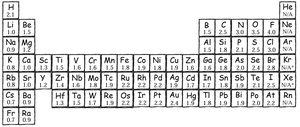
Recall that ionization energy generally increases across a period (left to right) and decreases down a group (top to bottom).
Locate each element on the periodic table and compare their positions.
Identify which element is furthest down and to the left, as these tend to have the lowest ionization energies.
Try solving on your own before revealing the answer!
Q29. Of the elements: B, C, F, Li, and Na, the element with the smallest atomic radius is:
Background
Topic: Periodic Trends – Atomic Radius
This question tests your understanding of how atomic radius changes across the periodic table.
Key Terms:
Atomic radius: The size of an atom, typically measured from the nucleus to the outermost electron shell.
Step-by-Step Guidance
Recall that atomic radius decreases across a period (left to right) and increases down a group (top to bottom).
Locate each element on the periodic table and compare their positions.
Identify which element is furthest up and to the right, as these tend to have the smallest atomic radii.
Try solving on your own before revealing the answer!
Q14. What is the symbol for the ion with 19 protons and 18 electrons?
Background
Topic: Ions – Protons and Electrons
This question tests your ability to determine the symbol and charge of an ion based on the number of protons and electrons.
Key Terms:
Ion: An atom or molecule with a net electric charge due to the loss or gain of electrons.
Cation: Positively charged ion (fewer electrons than protons).
Anion: Negatively charged ion (more electrons than protons).
Step-by-Step Guidance
Recall that the number of protons determines the element (atomic number 19 is potassium, K).
Calculate the charge: charge = protons - electrons.
Write the symbol for the ion, including the correct charge.
Try solving on your own before revealing the answer!
Q15. The correct formula for a compound formed from the elements Al and O is:
Background
Topic: Ionic Compounds – Formula Writing
This question tests your ability to write the correct formula for an ionic compound formed from two elements.
Key Terms:
Aluminum (Al): Forms a +3 ion (Al3+).
Oxygen (O): Forms a -2 ion (O2-).
Step-by-Step Guidance
Write the charges for each ion: Al3+ and O2-.
Use the criss-cross method to balance the charges and write the formula.
Try solving on your own before revealing the answer!
Q16. Which one of the following elements forms two or more ions with different ionic charges?
Background
Topic: Transition Metals – Variable Oxidation States
This question tests your knowledge of which elements can form multiple ions with different charges.
Key Terms:
Transition metals: Elements that can form more than one type of positive ion (different oxidation states).
Step-by-Step Guidance
Identify which elements in the list are transition metals.
Recall that transition metals often form more than one ion with different charges.
Eliminate elements that only form one type of ion.
Try solving on your own before revealing the answer!
Q33. The name of Al2(SO4)3 is:
Background
Topic: Naming Ionic Compounds – Polyatomic Ions
This question tests your ability to name an ionic compound containing a polyatomic ion.
Key Terms:
Aluminum (Al): Forms a +3 ion.
Sulfate (SO42-): A common polyatomic ion.
Step-by-Step Guidance
Recognize the cation (Al3+) and the polyatomic anion (SO42-).
Recall the rules for naming ionic compounds with polyatomic ions: name the cation first, then the anion.
Check if a Roman numeral is needed (only if the metal can have more than one charge; aluminum only forms +3).
Try solving on your own before revealing the answer!
Q17. The formula of copper(I) sulfide is:
Background
Topic: Ionic Compounds – Formula Writing with Transition Metals
This question tests your ability to write the formula for an ionic compound with a transition metal that has a specified charge.
Key Terms:
Copper(I): Indicates a +1 charge (Cu+).
Sulfide: Indicates a -2 charge (S2-).
Step-by-Step Guidance
Write the charges for each ion: Cu+ and S2-.
Use the criss-cross method to balance the charges and write the formula.
Try solving on your own before revealing the answer!
Q18. In a molecule with covalent bonding:
Background
Topic: Chemical Bonding – Covalent Bonds
This question tests your understanding of how atoms are held together in covalent compounds.
Key Terms:
Covalent bond: A chemical bond formed by the sharing of electrons between atoms.
Step-by-Step Guidance
Recall that covalent bonds involve the sharing of electrons, typically between nonmetals.
Eliminate answer choices that describe ionic bonding or metallic bonding.
Try solving on your own before revealing the answer!
Q19. The correct name for the compound IF3 is:
Background
Topic: Naming Covalent Compounds
This question tests your ability to name a binary covalent compound using prefixes.
Key Terms:
Binary covalent compound: A compound composed of two nonmetals.
Prefixes: Used to indicate the number of each atom (mono-, di-, tri-, etc.).
Step-by-Step Guidance
Identify the elements present: iodine (I) and fluorine (F).
Use the appropriate prefix for three fluorine atoms (tri-).
Combine the names according to the rules for naming covalent compounds.
Try solving on your own before revealing the answer!
Q20. How many lone pairs of electrons are in the Lewis structure of H2O?
Background
Topic: Lewis Structures – Lone Pairs
This question tests your ability to draw the Lewis structure for water and count the lone pairs on the central atom.
Key Terms:
Lone pair: A pair of valence electrons not involved in bonding.
Step-by-Step Guidance
Draw the Lewis structure for H2O, placing oxygen in the center and hydrogen atoms on either side.
Count the number of lone pairs on the oxygen atom.
Try solving on your own before revealing the answer!
Q21. Choose the best Lewis structure for OCl2.
Background
Topic: Lewis Structures – Molecular Geometry
This question tests your ability to select the correct Lewis structure for a molecule based on the arrangement of atoms and lone pairs.
Key Terms:
Lewis structure: A diagram showing the arrangement of atoms, bonds, and lone pairs in a molecule.
Step-by-Step Guidance
Count the total number of valence electrons for OCl2 (oxygen and two chlorines).
Arrange the atoms with oxygen in the center and chlorines on either side.
Distribute the electrons to satisfy the octet rule for each atom.
Try solving on your own before revealing the answer!
Q22. The carbon tetrachloride molecule, CCl4, has a ________ shape.
Background
Topic: Molecular Geometry – VSEPR Theory
This question tests your understanding of the three-dimensional shape of molecules based on the VSEPR theory.
Key Terms:
VSEPR theory: Valence Shell Electron Pair Repulsion theory, used to predict molecular shapes.
Step-by-Step Guidance
Draw the Lewis structure for CCl4.
Count the number of bonding pairs and lone pairs around the central atom (carbon).
Use VSEPR theory to determine the molecular shape based on the number of electron groups.
Try solving on your own before revealing the answer!
Q23. Which of the following compounds contains an ionic bond?
Background
Topic: Chemical Bonding – Ionic vs. Covalent Bonds
This question tests your ability to distinguish between ionic and covalent compounds.
Key Terms:
Ionic bond: A chemical bond formed between a metal and a nonmetal by the transfer of electrons.
Step-by-Step Guidance
Identify which compounds are formed from a metal and a nonmetal (ionic), versus two nonmetals (covalent).
Recall that ionic compounds typically contain a metal cation and a nonmetal anion.
Review the answer choices and select the one that fits the definition of an ionic compound.
Try solving on your own before revealing the answer!
