 Back
GOB Chemistry Exam 1 Study Guide: Chapters 1, 2, 3, 4, & 6
Study Guide - Smart Notes
 Tailored notes based on your materials, expanded with key definitions, examples, and context.
Chapter 1 – Chemistry & Problem Solving
Scientific Method
The scientific method is a systematic approach to understanding the natural world through observation, hypothesis formation, experimentation, and the development of laws and theories.
Observation: Gathering information through the senses or measurement. Example: "The solution turned blue."
Hypothesis: A testable explanation or prediction. Example: "The solution turns blue because substance X reacts with it."
Experiment: A controlled procedure to test a hypothesis.
Law: A statement describing a consistent pattern in nature (often mathematical).
Theory: A well-supported explanation of why something happens, based on evidence.
Example: If a student observes that a plant grows taller near a window (observation) and predicts that sunlight causes this (hypothesis), she can design an experiment to test this idea.
Strategies for Learning Chemistry
Review material regularly and avoid cramming.
Practice solving problems and check your units and significant figures.
Understand concepts before memorizing details.
Scientific Notation
Scientific notation expresses numbers as , where .
Large numbers: positive exponent (e.g., )
Small decimals: negative exponent (e.g., )
Percentages
Percentages are calculated as:
Example: If 15 out of 20 questions are correct:
Decimal, Fraction, and Percentage Conversions
To convert a decimal to a fraction: 0.375 =
To convert a decimal to a percentage: 0.375 = 37.5%
To convert a percentage to a decimal: 65% = 0.65
Chapter 2 – Measurements & Calculations
Exact vs. Measured Numbers
Exact numbers: Have no uncertainty (e.g., 12 eggs in a dozen).
Measured numbers: Obtained by measurement and have some uncertainty (e.g., 12.5 g).
Significant Figures
Nonzero digits are always significant.
Zeros between nonzero digits are significant.
Leading zeros are not significant.
Trailing zeros after a decimal are significant.
Trailing zeros without a decimal can be ambiguous; use scientific notation for clarity.
Multiplication/Division: The answer has the same number of significant figures as the measurement with the fewest significant figures. Addition/Subtraction: The answer has the same number of decimal places as the measurement with the fewest decimal places.
Dimensional Analysis
Dimensional analysis uses conversion factors to change units:
Write the given value.
Multiply by conversion factors so units cancel appropriately.
Calculate and check units.
Example: Convert 2.5 m to cm:
Metric & SI Units
Length: meter (m)
Mass: kilogram (kg)
Volume: liter (L)
Time: second (s)
Temperature: kelvin (K)
Common conversions: , ,
Density
Density is defined as mass per unit volume:
Rearranged:
Example: If mass = 20.0 g and volume = 5.0 mL,
Chapter 3 – Matter & Energy
Classification of Matter
Pure substances: Constant composition (elements or compounds).
Element: One type of atom (e.g., Fe, O2).
Compound: Two or more elements chemically bonded (e.g., H2O, CO2).
Mixture: Physical combination of substances (homogeneous or heterogeneous).
States of Matter
Solid: Fixed shape and volume; particles vibrate in place.
Liquid: Fixed volume, takes shape of container; particles move past each other.
Gas: No fixed volume or shape; particles move freely.
Physical vs. Chemical Changes
Physical change: Identity does not change (e.g., melting ice).
Chemical change: New substance formed (e.g., burning wood).
Temperature Scales
Celsius (°C), Fahrenheit (°F), Kelvin (K)
Conversions:
Changes of State
Melting: solid → liquid
Freezing: liquid → solid
Evaporation/Boiling: liquid → gas
Condensation: gas → liquid
Sublimation: solid → gas
Deposition: gas → solid
Calories & Joules
1 cal = 4.184 J
1 Cal (nutritional Calorie) = 1 kcal = 1000 cal = 4184 J
Chapter 4 – Atoms & the Periodic Table
Groups & Periods
Group: Vertical column (e.g., Group 1 = alkali metals)
Period: Horizontal row
Elements in the same group have similar chemical properties.
Metals, Nonmetals, and Metalloids
Metals: Shiny, conduct electricity, malleable, ductile (left/center of table).
Nonmetals: Poor conductors, brittle, many are gases (upper right).
Metalloids: Properties between metals and nonmetals (along stair-step line).
Subatomic Particles
Particle | Charge | Location | Approx. Mass |
|---|---|---|---|
Proton | +1 | Nucleus | 1 amu |
Neutron | 0 | Nucleus | 1 amu |
Electron | −1 | Outside nucleus | ~0 amu |
Atomic Number & Mass Number
Atomic number (Z): Number of protons; identifies the element.
Mass number (A): Protons + neutrons.
Neutrons = A − Z
Example: Atomic number = 17, Mass number = 37 → Protons = 17, Neutrons = 20
Isotopes
Atoms of the same element with different numbers of neutrons (different mass numbers).
Isotope notation:
Example: Carbon-14: 6 protons, 8 neutrons
Chapter 6 – Chemical Compounds & Bonding
Types of Compounds
Element: Only one type of atom (e.g., Fe, O2).
Ionic compound: Metal + nonmetal or contains polyatomic ions (e.g., NaCl).
Molecular (covalent) compound: Nonmetal + nonmetal (e.g., CO2).
Ions
Cation: Positive ion (atom loses electrons).
Anion: Negative ion (atom gains electrons).
Example: (cation); (anion)
Fixed vs. Variable Charges
Group 1 metals: +1 charge
Group 2 metals: +2 charge
Some metals (e.g., Fe, Cu, Sn) have variable charges; use Roman numerals in names.
Naming Ionic Compounds
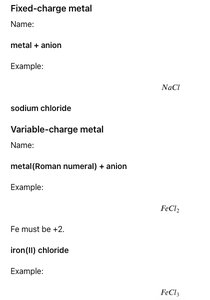
Fixed-charge metal: Name = metal + anion Example: sodium chloride ()
Variable-charge metal: Name = metal (Roman numeral) + anion Example: iron(II) chloride (), iron(III) chloride ()
Polyatomic Ions
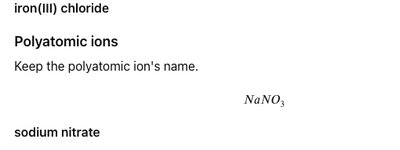
A polyatomic ion is a group of atoms with an overall charge.
Keep the polyatomic ion's name in the compound name. Example: sodium nitrate ()
Writing Molecular Compound Formulas
Prefixes indicate the number of atoms (e.g., CO2 is carbon dioxide).
Common prefixes: mono-, di-, tri-, tetra-, penta-, hexa-, hepta-, octa-, nona-, deca-
Diatomic Molecules
Seven elements naturally exist as diatomic molecules: H2, N2, O2, F2, Cl2, Br2, I2
Memory aid: "Have No Fear Of Ice Cold Beer"
Electronegativity
Electronegativity is an atom's ability to attract shared electrons in a bond.
Increases left to right and bottom to top on the periodic table; fluorine is the most electronegative.
Polar vs. Nonpolar Covalent Bonds
Nonpolar: Electrons shared equally; small or zero electronegativity difference.
Polar: Electrons shared unequally; larger electronegativity difference.
Difference:
Intermolecular Attractions
London Dispersion Forces: Present in all molecules; stronger in larger/more polarizable particles.
Dipole-Dipole: Between polar molecules; positive end of one attracts negative end of another.
Hydrogen Bonding: Strong dipole-dipole attraction when H is bonded to N, O, or F.
Relative strength: Hydrogen bonding > dipole-dipole > dispersion forces (for comparable molecules).
Key Formulas to Know
Highest-Priority Exam Skills
Solve: significant figures, rounding, dimensional analysis, density, temperature, and energy conversions, atomic structure, writing/naming compounds, bond polarity.
Identify/explain: scientific method, types of numbers, matter classification, changes, periodic table groups, subatomic particles, isotopes, ions, bonding, polyatomic ions, electronegativity, intermolecular forces.
