Back
BackGOB Chemistry Exam Study Guide: Concepts, Calculations, and Practice
Study Guide - Smart Notes
 Tailored notes based on your materials, expanded with key definitions, examples, and context.
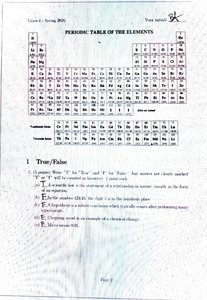
Q1. True/False: Various statements about chemistry concepts (e.g., scientific method, SI units, density, physical/chemical changes)
Background
Topic: Basic Chemistry Concepts
This section tests your understanding of foundational chemistry concepts, including the scientific method, SI units, density, and distinguishing between physical and chemical changes.
Key Terms:
Scientific Method: A systematic approach to research and experimentation.
SI Units: The International System of Units used for scientific measurements (e.g., meter, kilogram, second).
Density: Mass per unit volume, typically expressed as or .
Physical Change: A change that does not alter the chemical composition of a substance.
Chemical Change: A change that results in the formation of new chemical substances.
Step-by-Step Guidance
Read each statement carefully and identify the key concept being tested (e.g., is it about measurement, changes in matter, or scientific reasoning?).
Recall the definitions and examples of each concept (e.g., what is a physical vs. chemical change?).
For statements about units or measurements, check if the units are correct for the property described (e.g., is density in ?).
For statements about the scientific method, consider the logical sequence of steps (observation, hypothesis, experiment, conclusion).
Try solving on your own before revealing the answer!
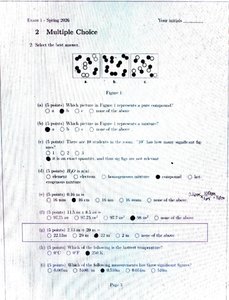
Q2. Multiple Choice: Identifying pure compounds, mixtures, and interpreting particle diagrams
Background
Topic: Classification of Matter and Particle Diagrams
This section tests your ability to distinguish between pure substances, mixtures, elements, and compounds using both definitions and visual representations (particle diagrams).
Key Terms:
Pure Substance: Matter with a fixed composition (element or compound).
Mixture: A combination of two or more substances that are not chemically bonded.
Element: A substance made of only one kind of atom.
Compound: A substance made of two or more elements chemically bonded.
Step-by-Step Guidance
Examine each particle diagram and note the types and arrangements of particles (are they all the same, or are there different types?).
Determine if the diagram represents a pure substance (all particles identical) or a mixture (different particles present).
For compounds, look for particles made of two or more different atoms bonded together.
For mixtures, identify if the components are elements, compounds, or both.
Try solving on your own before revealing the answer!
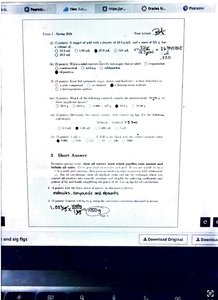
Q3. Calculations: Significant Figures, Density, and Unit Conversions
Background
Topic: Measurement, Significant Figures, and Density Calculations
This section tests your ability to perform calculations involving significant figures, density, and unit conversions, which are essential skills in chemistry lab work and data analysis.
Key Formulas:
Density:
Unit Conversion: Use conversion factors to change units (e.g., ).
Significant Figures: The number of meaningful digits in a measurement.
Step-by-Step Guidance
Identify the given values and their units (e.g., mass in grams, volume in mL).
Set up the calculation using the appropriate formula (e.g., for density, divide mass by volume).
Convert units if necessary so they are compatible (e.g., all in grams and mL).
Apply the rules for significant figures to your final answer (the result should have the same number of significant figures as the least precise measurement).
Try solving on your own before revealing the answer!
Q4. Multiple Choice: Reading graduated cylinders and applying significant figures
Background
Topic: Measurement and Significant Figures
This section tests your ability to read measurements from laboratory equipment (graduated cylinders) and report values with the correct number of significant figures.
Key Concepts:
Graduated Cylinder Reading: Always read the bottom of the meniscus at eye level.
Significant Figures: Record all certain digits plus one estimated digit.
Step-by-Step Guidance
Examine the graduated cylinder and determine the value at the bottom of the meniscus.
Record the measurement, including all certain digits and one uncertain (estimated) digit.
Express your answer with the correct number of significant figures based on the instrument's precision.
Try solving on your own before revealing the answer!
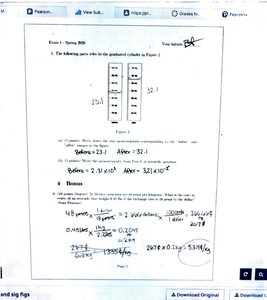
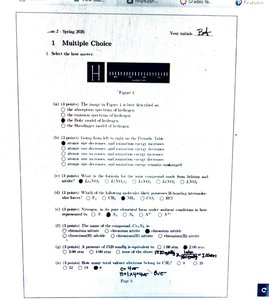
Q5. Multiple Choice: Identifying elements, compounds, and mixtures using the periodic table and diagrams
Background
Topic: Classification of Matter and Periodic Table
This section tests your ability to use the periodic table and visual representations to classify substances as elements, compounds, or mixtures.
Key Concepts:
Element: Found on the periodic table, made of one type of atom.
Compound: Made of two or more elements chemically bonded.
Mixture: Contains two or more substances not chemically bonded.
Step-by-Step Guidance
Refer to the periodic table to identify elements by their symbols.
For compounds, look for chemical formulas with two or more different elements.
For mixtures, identify if more than one type of particle or substance is present.
Try solving on your own before revealing the answer!
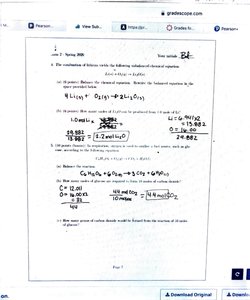
Q6. Calculations: Moles, Molar Mass, and Chemical Equations
Background
Topic: Stoichiometry and Chemical Reactions
This section tests your ability to use chemical equations, calculate moles, and determine molar mass for stoichiometric calculations.
Key Formulas:
Moles:
Molar Mass: The sum of the atomic masses of all atoms in a molecule.
Stoichiometry: Use balanced chemical equations to relate moles of reactants and products.
Step-by-Step Guidance
Write the balanced chemical equation for the reaction.
Calculate the molar mass of each compound involved.
Convert given masses to moles using the molar mass.
Use the coefficients from the balanced equation to set up mole ratios for the calculation.
Try solving on your own before revealing the answer!
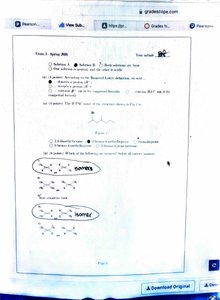
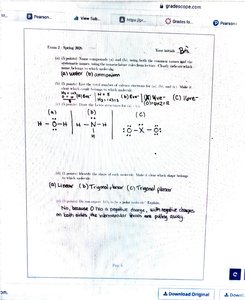
Q7. Lewis Structures and Molecular Geometry
Background
Topic: Lewis Structures and VSEPR Theory
This section tests your ability to draw Lewis structures for molecules and predict their shapes using VSEPR (Valence Shell Electron Pair Repulsion) theory.
Key Concepts:
Lewis Structure: A diagram showing the arrangement of valence electrons around atoms in a molecule.
VSEPR Theory: Predicts the shape of molecules based on electron pair repulsion.
Step-by-Step Guidance
Count the total number of valence electrons for the molecule.
Arrange the atoms and connect them with single bonds.
Distribute remaining electrons to satisfy the octet rule (or duet for hydrogen).
Use VSEPR theory to predict the molecular geometry based on the number of bonding and lone pairs around the central atom.
Try solving on your own before revealing the answer!
Q8. Organic Chemistry: Isomers and Functional Groups
Background
Topic: Organic Chemistry – Isomers and Functional Groups
This section tests your ability to identify isomers (compounds with the same formula but different structures) and recognize common organic functional groups.
Key Concepts:
Isomers: Compounds with the same molecular formula but different structural arrangements.
Functional Groups: Specific groups of atoms within molecules that determine chemical reactivity (e.g., alcohol, ketone, carboxylic acid).
Step-by-Step Guidance
Compare the molecular formulas of the given compounds to confirm they are isomers.
Draw the structures to visualize differences in connectivity or arrangement.
Identify and label the functional groups present in each structure.
Try solving on your own before revealing the answer!