 Back
GOB Chemistry Study Guide: Organic Compounds, Reactions, and Functional Groups
Study Guide - Smart Notes
 Tailored notes based on your materials, expanded with key definitions, examples, and context.
Organic Compounds and Their Structures
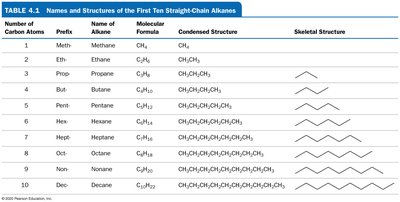
Alkanes: Names, Structures, and Formulas
Alkanes are saturated hydrocarbons containing only single bonds between carbon atoms. Their names, formulas, and structures follow a systematic pattern based on the number of carbon atoms.
Key Point 1: The molecular formula for straight-chain alkanes is CnH2n+2.
Key Point 2: The prefix indicates the number of carbon atoms (e.g., 'meth-' for 1, 'eth-' for 2).
Key Point 3: Alkanes can be represented by condensed and skeletal structures.
Example: Hexane (C6H14) has the condensed structure CH3CH2CH2CH2CH2CH3.
Greek Prefixes in Chemistry
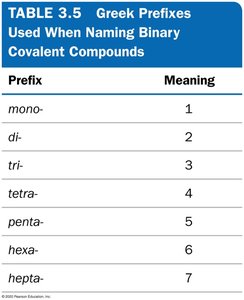
Binary Covalent Compound Naming
Greek prefixes are used to indicate the number of atoms of each element in binary covalent compounds.
Key Point 1: Prefixes such as mono-, di-, tri-, tetra-, penta-, hexa-, and hepta- correspond to numbers 1 through 7.
Key Point 2: The prefix is placed before the element name to indicate quantity.
Example: CO2 is named carbon dioxide ('di-' for two oxygens).
Families of Organic Compounds: Functional Groups
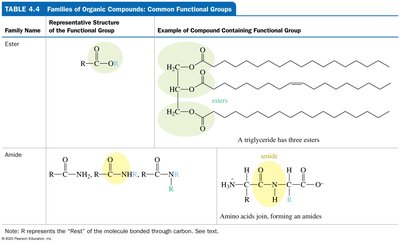
Common Functional Groups in Organic Chemistry
Functional groups are specific groups of atoms within molecules that are responsible for the characteristic chemical reactions of those molecules.
Key Point 1: The ester group has the structure R–COO–R', and is found in triglycerides.
Key Point 2: The amide group has the structure R–CONH2, and is found in proteins.
Example: Amino acids join to form amides (peptide bonds) in proteins.
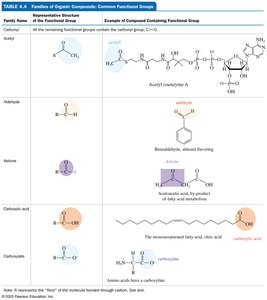
Carbonyl-Containing Functional Groups
Carbonyl groups (C=O) are present in several important organic functional groups, including acetyl, aldehyde, ketone, and carboxylic acid.
Key Point 1: Aldehydes have the structure R–CHO, while ketones have R–CO–R'.
Key Point 2: Carboxylic acids have the structure R–COOH, and are acidic due to the presence of the carboxyl group.
Example: Acetyl coenzyme A contains an acetyl group, important in metabolism.
Other Functional Groups: Sulfide, Phosphate, Amines
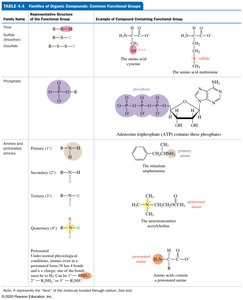
Organic molecules may also contain sulfide, phosphate, and amine groups, which contribute to their chemical properties and biological functions.
Key Point 1: Sulfides contain R–S–R', phosphates contain PO43−, and amines contain nitrogen atoms bonded to carbon.
Key Point 2: Amines are classified as primary, secondary, tertiary, or quaternary based on the number of carbon groups attached to the nitrogen.
Example: ATP (adenosine triphosphate) contains three phosphate groups.
Monosaccharides: Fischer Projections and Nomenclature
D-Monosaccharides with 5 and 6 Carbons
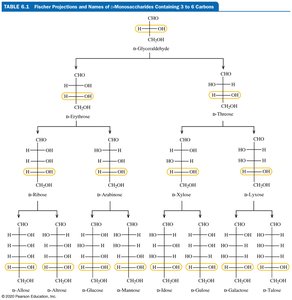
Monosaccharides are simple sugars classified by the number of carbon atoms and the type of carbonyl group (aldose or ketose). Fischer projections are used to represent their three-dimensional structure in two dimensions.
Key Point 1: Aldoses have an aldehyde group at the top, while ketoses have a ketone group.
Key Point 2: The arrangement of hydroxyl groups determines the specific sugar (e.g., D-ribose, D-glucose).
Example: D-glucose is a hexose (six carbons) and an aldose.
Chemical Reactions: Energy and Activation Energy
Reaction Energy Diagrams
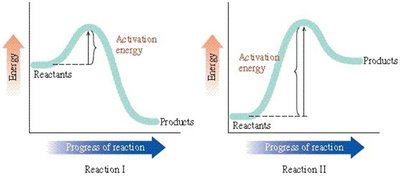
Chemical reactions involve changes in energy. The activation energy is the minimum energy required for a reaction to occur, and the free energy change (ΔG) determines whether a reaction is spontaneous.
Key Point 1: Exergonic reactions release energy (ΔG < 0), while endergonic reactions absorb energy (ΔG > 0).
Key Point 2: The height of the activation energy barrier affects the reaction rate.
Example: Catalysts lower the activation energy, increasing the reaction rate.
Additional info:
All tables and diagrams included are directly relevant to GOB Chemistry topics, including organic nomenclature, functional groups, monosaccharide structure, and reaction energetics.
Study notes are structured to reinforce foundational concepts for exam preparation.
