 Back
BackGOB I Review: Introduction to Chemistry, Measurement, and Atomic Structure
Study Guide - Smart Notes
 Tailored notes based on your materials, expanded with key definitions, examples, and context.
Introduction to Chemistry
What Is Chemistry?
Chemistry is the scientific study of the properties, structure, and transformations of matter. Matter is defined as anything that has mass and occupies space. The fundamental building blocks of matter are atoms, which determine the behavior and characteristics of substances in the world.
Atoms: Extremely tiny particles that are the basic units of matter.
Matter: Includes both naturally occurring substances (e.g., sucrose from plants) and synthetic substances (e.g., medications, plastics).
Classification of Matter
Pure Substances vs. Mixtures
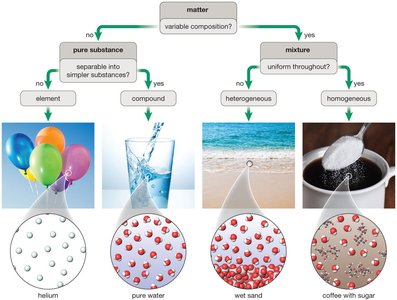
Matter can be classified based on its composition. A pure substance consists of a single component with constant composition, while a mixture contains more than one substance and can have variable composition.
Element: A pure substance that cannot be broken down chemically into simpler substances.
Compound: A pure substance formed when two or more elements combine in constant proportions.
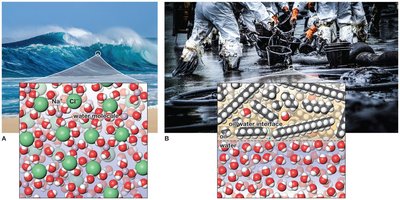
Homogeneous Mixture: Uniform composition throughout (e.g., salt dissolved in water).
Heterogeneous Mixture: Non-uniform composition (e.g., oil and water).
States of Matter
Solid, Liquid, and Gas
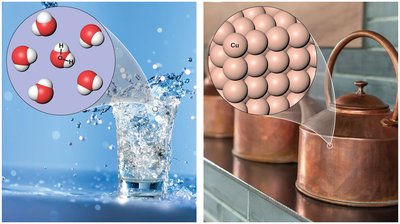
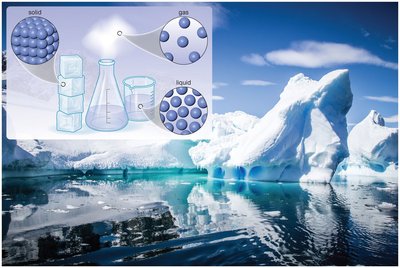
Matter exists in three primary states: solid, liquid, and gas. Each state has distinct physical properties.
Solid: Definite volume and shape.
Liquid: Definite volume, but takes the shape of its container.
Gas: No definite shape or volume; fills the container it occupies.
Chemical Properties and Changes
Chemical Reactions
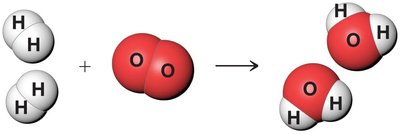
Chemical properties are observed when a substance undergoes a chemical change, resulting in the formation of a new substance. A chemical reaction is the process by which substances are converted into different substances.
Example: The reaction of hydrogen and oxygen to form water.
Elements and the Periodic Table
Elements and Their Symbols
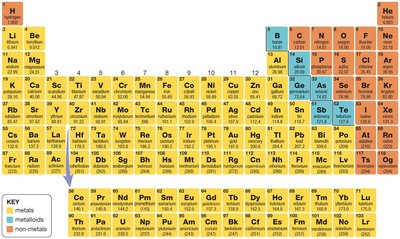
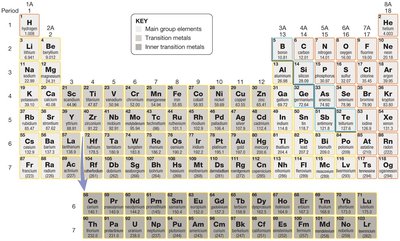
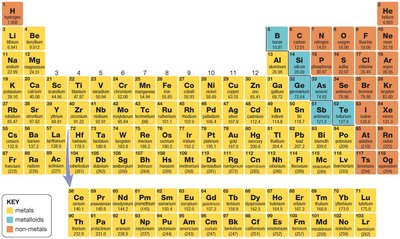
An element is a pure substance that cannot be broken down further. Each element is represented by a unique chemical symbol, consisting of one or two letters. The periodic table organizes all known elements based on their properties.
There are 118 known elements.
Examples: Oxygen (O), Helium (He), Iron (Fe), Gold (Au).
Compounds and Chemical Formulas
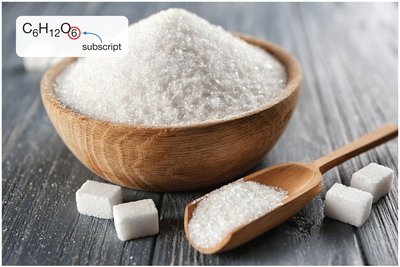
Elements combine to form compounds. Chemical formulas use element symbols and subscripts to indicate the ratio of elements in a compound.
Example: Glucose is represented as .
Periods and Groups
The periodic table is organized into periods (horizontal rows) and groups (vertical columns). Elements in the same group have similar properties.
Periods are numbered 1–7.
Groups are numbered 1–18 (or 1A–8A for main group elements).
Transition metals are labeled with a B.
Metals, Metalloids, and Nonmetals
Elements are classified as metals, metalloids, or nonmetals based on their properties.
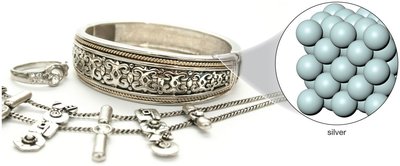
Metals: Shiny, conduct electricity, ductile, malleable.
Nonmetals: Dull, poor conductors of heat and electricity.
Metalloids: Properties intermediate between metals and nonmetals; found along the staircase line of the periodic table.
Measurement in Science and Medicine
Units of Measurement
The metric system is used for scientific and medical measurements. It is based on base units for each type of measurement.
Measurement | Metric Unit | SI Unit |
|---|---|---|
Length | meter (m) | meter (m) |
Volume | liter (L) | cubic meter (m3) |
Mass | gram (g) | kilogram (kg) |
Temperature | degree Celsius (°C) | kelvin (K) |
Time | second (s) | second (s) |
Metric Prefixes
Prefixes are used to indicate multiples or fractions of base units.
Prefix | Symbol | Meaning | Value | Scientific Notation |
|---|---|---|---|---|
giga- | G | billion | 1,000,000,000 | |
mega- | M | million | 1,000,000 | |
kilo- | k | thousand | 1,000 | |
deci- | d | tenth | 0.1 | |
centi- | c | hundredth | 0.01 | |
milli- | m | thousandth | 0.001 | |
micro- | μ | millionth | 0.000001 | |
nano- | N | billionth | 0.000000001 |
Scientific Notation and Significant Figures
Measurements are reported using scientific notation and significant figures to ensure clarity and precision.
Scientific Notation: Used for very large or small numbers (e.g., ).
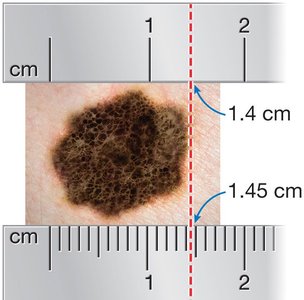
Significant Figures: All digits in a measured number, including one estimated digit.
Exact Numbers: Obtained from counting.
Measured Numbers: Obtained from measurement and contain uncertainty.
Rules for Significant Figures
Rule | Example | Number of Significant Figures |
|---|---|---|
Not a zero | 3.9 g | 2 |
Zero between nonzero digits | 9008 mm | 4 |
Zero at end with decimal point | 30.0 °C | 3 |
Zero at beginning | 0.00032 cm | 2 |
Zero at end without decimal point | 380,000 m | 2 |
Unit Conversions and Dimensional Analysis
Unit conversions use conversion factors to change from one unit to another. Dimensional analysis is a systematic method for solving conversion problems.
Example:
Atoms: The Building Blocks of Chemistry
Structure of Atoms
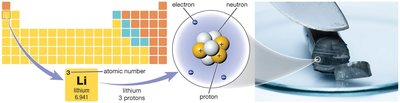
Atoms are composed of protons, neutrons, and electrons. The nucleus contains protons and neutrons, while electrons occupy the surrounding electron cloud.
Proton (p): Positive charge, mass ≈ 1 amu
Neutron (n): No charge, mass ≈ 1 amu
Electron (e): Negative charge, mass ≈ 0.00055 amu
Atomic Number and Mass
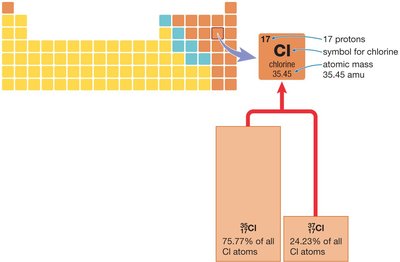
The atomic number (Z) is the number of protons in the nucleus and uniquely identifies each element. The atomic mass is the weighted average mass of all naturally occurring isotopes of an element.
Atomic number is written above the chemical symbol in the periodic table.
Example: Lithium (Li) has atomic number 3 (3 protons).
Electrical Neutrality of Atoms
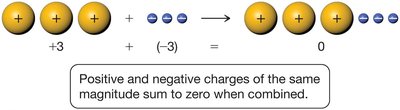
Atoms are electrically neutral when they have equal numbers of protons and electrons, resulting in a net charge of zero.
Example: Lithium atom has 3 protons and 3 electrons.
Isotopes and Atomic Mass
Isotopes are atoms of the same element with different numbers of neutrons. The atomic mass reflects the weighted average of all isotopes.
Valence Electrons
Valence electrons are the electrons in the outermost shell of an atom. The group number for elements in groups 1A–8A corresponds to the number of valence electrons.
Group 1A: 1 valence electron
Group 2A: 2 valence electrons
 Additional info: These notes cover the foundational concepts from Chapters 1–3 of a GOB Chemistry course, including matter classification, measurement, atomic structure, and periodic table organization.
