 Back
BackIdentifying Functional Groups and Naming Organic Compounds
Study Guide - Smart Notes
 Tailored notes based on your materials, expanded with key definitions, examples, and context.
Q25. Which of the following compounds contains an aldehyde functional group?
Background
Topic: Organic Functional Groups
This question tests your ability to recognize the aldehyde functional group among several organic structures. Aldehydes are a key class of organic compounds, and identifying them is foundational in organic chemistry.
Key Terms and Concepts:
Aldehyde: An organic compound containing a carbonyl group (C=O) bonded to at least one hydrogen atom. The general structure is R-CHO.
Functional Group: A specific group of atoms within a molecule responsible for the characteristic chemical reactions of that molecule.
How to Identify an Aldehyde:
Look for a carbon atom double-bonded to oxygen (C=O) and single-bonded to a hydrogen atom (–CHO group).
The carbonyl group must be at the end of the carbon chain.
Step-by-Step Guidance
Examine each structure for the presence of a carbonyl group (C=O).
Check if the carbonyl carbon is also bonded to a hydrogen atom (–CHO group), which is the hallmark of an aldehyde.
Eliminate any structure where the carbonyl group is not at the end of the chain or is bonded to two carbons (which would indicate a ketone).
Review the remaining options to confirm which one fits the aldehyde definition.
Try solving on your own before revealing the answer!
Q30. What is the IUPAC name of the following compound?
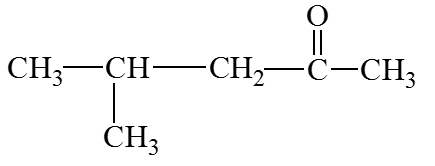
Background
Topic: IUPAC Nomenclature of Ketones
This question tests your ability to apply IUPAC rules to name a ketone with a branched alkyl group. Understanding how to number the carbon chain and identify substituents is essential for naming organic compounds correctly.
Key Terms and Concepts:
Ketone: An organic compound with a carbonyl group (C=O) bonded to two carbon atoms.
IUPAC Naming: The systematic method for naming organic chemical compounds as recommended by the International Union of Pure and Applied Chemistry.
Substituent: An atom or group of atoms that replaces hydrogen in an organic compound.
Key Steps for Naming:
Identify the longest continuous carbon chain containing the carbonyl group.
Number the chain so that the carbonyl carbon gets the lowest possible number.
Identify and name any substituents, and assign their position numbers based on the main chain numbering.
Combine the substituent names and positions with the parent ketone name.
Step-by-Step Guidance
Locate the carbonyl group (C=O) in the structure and identify the longest chain containing it.
Number the chain from the end nearest the carbonyl group to give the ketone the lowest possible number.
Identify the position and name of any alkyl substituents attached to the main chain.
Assemble the name by placing the substituent(s) with their position(s) before the parent name, and indicate the position of the ketone group.
Try solving on your own before revealing the answer!
