 Back
BackIntroduction to Organic Chemistry: Alkanes and Nomenclature
Study Guide - Smart Notes
 Tailored notes based on your materials, expanded with key definitions, examples, and context.
Introduction to Organic Chemistry
Definition and Scope
Organic chemistry is the branch of chemistry that studies compounds primarily composed of carbon and hydrogen, often with other elements such as oxygen, nitrogen, sulfur, and halogens. Organic compounds are distinguished from inorganic compounds by their structure, bonding, and properties.
Organic compounds: Compounds with carbon as the principal element, typically containing C-H bonds.
Inorganic compounds: Compounds that do not primarily contain carbon-hydrogen frameworks.

Classification of Organic Compounds
Hydrocarbons and Derivatives
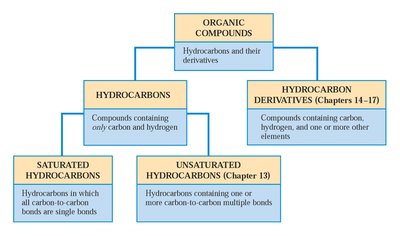
Organic compounds are broadly classified into hydrocarbons (containing only carbon and hydrogen) and their derivatives (containing additional elements).
Hydrocarbons: Only carbon and hydrogen atoms.
Hydrocarbon derivatives: Contain other elements such as O, N, S, or halogens.
Hydrocarbons
Saturated and Unsaturated Hydrocarbons
Hydrocarbons are divided into saturated and unsaturated types based on the types of bonds between carbon atoms.
Saturated hydrocarbons (Alkanes): Only single bonds between carbon atoms. General formula:
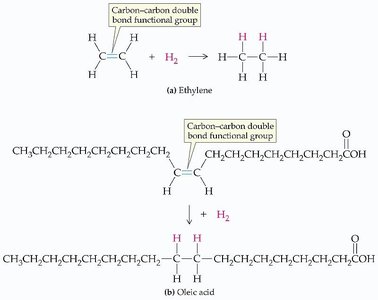
Unsaturated hydrocarbons: Contain one or more double (alkenes) or triple (alkynes) bonds.

Bonding and Structure in Organic Compounds
Bonding Patterns
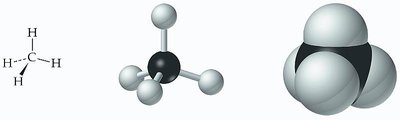
Carbon is tetravalent, forming four covalent bonds. The geometry around carbon atoms depends on the type of bonding:
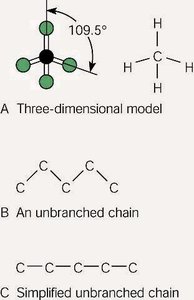
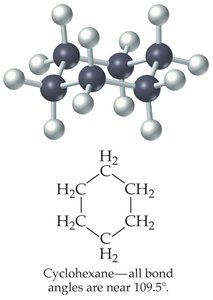
Tetrahedral (sp3): Four single bonds, bond angles of 109.5° (e.g., methane, ethane).
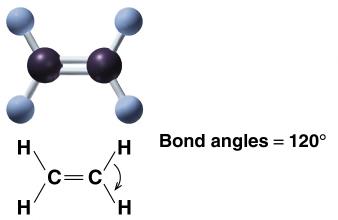
Trigonal planar (sp2): Double bonds, bond angles of 120° (e.g., ethene).
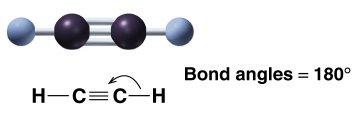
Linear (sp): Triple bonds, bond angles of 180° (e.g., ethyne).

Functional Groups
Definition and Importance
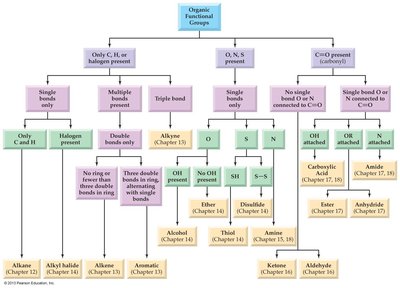
A functional group is a specific group of atoms within a molecule that imparts characteristic chemical properties and reactivity. Organic molecules are grouped into families based on their functional groups.
Functional groups determine the chemical behavior of organic molecules.
Examples include hydroxyl (-OH), carbonyl (C=O), carboxyl (-COOH), amino (-NH2), and halides (-Cl, -Br, etc.).
Physical and Chemical Properties: Organic vs. Inorganic Compounds
Comparison Table
Organic and inorganic compounds differ in their bonding, physical properties, and solubility.
Property | Organic (Covalent) | Inorganic (Ionic) |
|---|---|---|
Boiling/Melting Points | Lower | Higher |
Intermolecular Forces | Weaker (London, dipole, H-bonding) | Stronger (ionic) |
Solubility in Water | Mostly insoluble | Mostly soluble |
Electrical Conductivity | Nonelectrolytes (do not conduct) | Electrolytes (conduct) |
Physical State | Often liquids/gases | Often solids |
Drawing Organic Structures
Types of Structural Representations
Organic molecules can be represented in several ways to convey different levels of detail:
Expanded (structural) formula: Shows all atoms and bonds explicitly.
Condensed formula: Groups atoms together, omitting some bonds.
Line-angle (skeletal) formula: Each vertex or line end represents a carbon; hydrogens on carbons are implied.

Nomenclature of Alkanes
IUPAC System
The International Union of Pure and Applied Chemistry (IUPAC) provides systematic rules for naming organic compounds. The name of an alkane consists of three parts: prefix (substituents), parent (number of carbons), and suffix (family).
Identify the longest continuous carbon chain (parent chain).
Number the chain to give substituents the lowest possible numbers.
Name and number substituents (branches), using prefixes (di-, tri-, etc.) for multiples.
List substituents alphabetically.


Greek Roots for Number of Carbons
The parent name is based on the number of carbons in the main chain:
Number of Carbons | Root | Example |
|---|---|---|
1 | meth- | methane |
2 | eth- | ethane |
3 | prop- | propane |
4 | but- | butane |
5 | pent- | pentane |
6 | hex- | hexane |
7 | hept- | heptane |
8 | oct- | octane |
9 | non- | nonane |
10 | dec- | decane |

Isomerism in Alkanes
Structural (Constitutional) Isomers
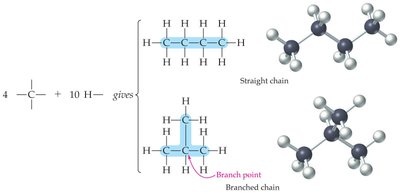
Isomers are compounds with the same molecular formula but different structures. In alkanes, structural isomers differ in the connectivity of their carbon atoms (straight-chain vs. branched).
Straight-chain isomer: All carbons in a single continuous chain.
Branched-chain isomer: At least one carbon is attached as a branch.
Cycloalkanes
Structure and Nomenclature
Cycloalkanes are saturated hydrocarbons with carbon atoms arranged in a ring. The prefix "cyclo-" is used in their names (e.g., cyclohexane).
General formula:
Number the ring to give substituents the lowest possible numbers.
Summary Table: Alkanes
Molecular Formula | IUPAC Prefix | IUPAC Name | Structural Formula |
|---|---|---|---|
CH4 | meth- | methane | CH4 |
C2H6 | eth- | ethane | CH3CH3 |
C3H8 | prop- | propane | CH3CH2CH3 |
C4H10 | but- | butane | CH3CH2CH2CH3 |
C5H12 | pent- | pentane | CH3(CH2)3CH3 |
C6H14 | hex- | hexane | CH3(CH2)4CH3 |
C7H16 | hept- | heptane | CH3(CH2)5CH3 |
C8H18 | oct- | octane | CH3(CH2)6CH3 |
C9H20 | non- | nonane | CH3(CH2)7CH3 |
C10H22 | dec- | decane | CH3(CH2)8CH3 |

Key Equations
General formula for acyclic alkanes:
General formula for cycloalkanes:
Additional info:
Organic chemistry is foundational for understanding biological molecules, pharmaceuticals, and materials science.
Practice in drawing and naming organic molecules is essential for mastery.
