Back
BackIonic and Molecular Compounds: Electronegativity, Bond Polarity, Molecular Shapes, and Intermolecular Forces
Study Guide - Smart Notes
 Tailored notes based on your materials, expanded with key definitions, examples, and context.
Ionic and Molecular Compounds
Electronegativity and Bond Polarity
Electronegativity is a measure of an atom's ability to attract shared electrons in a chemical bond. The concept is crucial for understanding the polarity of bonds and the resulting properties of compounds.
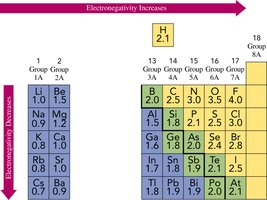
Electronegativity Trends: Electronegativity increases from left to right across a period and from bottom to top within a group on the periodic table. Nonmetals, especially fluorine, have the highest electronegativity values, while metals have the lowest.
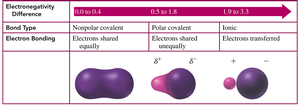
Bond Polarity: The difference in electronegativity between two atoms determines the type of bond formed:
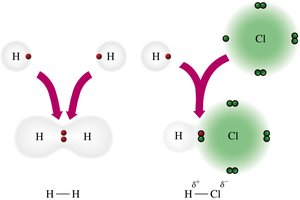
Nonpolar Covalent Bond: Electrons are shared equally (difference: 0.0–0.4).
Polar Covalent Bond: Electrons are shared unequally (difference: 0.5–1.8).
Ionic Bond: Electrons are transferred from one atom to another (difference: 1.9–3.3).
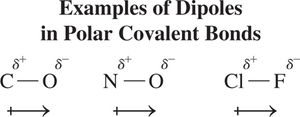
Dipole: A polar covalent bond creates a dipole, with partial positive (δ+) and partial negative (δ−) charges at opposite ends of the bond.
Electronegativity Difference | Bond Type | Electron Bonding |
|---|---|---|
0.0 to 0.4 | Nonpolar covalent | Electrons shared equally |
0.5 to 1.8 | Polar covalent | Electrons shared unequally |
1.9 to 3.3 | Ionic | Electrons transferred |
Shapes of Molecules (VSEPR Theory)
Valence Shell Electron-Pair Repulsion (VSEPR) Theory
VSEPR theory predicts the three-dimensional structure of molecules based on the repulsion between electron groups around a central atom. The arrangement minimizes repulsion, determining the molecular geometry.
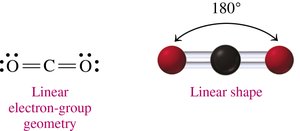
Linear: Two electron groups, 180° bond angle (e.g., CO2).
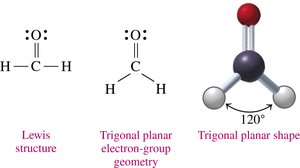
Trigonal Planar: Three electron groups, 120° bond angle (e.g., formaldehyde).
Bent: Three electron groups (two bonds, one lone pair) or four electron groups (two bonds, two lone pairs), bond angle less than 120° or 109°.
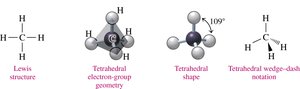
Tetrahedral: Four electron groups, 109° bond angle (e.g., methane).
Trigonal Pyramidal: Four electron groups (three bonds, one lone pair), bond angle ~107° (e.g., ammonia).
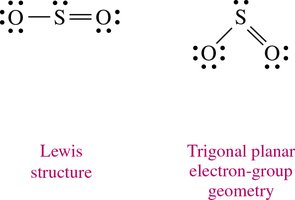
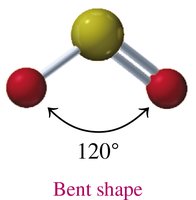
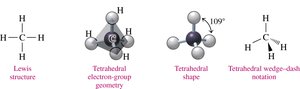
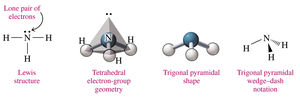
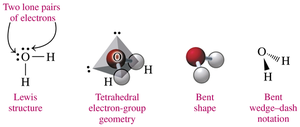
Number of Electron Groups | Bonded Atoms | Lone Pairs | Shape | Bond Angle |
|---|---|---|---|---|
2 | 2 | 0 | Linear | 180° |
3 | 3 | 0 | Trigonal planar | 120° |
3 | 2 | 1 | Bent | <120° |
4 | 4 | 0 | Tetrahedral | 109° |
4 | 3 | 1 | Trigonal pyramidal | ~107° |
4 | 2 | 2 | Bent | ~104.5° |
Polarity of Molecules and Intermolecular Forces
Polarity of Molecules
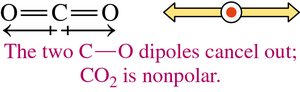
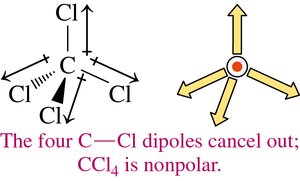
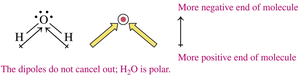
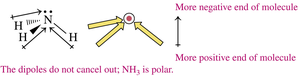
The overall polarity of a molecule depends on both the polarity of its bonds and its molecular shape. If the dipoles in a molecule cancel due to symmetry, the molecule is nonpolar; if not, it is polar.
Nonpolar Molecules: All dipoles cancel (e.g., CO2, CCl4).
Polar Molecules: Dipoles do not cancel (e.g., H2O, NH3, HCl).

Intermolecular Forces
Intermolecular forces are the attractions between molecules, influencing physical properties such as melting and boiling points.
Ionic Bonds: Strongest forces, occur between ions in ionic compounds (e.g., NaCl).
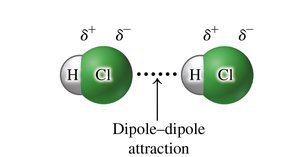
Dipole–Dipole Attractions: Occur between polar molecules; positive end of one molecule is attracted to the negative end of another (e.g., HCl).
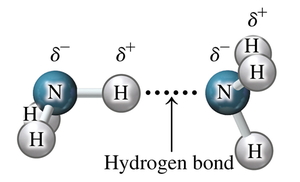
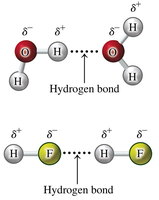
Hydrogen Bonds: Special dipole–dipole attractions between hydrogen and F, O, or N; strongest intermolecular force in covalent compounds (e.g., H2O, NH3).
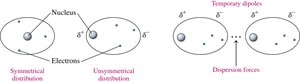
Dispersion Forces: Weakest forces, present in all molecules but dominant in nonpolar molecules; caused by temporary dipoles due to electron movement.
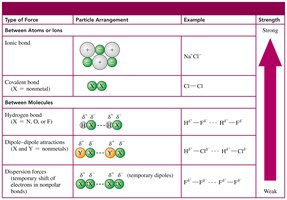
Type of Force | Particle Arrangement | Example | Strength |
|---|---|---|---|
Ionic bond | Na+ Cl− | NaCl | Strong |
Covalent bond | Cl—Cl | Cl2 | Strong |
Hydrogen bond | H—F ··· H—F | HF | Moderate |
Dipole–dipole | δ+—δ− | HCl | Weak |
Dispersion forces | Temporary dipoles | Cl2 | Very weak |
Melting Points and Attractive Forces
The melting point of a substance is directly related to the strength of the attractive forces between its particles:
Ionic compounds: Highest melting points due to strong ionic bonds.
Covalent compounds with hydrogen bonds: High melting points, but lower than ionic compounds.
Covalent compounds with dipole–dipole or dispersion forces: Lower melting points.
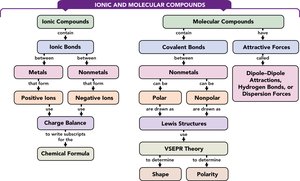
Concept Map: Ionic and Molecular Compounds
This concept map summarizes the relationships between ionic and molecular compounds, their bonding, and the resulting properties.