 Back
BackIonic and Molecular Compounds: Polyatomic Ions, Naming, and Lewis Structures
Study Guide - Smart Notes
 Tailored notes based on your materials, expanded with key definitions, examples, and context.
Polyatomic Ions
Definition and Characteristics
Polyatomic ions are groups of covalently bonded atoms that carry an overall charge. These ions often consist of a nonmetal (such as phosphorus, sulfur, carbon, or nitrogen) bonded to oxygen atoms. Most polyatomic ions have a negative charge, except for the ammonium ion, which is positively charged.
Polyatomic ion: A charged group of covalently bonded atoms.
Most are anions (negatively charged), except ammonium (NH4+), which is a cation.
Common examples include sulfate (SO42−), nitrate (NO3−), and carbonate (CO32−).
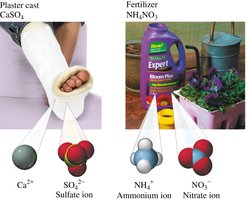
Naming Polyatomic Ions
The names of most common polyatomic ions end in -ate. If a related ion has one less oxygen atom, its name ends in -ite. Halogens can form four different polyatomic ions with oxygen, each with a different number of oxygen atoms and a consistent charge.
-ate: Most common form (e.g., sulfate SO42−).
-ite: One less oxygen (e.g., sulfite SO32−).
Prefixes per- (one more O) and hypo- (one less O than -ite) are used for halogen-based ions.
Writing Formulas for Compounds with Polyatomic Ions
When writing formulas for ionic compounds containing polyatomic ions, the same rules of charge balance apply as for simple ionic compounds. Parentheses are used around the polyatomic ion if more than one is needed.
Write the cation first, then the polyatomic ion.
Balance charges so the total positive and negative charges are equal.
Use parentheses if more than one polyatomic ion is needed (e.g., Mg(NO3)2).
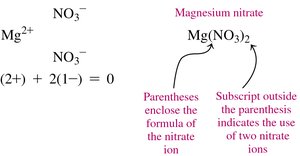
Naming Compounds with Polyatomic Ions
To name an ionic compound containing a polyatomic ion, write the name of the cation (usually a metal) first, followed by the name of the polyatomic ion. No prefixes are used.
Recognize polyatomic ions in the formula to name the compound correctly.
Examples: Na2SO4 is sodium sulfate; FePO4 is iron(III) phosphate.
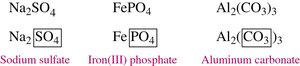
Molecular Compounds: Sharing Electrons
Covalent Bonds and Molecular Compounds
Molecular compounds form when atoms of two or more nonmetals share electrons, creating covalent bonds. The shared electrons allow each atom to achieve a stable electron configuration.
Covalent bond: A bond formed by sharing electrons between nonmetal atoms.
Molecule: A neutral group of atoms held together by covalent bonds.
Naming Molecular Compounds
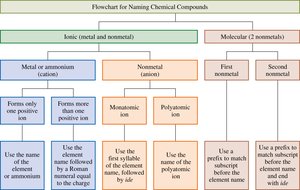
The names of molecular compounds use prefixes to indicate the number of each type of atom. The first nonmetal is named by its element name; the second nonmetal uses the root plus -ide. Prefixes (mono-, di-, tri-, etc.) indicate the number of atoms, but "mono-" is usually omitted for the first element.
First element: Use the element name.
Second element: Use the root + "-ide" ending.
Prefixes: mono- (1), di- (2), tri- (3), tetra- (4), penta- (5), hexa- (6), etc.
Example: CO2 is carbon dioxide; N2O4 is dinitrogen tetroxide.
Writing Formulas for Molecular Compounds
To write the formula from the name, use the prefixes to determine the number of each atom and write the symbols in the order given by the name.
Example: Diphosphorus pentoxide is P2O5.
Distinguishing Ionic and Molecular Compounds
A compound is usually ionic if the first element is a metal or the ammonium ion; it is molecular if the first element is a nonmetal. Naming rules differ for each type.
Ionic: Metal + nonmetal or polyatomic ion (e.g., K2O, potassium oxide).
Molecular: Nonmetal + nonmetal (e.g., N2O, dinitrogen oxide).
Lewis Structures for Molecules
Introduction to Lewis Structures
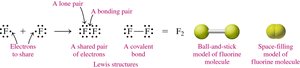
Lewis structures are diagrams that show the arrangement of valence electrons among atoms in a molecule. They help visualize single, double, and triple bonds, as well as lone pairs of electrons.
Each line or pair of dots represents a shared pair of electrons (bonding pair).
Lone pairs are shown as pairs of dots on individual atoms.
Hydrogen achieves a duet (2 electrons); other nonmetals aim for an octet (8 electrons).
Formation of Covalent Bonds
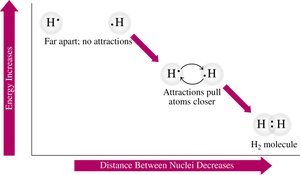
Covalent bonds form as atoms approach each other and share electrons, resulting in a more stable arrangement. For example, two hydrogen atoms share electrons to form H2.
Drawing Lewis Structures
To draw a Lewis structure, determine the number of valence electrons, arrange atoms, and distribute electrons to satisfy the octet rule (or duet for hydrogen).
Example: F2 molecule—each fluorine shares one electron to complete its octet.
Diatomic Molecules
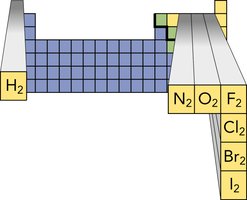
Some elements exist naturally as diatomic molecules, meaning two atoms of the same element are bonded together. These include H2, N2, O2, F2, Cl2, Br2, and I2.
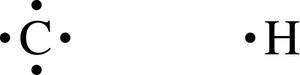
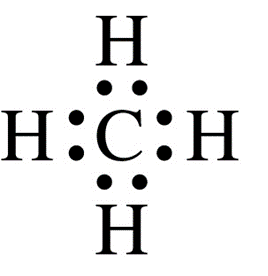
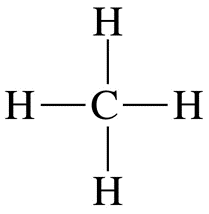
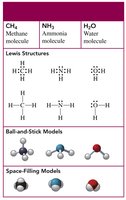
Lewis Structures for Methane (CH4)
Methane is a simple molecule where carbon forms four single covalent bonds with hydrogen atoms. The Lewis structure shows carbon at the center with four shared pairs of electrons.
Double and Triple Covalent Bonds
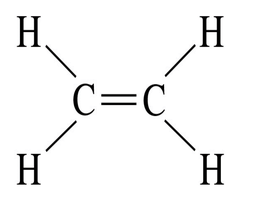
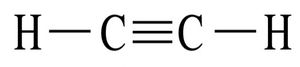
Double bonds involve two pairs of shared electrons, while triple bonds involve three pairs. These bonds are found in molecules where atoms need to share more electrons to achieve an octet.
Example: O2 has a double bond; N2 has a triple bond.
Lewis Structure Example: Carbon Dioxide (CO2)
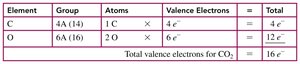
To draw the Lewis structure for CO2:
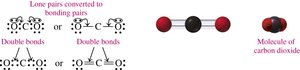
Arrange atoms: O–C–O
Count valence electrons: C (4) + 2 × O (6) = 16 electrons
Distribute electrons to form double bonds so each atom achieves an octet.
Exceptions to the Octet Rule
Some elements do not follow the octet rule strictly. Hydrogen only needs two electrons. Elements like phosphorus, sulfur, chlorine, bromine, and iodine can have expanded octets (10 or 12 electrons) in some compounds.
Example: SF6 (sulfur hexafluoride) has 12 electrons around sulfur.
