 Back
BackIonic and Molecular Compounds: Structure, Formation, and Nomenclature
Study Guide - Smart Notes
 Tailored notes based on your materials, expanded with key definitions, examples, and context.
Ionic and Molecular Compounds
Introduction
Ionic and molecular compounds are fundamental to understanding chemical bonding and the properties of substances. This section explores how atoms form ions, the nature of ionic and covalent bonds, and the rules for naming and writing formulas for these compounds.
6.1 Ions: Transfer of Electrons
Formation of Ions
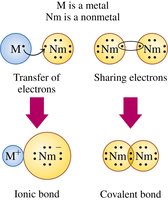
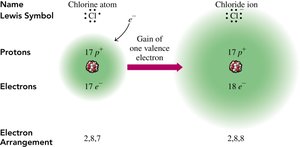
Atoms form ions by gaining or losing electrons to achieve a stable electron configuration, typically that of the nearest noble gas (the octet rule). Metals tend to lose electrons to form cations (positively charged ions), while nonmetals gain electrons to form anions (negatively charged ions).
Ionic bonds are the strong attractive forces between positive and negative ions.
Metals (Groups 1A, 2A, 3A) lose electrons; nonmetals (Groups 5A, 6A, 7A) gain electrons.
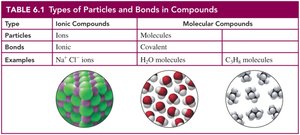
Types of Particles and Bonds in Compounds
The type of bonding and particles present in a compound determine its properties.
Type | Particles | Bonds | Examples |
|---|---|---|---|
Ionic Compounds | Ions | Ionic | Na+ Cl- ions |
Molecular Compounds | Molecules | Covalent | H2O, C3H8 |
Formation of Positive Ions (Cations)
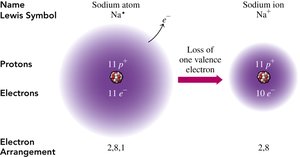
Metals lose electrons to form cations with a positive charge.
Example: Sodium (Na) loses one electron to form Na+.
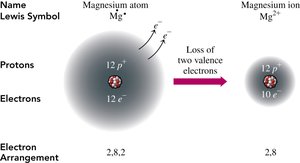
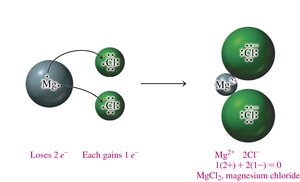
Example: Magnesium (Mg) loses two electrons to form Mg2+.
Formation of Negative Ions (Anions)
Nonmetals gain electrons to form anions with a negative charge.
Example: Chlorine (Cl) gains one electron to form Cl-.
Ionic Charges from Group Numbers
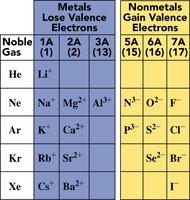
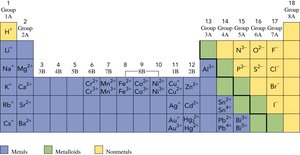
The periodic table group number helps predict the charge of ions formed by representative elements.
Noble Gas | 1A (1) | 2A (2) | 3A (13) | 5A (15) | 6A (16) | 7A (17) |
|---|---|---|---|---|---|---|
He | Li+ | |||||
Ne | Na+ | Mg2+ | Al3+ | |||
Ar | K+ | Ca2+ | P3- | S2- | Cl- | |
Kr | Rb+ | Sr2+ | Se2- | Br- | ||
Xe | Cs+ | Ba2+ | I- |
6.2 Ionic Compounds
Formation and Properties of Ionic Compounds
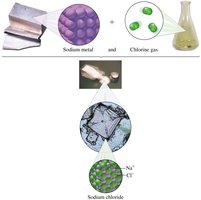
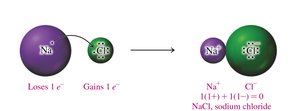
Ionic compounds are formed when metals react with nonmetals, resulting in the transfer of electrons and the formation of a crystal lattice of alternating positive and negative ions.
Example: Sodium (Na) reacts with chlorine (Cl) to form sodium chloride (NaCl), or table salt.
Ionic compounds have high melting points and are solid at room temperature.
Writing Formulas for Ionic Compounds
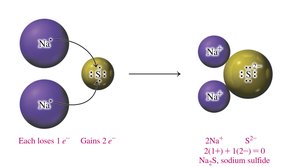
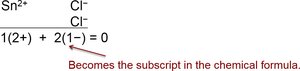
The chemical formula for an ionic compound reflects the lowest whole-number ratio of ions that results in a neutral compound (total positive charge equals total negative charge).
Subscripts are used to indicate the number of each ion needed for charge balance.
Example: Mg2+ and Cl- combine to form MgCl2.
Example: Na+ and S2- combine to form Na2S.
6.3 Naming and Writing Ionic Formulas
Naming Ionic Compounds
The name of an ionic compound consists of the name of the metal (cation) followed by the name of the nonmetal (anion) with its ending changed to -ide.
Example: NaCl is named sodium chloride.
Example: CaO is named calcium oxide.
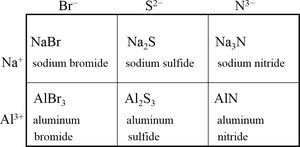
Formulas and Names for Common Ionic Compounds
Br- | S2- | N3- | |
|---|---|---|---|
Na+ | NaBr sodium bromide | Na2S sodium sulfide | Na3N sodium nitride |
Al3+ | AlBr3 aluminum bromide | Al2S3 aluminum sulfide | AlN aluminum nitride |
Metals with Variable Charges
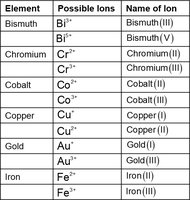
Many transition metals can form more than one type of positive ion. The charge is specified using a Roman numeral in parentheses after the metal's name.
Element | Possible Ions | Name of Ion |
|---|---|---|
Iron | Fe2+, Fe3+ | Iron(II), Iron(III) |
Copper | Cu+, Cu2+ | Copper(I), Copper(II) |
Lead | Pb2+, Pb4+ | Lead(II), Lead(IV) |
Nickel | Ni2+, Ni3+ | Nickel(II), Nickel(III) |
Writing Formulas from Names of Ionic Compounds
To write the formula from the name of an ionic compound:
Identify the cation and anion, including their charges.
Balance the charges by adjusting subscripts as needed.
Write the formula with the cation first, followed by the anion.
Summary Table: Ion Charges in the Periodic Table
The periodic table can be used to predict the charges of ions formed by main group elements.
Key Equations and Concepts
Charge balance in ionic compounds:
Example for NaCl:
Example for MgCl2:
Example for Al2S3:
Additional info:
Some images and tables were inferred to provide a complete academic context for the study of ionic and molecular compounds.
