 Back
BackIonic and Molecular Compounds: Structure, Formation, and Nomenclature
Study Guide - Smart Notes
 Tailored notes based on your materials, expanded with key definitions, examples, and context.
Ionic and Molecular Compounds
Introduction to Bonding
Chemical bonding is the process by which atoms join together to form compounds, resulting in a stable arrangement of electrons. There are two primary types of chemical bonds:
Ionic bonds: Formed by the transfer of electrons from one atom to another, typically between metals and nonmetals.
Covalent bonds: Formed by the sharing of electrons between two atoms, usually nonmetals.
Atoms bond to achieve the electron configuration of the nearest noble gas, which is associated with maximum stability.
The Octet Rule
The octet rule states that main group elements are especially stable when they possess eight electrons in their valence shell. Atoms achieve this configuration by gaining, losing, or sharing electrons.
Typically, an octet means 8 valence electrons.
Noble gases naturally possess a complete octet, making them chemically inert.
Valence Electrons
Valence electrons are the electrons in the outermost shell of an atom and are responsible for chemical reactivity. The number of valence electrons determines how an element will bond.
He: 2 valence electrons
Ne: 8 valence electrons
Ar: 8 valence electrons
Kr: 8 valence electrons
Classification of Compounds
Compounds can be classified as either ionic or molecular (covalent):
Ionic compounds: Composed of metals and nonmetals; electrons are transferred.
Molecular compounds: Composed of nonmetals; electrons are shared.
Ionic Compounds: Structure and Properties
Physical Properties of Ionic Compounds
Ionic compounds are characterized by their unique physical properties:
They are crystalline solids with high melting points (e.g., NaCl melts at 801°C).
They have high boiling points (e.g., NaCl boils at 1413°C).
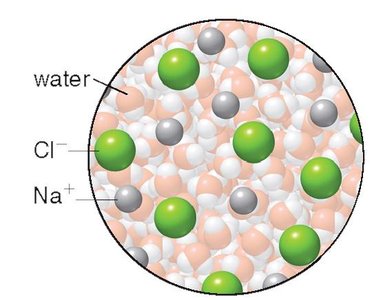
When dissolved in water, ionic compounds dissociate into ions, allowing the solution to conduct electricity.
Ionic Bonding
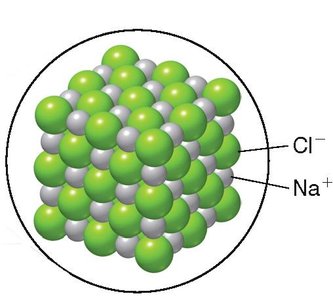
Ionic bonds form between a metal (left side of the periodic table) and a nonmetal (right side of the periodic table). The metal loses electrons to become a cation, and the nonmetal gains electrons to become an anion. The resulting electrostatic attraction holds the ions together in a crystal lattice.
Formation of Ions
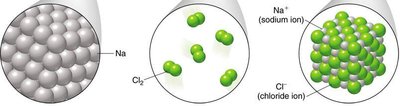
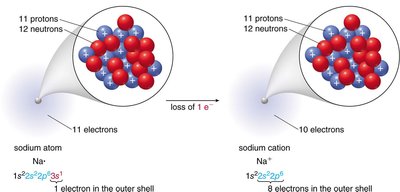
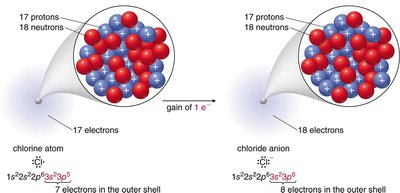
Ions are charged species formed when atoms gain or lose electrons:
Cations: Positively charged ions formed when an atom loses electrons (typically metals).
Anions: Negatively charged ions formed when an atom gains electrons (typically nonmetals).
Electrons are transferred from metals to nonmetals during ionic bond formation.
Relating Group Number to Ionic Charge
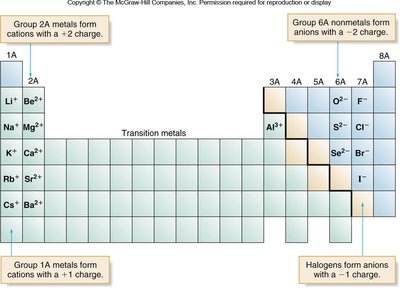
The charge of ions formed by main group elements can be predicted from their group number:
Group 1A: +1 charge (e.g., Na+)
Group 2A: +2 charge (e.g., Mg2+)
Group 3A: +3 charge (e.g., Al3+)
Group 5A: -3 charge (e.g., N3−)
Group 6A: -2 charge (e.g., O2−)
Group 7A: -1 charge (e.g., Cl−)
Metals with Variable Charge (Transition Metals)
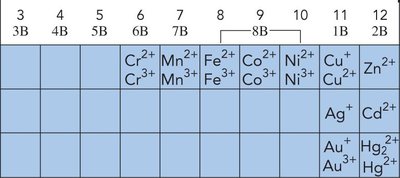
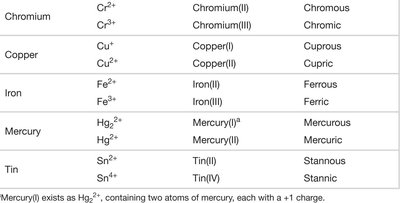
Many transition metals and some main group metals can form more than one type of positive ion (variable charge). The charge is specified using Roman numerals in parentheses.
Polyatomic Ions
Definition and Examples
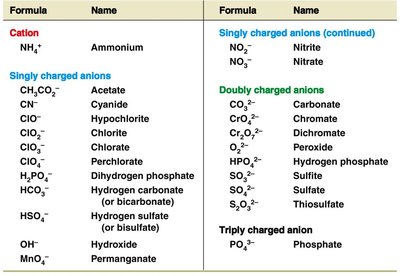
Polyatomic ions are ions composed of two or more atoms covalently bonded, carrying a net charge. They act as a single unit in chemical reactions and formulas.
Examples: NH4+ (ammonium), NO3− (nitrate), SO42− (sulfate)
Writing and Naming Ionic Compounds
Rules for Writing Formulas
Write the symbol of the cation (metal) first, followed by the anion (nonmetal or polyatomic ion).
Use subscripts to indicate the number of each ion needed to balance the overall charge to zero.
Subscripts should be the lowest whole number ratio.
Do not include ion charges in the final formula.
When more than one polyatomic ion is needed, enclose it in parentheses and use a subscript.
Criss-Cross Method
The criss-cross method is a shortcut for writing ionic formulas:
Write the symbols and charges of the ions.
Criss-cross the charges to become the subscripts of the opposite ion.
Reduce subscripts to the lowest whole number ratio.
Naming Ionic Compounds
Main group metals: Name the cation as the element, and the anion by changing the ending to “-ide”.
Transition metals: Indicate the charge of the cation with a Roman numeral in parentheses (systematic name), or use “-ous”/“-ic” suffixes for common names.
Polyatomic ions: Use the name of the polyatomic ion as is.
Examples
NaCl: Sodium chloride
MgCl2: Magnesium chloride
FeCl2: Iron(II) chloride or ferrous chloride
FeCl3: Iron(III) chloride or ferric chloride
Al2(SO4)3: Aluminum sulfate
NaHCO3: Sodium hydrogen carbonate (bicarbonate)
Practice Problems and Applications
Classify compounds as ionic or molecular based on their composition.
Determine the number of valence electrons and predict ion charges using the periodic table.
Write formulas and names for compounds containing polyatomic ions.
Identify isoelectronic species (ions or atoms with the same electron configuration).
Summary Table: Common Polyatomic Ions
Formula | Name |
|---|---|
NH4+ | Ammonium |
NO3− | Nitrate |
SO42− | Sulfate |
CO32− | Carbonate |
PO43− | Phosphate |
OH− | Hydroxide |
HCO3− | Hydrogen carbonate (bicarbonate) |
Additional info: The above notes expand on the original content by providing definitions, examples, and context for each topic, ensuring the material is self-contained and suitable for exam preparation.
