 Back
BackIonic and Molecular Compounds: Structure, Naming, and Formulas
Study Guide - Smart Notes
 Tailored notes based on your materials, expanded with key definitions, examples, and context.
Ionic & Molecular Compounds l
Types of Chemical Bonds
Ionic and molecular compounds are formed through the interaction of atoms, either by transferring or sharing electrons. The nature of the bond depends on the elements involved and their tendency to achieve a stable electron configuration, often described by the Octet Rule.
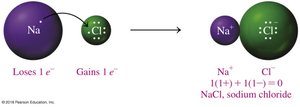
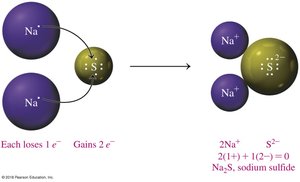
Ionic Bonds: Formed when valence electrons are transferred from a metal to a nonmetal, resulting in the formation of ions.
Covalent Bonds: Formed when nonmetals share valence electrons, resulting in molecular compounds. L
. Ions: Formation and Properties
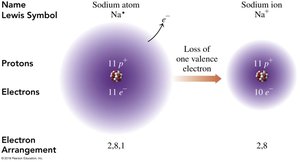
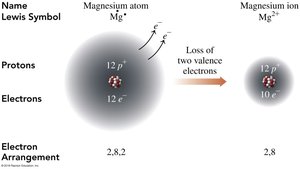
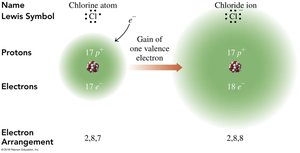
Ions are atoms or groups of atoms with an electrical charge, formed by the loss or gain of electrons to achieve stability.
Cations: Positive ions formed when atoms lose electrons (typically metals in Groups 1, 2, and 13).
Anions: Negative ions formed when atoms gain electrons (typically nonmetals in Groups 15, 16, and 17).
Ionic Charges from Group Numbers
The charge of ions can often be predicted based on their group number in the periodic table:
Group 1A: Lose 1 electron (+1 charge)
Group 2A: Lose 2 electrons (+2 charge)
Group 3A: Lose 3 electrons (+3 charge)
Group 5A: Gain 3 electrons (-3 charge)
Group 6A: Gain 2 electrons (-2 charge)
Group 7A: Gain 1 electron (-1 charge)
Writing Chemical Formulas for Ionic Compounds
The formula of an ionic compound represents the ratio of positive and negative ions that results in a net charge of zero.
Always write the cation first, followed by the anion.
Use subscripts to indicate the number of ions needed to balance the charge.
Use the lowest whole number ratio (formula unit).
Example: 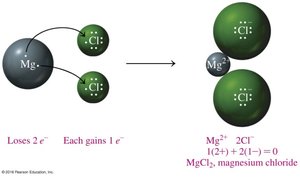
Naming Ionic Compounds
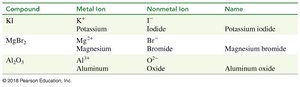
The name of an ionic compound consists of two parts:
Metal (cation): Name does not change.
Nonmetal (anion): Name changes to end with "-ide".
Subscripts are not used in the name, only in the formula.
Metals with Variable Charges (Transition Elements)
Many transition metals can form more than one type of positive ion (variable charge).
A Roman numeral is used in parentheses after the metal name to indicate the charge.
Some transition metals (Zn2+, Cd2+, Ag+) have only one common charge.
Example: Manganese(II) fluoride ():
Mn charge: 2+
F charge: 1- (two fluorides needed)
Name: manganese(II) fluoride
Writing Formulas from Names
To write the formula for an ionic compound:
Identify the cation and its charge.
Identify the anion and its charge.
Balance the charges.
Write the formula with appropriate subscripts.
Example: Tin(II) chloride:
Cation: Sn2+
Anion: Cl-
Formula: SnCl2
Polyatomic Ions
Polyatomic ions are groups of atoms that carry a charge and act as a single unit in compounds.
Most end in "-ate"; "-ite" is used for ions with one less oxygen.
"Per-" and "hypo-" prefixes indicate more or fewer oxygens, respectively.
Charge remains the same for "-ate" and "-ite" forms of the same nonmetal.
Example:
ClO4-: Perchlorate
ClO3-: Chlorate
ClO2-: Chlorite
ClO-: Hypochlorite
Writing Formulas for Compounds with Polyatomic Ions
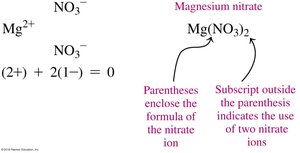
Balance total positive and negative charges to zero.
Use parentheses around polyatomic ions when more than one is needed.
Subscripts for polyatomic ions are placed outside the parentheses.
Naming Compounds with Polyatomic Ions
Write the cation name first.
Write the name of the polyatomic ion second.
Recognition and memorization of common polyatomic ions is essential.
Summary Table: Common Ionic Compounds
Compound | Metal Ion | Nonmetal Ion | Name |
|---|---|---|---|
KI | K+ | I- | Potassium iodide |
MgBr2 | Mg2+ | Br- | Magnesium bromide |
Al2O3 | Al3+ | O2- | Aluminum oxide |
Practice and Application
Determine charges and names for compounds with variable charge metals.
Write formulas for compounds given their names, including those with polyatomic ions.
Name compounds containing polyatomic ions using established rules.
Additional info: These notes cover the essential concepts from Chapter 6 (Ionic and Molecular Compounds) as outlined in the provided lecture, including the formation, naming, and formula writing for both simple and polyatomic ionic compounds, with relevant examples and visual aids.
