 Back
Ionic and Molecular Compounds: Structure, Naming, and Properties
Study Guide - Smart Notes
 Tailored notes based on your materials, expanded with key definitions, examples, and context.
Ionic and Molecular Compounds
Introduction to Ionic and Molecular Compounds
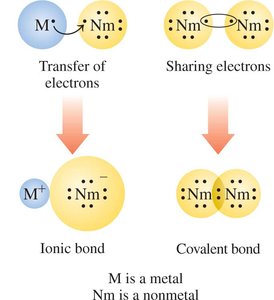
Ionic and molecular compounds are fundamental to understanding chemical bonding and the properties of substances. Ionic compounds are formed from the transfer of electrons between metals and nonmetals, while molecular compounds arise from the sharing of electrons between nonmetals. These concepts are essential for pharmacy technicians and other health professionals, as many medications and biological molecules are composed of these compounds.

Ions: Transfer of Electrons
Atoms form ions by losing or gaining electrons. Metals lose electrons to form positively charged ions (cations), while nonmetals gain electrons to form negatively charged ions (anions). Ionic bonds are the result of strong attractive forces between these oppositely charged ions.
Cations: Formed when metals lose electrons.
Anions: Formed when nonmetals gain electrons.
Ionic Bond: The electrostatic attraction between cations and anions.
Formation of Positive Ions (Cations)
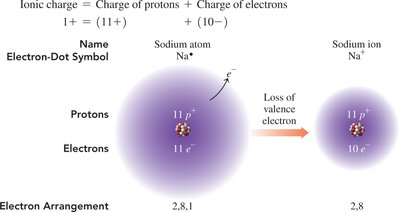
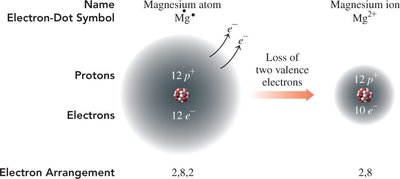
Metals in Groups 1A, 2A, and 3A have low ionization energies and readily lose electrons to achieve a stable electron configuration, often matching the nearest noble gas.
Example: Sodium (Na) loses one electron to form Na+.
Example: Magnesium (Mg) loses two electrons to form Mg2+.
Formation of Negative Ions (Anions)
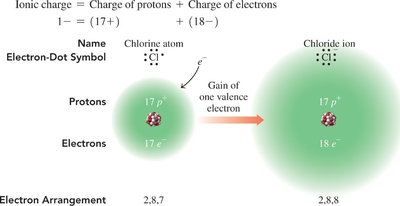
Nonmetals in Groups 5A, 6A, and 7A have high ionization energies and gain electrons to achieve a stable octet, forming anions.
Example: Chlorine (Cl) gains one electron to form Cl−.
Formulas and Names of Common Ions
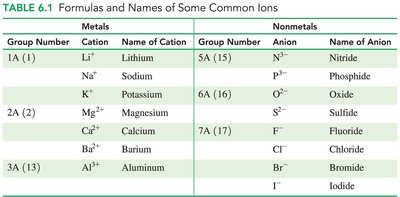
The periodic table group numbers help determine the charges of representative element ions. Common ions are listed below:
Group Number | Cation | Name of Cation | Group Number | Anion | Name of Anion |
|---|---|---|---|---|---|
1A (1) | Li+ | Lithium | 5A (15) | N3− | Nitride |
1A (1) | Na+ | Sodium | 6A (16) | O2− | Oxide |
2A (2) | Mg2+ | Magnesium | 6A (16) | S2− | Sulfide |
2A (2) | Ca2+ | Calcium | 7A (17) | F− | Fluoride |
3A (13) | Al3+ | Aluminum | 7A (17) | Cl− | Chloride |
7A (17) | Br− | Bromide | |||
7A (17) | I− | Iodide |
Monatomic Ions and Noble Gases
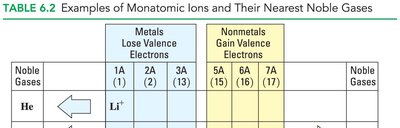
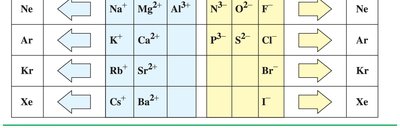
Monatomic ions achieve electron configurations similar to noble gases by losing or gaining electrons.
Noble Gas | Metals Lose Valence Electrons | Nonmetals Gain Valence Electrons | Noble Gas |
|---|---|---|---|
He | Li+ | He | |
Ne | Na+, Mg2+, Al3+ | N3−, O2−, F− | Ne |
Ar | K+, Ca2+ | P3−, S2−, Cl− | Ar |
Kr | Rb+, Sr2+ | Br− | Kr |
Xe | Cs+, Ba2+ | I− | Xe |
Health Relevance of Ions
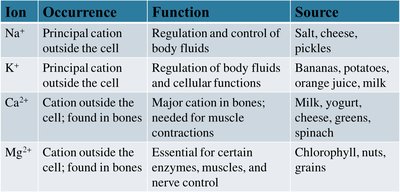
Ions play crucial roles in regulating body functions, including fluid balance, muscle contraction, and nerve transmission.
Ion | Occurrence | Function | Source |
|---|---|---|---|
Na+ | Principal cation outside the cell | Regulation and control of body fluids | Salt, cheese, pickles |
K+ | Principal cation outside the cell | Regulation of body fluids and cellular functions | Bananas, potatoes, orange juice, milk |
Ca2+ | Cation outside the cell; found in bones | Major cation in bones; needed for muscle contractions | Milk, yogurt, cheese, greens, spinach |
Mg2+ | Cation outside the cell; found in bones | Essential for certain enzymes, muscles, and nerve control | Chlorophyll, nuts, grains |
Writing Formulas for Ionic Compounds
Charge Balance in Ionic Compounds
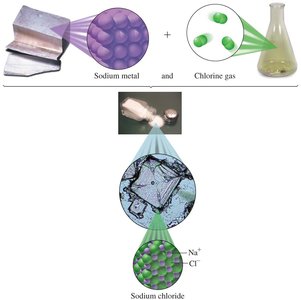
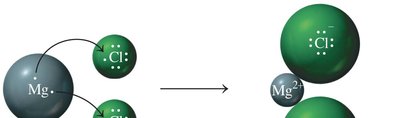
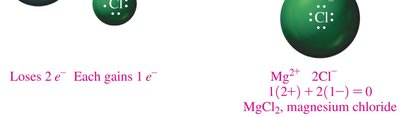
Ionic compounds consist of positive and negative ions held together by strong electrical attractions. The chemical formula must reflect charge balance, where the total positive charge equals the total negative charge.
Example: NaCl is formed from Na+ and Cl− ions.
Example: MgCl2 is formed from Mg2+ and two Cl− ions.
Subscripts in Formulas
Subscripts indicate the number of each ion needed to achieve charge balance in the compound.
Example: BaCl2 is formed from Ba2+ and two Cl− ions.
Naming Ionic Compounds
Rules for Naming Ionic Compounds
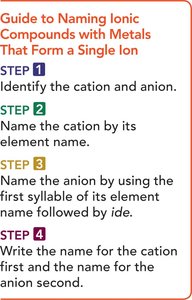
When naming ionic compounds:
The metal (cation) is named first, using its element name.
The nonmetal (anion) is named second, using the first syllable of its name plus the suffix -ide.
A space separates the names of the cation and anion.
Metals with Variable Charge
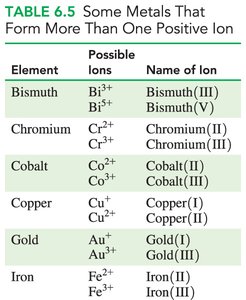
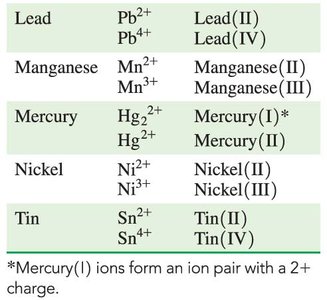
Transition metals can form more than one positive ion. The charge is indicated by a Roman numeral in parentheses after the metal name.
Element | Possible Ions | Name of Ion |
|---|---|---|
Iron | Fe2+, Fe3+ | Iron(II), Iron(III) |
Copper | Cu+, Cu2+ | Copper(I), Copper(II) |
Lead | Pb2+, Pb4+ | Lead(II), Lead(IV) |
Chromium | Cr2+, Cr3+ | Chromium(II), Chromium(III) |
Nickel | Ni2+, Ni3+ | Nickel(II), Nickel(III) |
Polyatomic Ions
Definition and Examples
Polyatomic ions are groups of atoms with an overall charge, often containing nonmetals and oxygen. Most are negatively charged, except ammonium (NH4+).
Common Polyatomic Ions: SO42− (sulfate), NO3− (nitrate), PO43− (phosphate), NH4+ (ammonium)
Naming and Writing Formulas with Polyatomic Ions
When naming compounds with polyatomic ions:
Name the metal or positive ion first.
Name the polyatomic ion second.
No prefixes are used.
Molecular Compounds: Sharing Electrons
Covalent Bonds and Molecular Compounds
Molecular compounds form when atoms of two or more nonmetals share electrons, creating covalent bonds. The number of covalent bonds a nonmetal forms is usually equal to the number of electrons it needs to achieve a stable electron arrangement.
Electron-Dot Formulas
Electron-dot formulas show the arrangement of valence electrons in molecules. For example, methane (CH4) and fluorine (F2) can be represented using electron-dot symbols.
Exceptions to the Octet Rule
Some elements do not follow the octet rule:
Hydrogen requires only two electrons.
Phosphorus, sulfur, chlorine, bromine, and iodine can have expanded octets (10 or 12 electrons).
Double and Triple Covalent Bonds
Double bonds occur when atoms share two pairs of electrons, and triple bonds occur when atoms share three pairs. These bonds are common in molecules like O2 (double bond) and N2 (triple bond).
Naming Molecular Compounds
Rules for naming covalent compounds:
The first nonmetal is named by its element name.
The second nonmetal is named using the first syllable plus -ide.
Prefixes indicate the number of atoms (mono-, di-, tri-, tetra-, etc.).
Electronegativity and Bond Polarity
Electronegativity
Electronegativity is the ability of an atom to attract shared electrons in a bond. It increases across a period and decreases down a group in the periodic table.
Bond Types Based on Electronegativity Difference
Nonpolar Covalent: Electronegativity difference 0–0.4; electrons shared equally.
Polar Covalent: Electronegativity difference 0.5–1.8; electrons shared unequally.
Ionic: Electronegativity difference >1.8; electron transfer occurs.
Shapes and Polarity of Molecules
VSEPR Theory and Molecular Geometry
The Valence Shell Electron-Pair Repulsion (VSEPR) theory predicts the shape of molecules based on the arrangement of electron groups around the central atom.
Linear: Two electron groups (CO2).
Trigonal Planar: Three electron groups (H2CO).
Bent: Two bonds and one or two lone pairs (SO2, H2O).
Tetrahedral: Four bonds (CH4).
Trigonal Pyramidal: Three bonds and one lone pair (NH3).
Polarity of Molecules
Molecules are polar if their dipoles do not cancel, resulting in a partial positive and negative end. Nonpolar molecules have dipoles that cancel or contain only nonpolar bonds.
Attractive Forces in Compounds
Types of Attractive Forces
Dipole–Dipole Attractions: Occur between polar molecules.
Hydrogen Bonds: Strong dipole attractions between H and F, O, or N.
Dispersion Forces: Weak attractions between nonpolar molecules due to temporary dipoles.
Ionic Bonds: Strongest attractive forces between ions in ionic compounds.
Melting Points and Attractive Forces
The strength of attractive forces affects melting points:
Dispersion forces: lowest melting points
Hydrogen bonds: higher melting points
Ionic bonds: highest melting points
Summary
Ionic and molecular compounds are distinguished by their bonding, structure, and properties. Understanding their formation, naming, and the forces between their particles is essential for chemistry and health sciences.
