 Back
BackIonic and Molecular Compounds: Structure, Naming, and Formulas
Study Guide - Smart Notes
 Tailored notes based on your materials, expanded with key definitions, examples, and context.
Ionic and Molecular Compounds
Types of Chemical Bonds
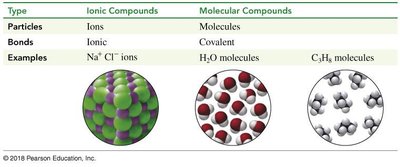
Chemical bonds are the forces that hold atoms together in compounds. The two main types are ionic bonds and covalent bonds. Ionic bonds involve the transfer of electrons from metals to nonmetals, forming ions, while covalent bonds involve the sharing of electrons between nonmetals to form molecules.
Ionic Compounds: Composed of positive and negative ions held together by electrostatic forces.
Molecular Compounds: Consist of molecules formed by atoms sharing electrons through covalent bonds.
The Octet Rule
The octet rule states that atoms tend to gain, lose, or share electrons to achieve a stable configuration of eight valence electrons, similar to noble gases. This rule explains the formation of both ionic and covalent bonds.
Ions: Formation and Properties
Formation of Ions
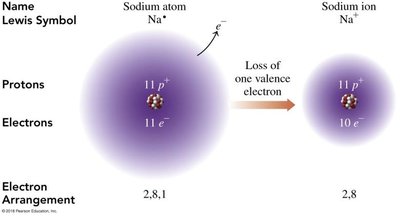
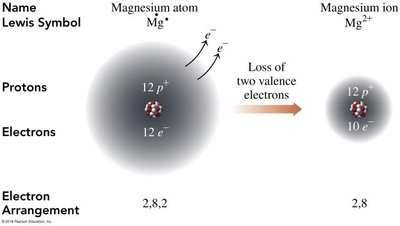
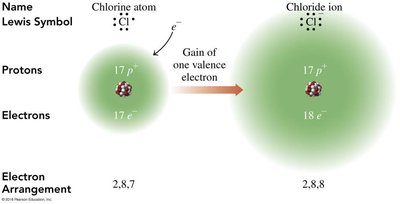
Ions are atoms or groups of atoms with a net electrical charge due to the loss or gain of electrons. Metals lose electrons to form cations (positive ions), while nonmetals gain electrons to form anions (negative ions).
Cations: Formed by metals losing valence electrons.
Anions: Formed by nonmetals gaining valence electrons.
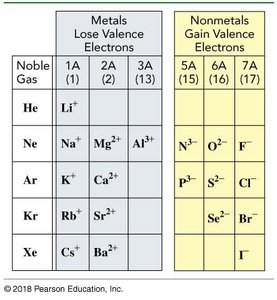
Determining Ionic Charges from the Periodic Table
The charge of an ion formed by a representative element can often be predicted from its group number:
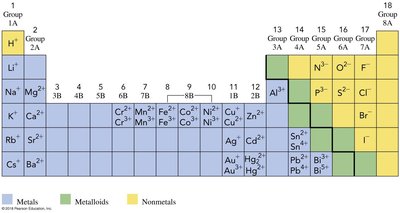
Group 1A: +1
Group 2A: +2
Group 3A: +3
Group 5A: -3
Group 6A: -2
Group 7A: -1
Writing and Naming Ionic Compounds
Formation of Ionic Compounds
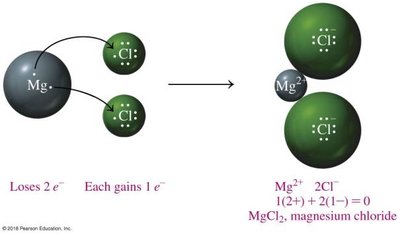
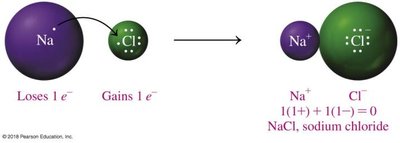
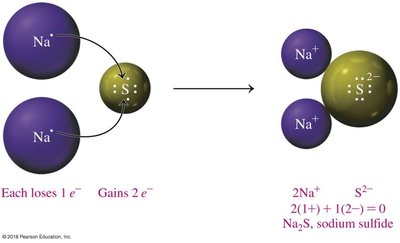
Ionic compounds form when electrons are transferred from metals to nonmetals, resulting in a strong electrostatic attraction between oppositely charged ions. The chemical formula represents the lowest whole-number ratio of ions that results in a neutral compound.
Always write the cation first, followed by the anion.
Use subscripts to indicate the number of each ion needed to balance the charges.
Naming Ionic Compounds
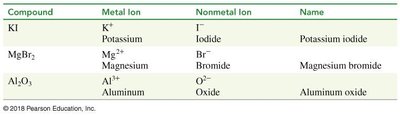
The name of an ionic compound consists of the name of the metal (cation) followed by the name of the nonmetal (anion) with its ending changed to "-ide." Subscripts are not included in the name.
Example: NaCl is named sodium chloride.
Example: MgCl2 is named magnesium chloride.
Metals with Variable Charges (Transition Metals)
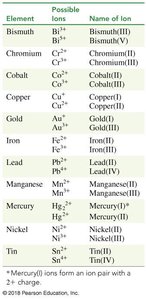
Many transition metals can form more than one type of positive ion. The charge is specified using a Roman numeral in parentheses after the metal's name.
Example: FeCl2 is iron(II) chloride; FeCl3 is iron(III) chloride.
Exceptions: Zn2+, Cd2+, and Ag+ have only one common charge.
Determining the Charge of Transition Metals in Compounds
To determine the charge of a transition metal in an ionic compound:
Calculate the total negative charge from the anion(s).
The total positive charge must balance the negative charge.
Assign the Roman numeral to the metal based on its charge.
Example: In MnF2, each F is -1, so Mn must be +2. The name is manganese(II) fluoride.
Periodic Table of Ions
The periodic table can be used to predict the charges of ions formed by main group elements and to identify common ions of transition metals.
Writing Formulas from Names
To write the formula for an ionic compound from its name:
Identify the cation and its charge.
Identify the anion and its charge.
Balance the charges so the total is zero.
Write the formula with the cation first, using subscripts as needed.
Polyatomic Ions
Definition and Common Polyatomic Ions
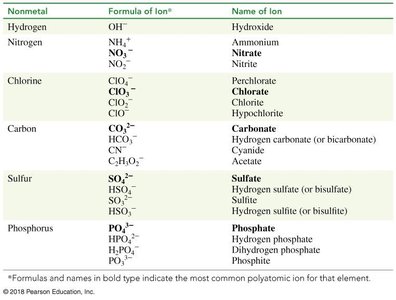
Polyatomic ions are groups of covalently bonded atoms that carry an overall charge. Most are anions, except for ammonium (NH4+).
Names ending in "-ate" have more oxygen atoms than those ending in "-ite."
Prefixes "per-" and "hypo-" indicate more or fewer oxygen atoms, respectively.
Examples:
ClO4-: Perchlorate
ClO3-: Chlorate
ClO2-: Chlorite
ClO-: Hypochlorite
Writing Formulas for Compounds with Polyatomic Ions
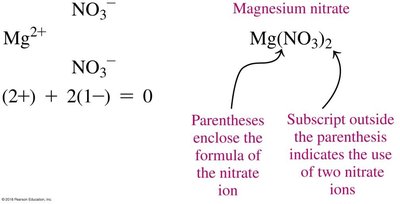
When writing formulas for compounds containing polyatomic ions, balance the total positive and negative charges. Use parentheses around the polyatomic ion if more than one is needed.
Example: Magnesium nitrate is Mg(NO3)2.
Naming Compounds with Polyatomic Ions
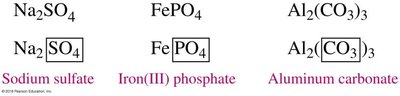
Follow the same rules as for simple ionic compounds: name the cation first, then the polyatomic ion. Recognition of polyatomic ions is essential for correct naming.
Example: Na2SO4 is sodium sulfate.
Example: FePO4 is iron(III) phosphate.
Summary Table: Key Concepts in Ionic and Molecular Compounds
Concept | Description |
|---|---|
Ionic Bond | Transfer of electrons from metal to nonmetal, forming ions |
Covalent Bond | Sharing of electrons between nonmetals |
Cation | Positively charged ion (metal loses electrons) |
Anion | Negatively charged ion (nonmetal gains electrons) |
Polyatomic Ion | Group of covalently bonded atoms with an overall charge |
Formula Unit | Lowest whole-number ratio of ions in an ionic compound |
Additional info: For further mastery, students should practice writing names and formulas for both simple and polyatomic ionic compounds, and memorize the most common polyatomic ions and their charges.
