 Back
BackIonic Compounds: Structure, Formation, and Nomenclature 3
Study Guide - Smart Notes
 Tailored notes based on your materials, expanded with key definitions, examples, and context.
3.1 Introduction to Bonding
Types of Chemical Bonds
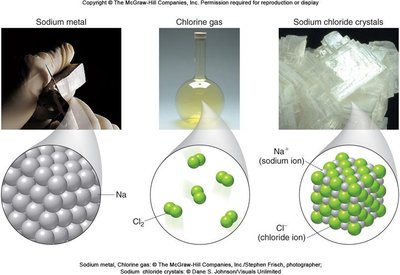
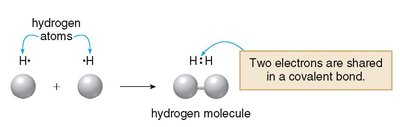
Chemical bonding involves the combination of atoms to achieve greater stability, typically by attaining the electron configuration of the nearest noble gas. There are two primary types of chemical bonds:
Ionic Bonds: Formed by the transfer of electrons from one atom (usually a metal) to another (usually a nonmetal), resulting in oppositely charged ions that attract each other.
Covalent Bonds: Formed by the sharing of electrons between two nonmetals or a metalloid and a nonmetal, resulting in the formation of molecules.
3.2 Ions
A. Cations and Anions
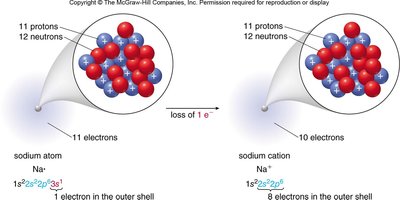
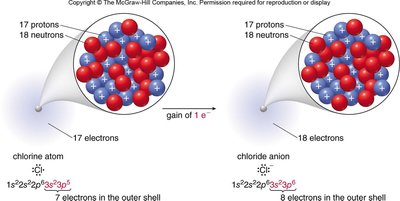
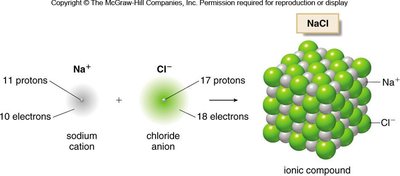
Ions are atoms or groups of atoms with a net electric charge due to the loss or gain of electrons. Ionic compounds are composed of cations (positively charged) and anions (negatively charged) held together by strong electrostatic forces.
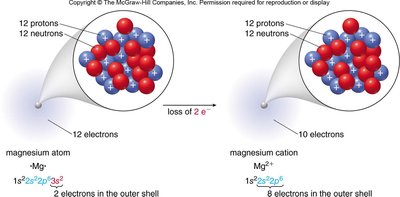
Cations: Positively charged ions formed when an atom loses one or more electrons. Metals typically form cations.
Anions: Negatively charged ions formed when an atom gains one or more electrons. Nonmetals typically form anions.
The Octet Rule
The octet rule states that main group elements are most stable when they possess eight electrons in their outer shell. Atoms gain or lose electrons to achieve a filled valence shell, forming ions with noble gas configurations.
B. Relating Group Number to Ionic Charge for Main Group Elements
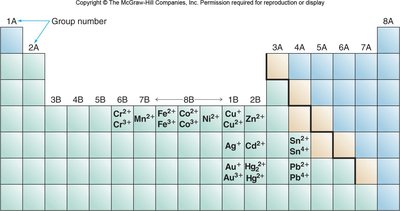
The periodic table group number helps predict the charge of ions formed by main group elements:
Groups 1A, 2A, 3A (Metals): Form cations with a charge equal to the group number.
Groups 6A, 7A (Nonmetals): Form anions with a charge equal to 8 minus the group number.


C. Metals with Variable Charge
Some transition metals and a few main group metals can form more than one type of cation with different charges. Their charge must be specified when naming compounds.
3.3 Ionic Compounds
Forming Ionic Compounds
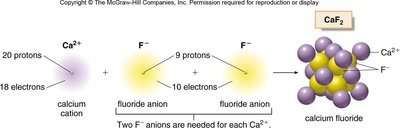
Ionic compounds are electrically neutral; the total positive charge of the cations equals the total negative charge of the anions. The formula of an ionic compound reflects the smallest whole-number ratio of ions needed to achieve neutrality.
Step 1: Identify the cation and anion, and their charges.
Step 2: Determine the ratio of ions needed for a net charge of zero.
Step 3: Write the formula with the cation first, followed by the anion. Use subscripts to indicate the number of each ion (omit the subscript if it is 1).
3.4 Naming Ionic Compounds
A. Naming Cations
Main Group Cations: Named after the element (e.g., Na+ is sodium, Ca2+ is calcium).
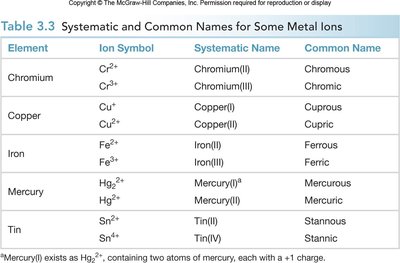
Variable Charge Metals: Use a Roman numeral in parentheses to indicate the charge (systematic name), or use the suffixes "-ous" (lower charge) and "-ic" (higher charge) for common names.
B. Naming Anions
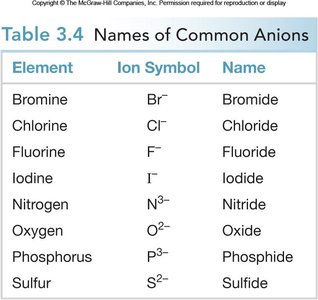
Anions are named by replacing the ending of the element name with "-ide" (e.g., Cl− is chloride, O2− is oxide).
C. Naming Compounds of Main Group Metals
Name the cation first, then the anion.
Do not specify the charge or the number of ions.
Examples: NaF is sodium fluoride, MgCl2 is magnesium chloride.
D. Naming Compounds of Metals with Variable Charge
Determine the charge on the metal cation based on the anion(s) present.
Name the cation with its charge (systematic) or with the appropriate suffix (common), then name the anion.
Example: CuCl2 is copper(II) chloride or cupric chloride.

E. Writing a Formula from the Name
Identify the cation and anion and their charges.
Balance the charges to write the correct formula.
Example: Tin(IV) oxide is SnO2.

3.5 Physical Properties of Ionic Compounds
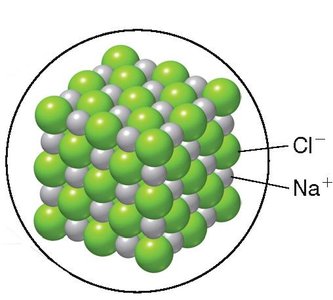
Ionic compounds are typically crystalline solids with high melting and boiling points. When dissolved in water, they dissociate into ions, making the solution conductive.
3.6 Polyatomic Ions
Definition and Examples
A polyatomic ion is a charged species composed of two or more atoms covalently bonded, acting as a single ion. Polyatomic ions can be cations or anions, but most are anions.
Writing Formulas for Ionic Compounds with Polyatomic Ions
If the cation and anion have equal charges, only one of each is needed (e.g., NaNO2, BaSO4).
If the charges are unequal, use subscripts to balance the total charge (e.g., Mg(OH)2).
Naming Ionic Compounds with Polyatomic Ions
Name the cation first, then the polyatomic anion.
Do not specify the charge or the number of ions.
Examples: NaHCO3 is sodium bicarbonate, Al2(SO4)3 is aluminum sulfate.
Summary Table: Systematic and Common Names for Some Metal Ions
Element | Ion Symbol | Systematic Name | Common Name |
|---|---|---|---|
Chromium | Cr2+ | Chromium(II) | Chromous |
Chromium | Cr3+ | Chromium(III) | Chromic |
Copper | Cu+ | Copper(I) | Cuprous |
Copper | Cu2+ | Copper(II) | Cupric |
Iron | Fe2+ | Iron(II) | Ferrous |
Iron | Fe3+ | Iron(III) | Ferric |
Mercury | Hg22+ | Mercury(I) | Mercurous |
Mercury | Hg2+ | Mercury(II) | Mercuric |
Tin | Sn2+ | Tin(II) | Stannous |
Tin | Sn4+ | Tin(IV) | Stannic |
Summary Table: Names of Common Anions
Element | Ion Symbol | Name |
|---|---|---|
Bromine | Br− | Bromide |
Chlorine | Cl− | Chloride |
Fluorine | F− | Fluoride |
Iodine | I− | Iodide |
Nitrogen | N3− | Nitride |
Oxygen | O2− | Oxide |
Phosphorus | P3− | Phosphide |
Sulfur | S2− | Sulfide |
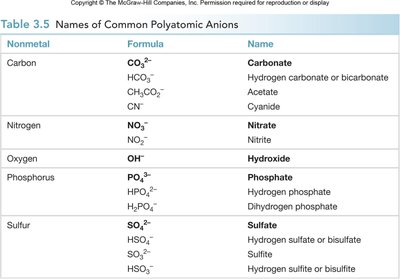
Summary Table: Names of Common Polyatomic Anions
Nonmetal | Formula | Name |
|---|---|---|
Carbon | CO32− | Carbonate |
Carbon | HCO3− | Hydrogen carbonate or bicarbonate |
Carbon | CH3CO2− | Acetate |
Carbon | CN− | Cyanide |
Nitrogen | NO3− | Nitrate |
Nitrogen | NO2− | Nitrite |
Oxygen | OH− | Hydroxide |
Phosphorus | PO43− | Phosphate |
Phosphorus | HPO42− | Hydrogen phosphate |
Phosphorus | H2PO4− | Dihydrogen phosphate |
Sulfur | SO42− | Sulfate |
Sulfur | HSO4− | Hydrogen sulfate or bisulfate |
Sulfur | SO32− | Sulfite |
Sulfur | HSO3− | Hydrogen sulfite or bisulfite |
Additional info: This guide covers the essential concepts of ionic bonding, ion formation, and the nomenclature of ionic compounds, including those with polyatomic ions, as outlined in a typical introductory chemistry curriculum.
