 Back
Ionic Compounds: Writing Formulas, Formula Units, and Naming
Study Guide - Smart Notes
 Tailored notes based on your materials, expanded with key definitions, examples, and context.
Writing Formulas for Ionic Compounds
Principles of Ionic Compound Formulas
Ionic compounds are composed of positively charged cations and negatively charged anions. The chemical formula for an ionic compound is always written to reflect a neutral overall charge, even though the compound consists of charged ions.
Neutrality Rule: The total positive charge must balance the total negative charge in the formula.
Example: For potassium fluoride (K+ and F-): Formula: KF
Example: For calcium iodide (Ca2+ and I-): Formula: CaI2
Example: For magnesium phosphate (Mg2+ and PO43-): Formula: Mg3(PO4)2
Example: For ammonium sulfate (NH4+ and SO42-): Formula: (NH4)2SO4
Formula Units
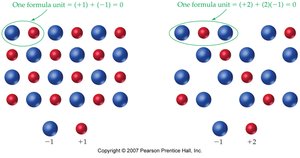
The smallest representative particle of an ionic compound is called a formula unit. Unlike molecules, formula units are the simplest ratio of ions that results in a neutral compound.
Definition: A formula unit is the lowest whole-number ratio of ions in an ionic compound.
Key Point: There is no such thing as a single neutral particle of an ionic compound; the formula unit is used to describe the composition.
Practice: Counting Particles in Formula Units
Examples
KNO3: 1 K+ ion, 1 NO3- ion → 2 particles per formula unit
NH4Cl: 1 NH4+ ion, 1 Cl- ion → 2 particles per formula unit
Ba(NO3)2: 1 Ba2+ ion, 2 NO3- ions → 3 particles per formula unit
Li3PO4: 3 Li+ ions, 1 PO43- ion → 4 particles per formula unit
Naming Ionic Compounds
Rules for Naming
To name an ionic compound, first name the cation (positive ion), then the anion (negative ion). For transition metals, indicate the charge with Roman numerals in parentheses.
SrBr2: Strontium bromide
Cs2HPO4: Cesium hydrogen phosphate
(NH4)2SO4: Ammonium sulfate
Na2S: Sodium sulfide
Cu2O: Copper(I) oxide
Fe2O3: Iron(III) oxide
Writing Formulas from Names
Copper(II) sulfate: CuSO4
Silver nitrate: AgNO3
Lithium oxide: Li2O
Iron(II) sulfide: FeS
Potassium dihydrogen phosphate: KH2PO4
Introduction to Acids and Bases
Acids in Water
When an acid dissolves in water, it reacts to form hydronium ions (H3O+).
General Reaction:
Bases in Water
Metal hydroxides dissolve in water to yield aqueous hydroxide ions (OH-). Other bases, such as ammonia (NH3), react with water to produce hydroxide ions.
Metal Hydroxide Example:
Ammonia Example:
