 Back
Key Math Skills for Chemistry: Foundations for GOB Chemistry
Study Guide - Smart Notes
 Tailored notes based on your materials, expanded with key definitions, examples, and context.
Chapter 1: Chemistry in Our Lives
Introduction to Chemistry and Its Relevance
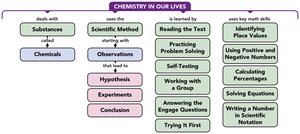
Chemistry is the study of substances, their properties, and the changes they undergo. It is foundational to understanding the world around us and is essential for students in General, Organic, and Biological (GOB) Chemistry courses. Mastery of basic math skills is crucial for success in chemistry, as calculations, measurements, and data interpretation are integral to the subject.
Key Math Skills for Chemistry
Identifying Place Values
Understanding place values is essential for reading and interpreting measurements in chemistry. Each digit in a number has a specific value depending on its position relative to the decimal point.
Whole Numbers: Each digit represents a value based on its position (ones, tens, hundreds, etc.). Example: In 2518 g, the '2' is in the thousands place, '5' in the hundreds, '1' in the tens, and '8' in the ones.
Decimal Numbers: Digits to the right of the decimal point represent tenths, hundredths, thousandths, etc. Example: In 6.407 g, '4' is in the tenths, '0' in the hundredths, and '7' in the thousandths place.

Example: For the number 15.24 g, '1' is in the tens, '5' in the ones, '2' in the tenths, and '4' in the hundredths place.
Using Positive and Negative Numbers in Calculations
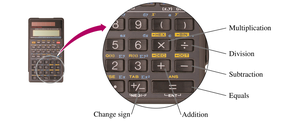
Positive and negative numbers are used to represent quantities above or below a reference point, such as temperature changes or energy changes in chemical reactions.
Positive Numbers: Greater than zero, often written without a sign (e.g., 8 or +8).
Negative Numbers: Less than zero, always written with a minus sign (e.g., -5).

Rules for Operations with Positive and Negative Numbers
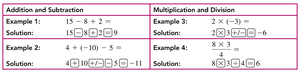
Multiplication/Division: The product or quotient of two numbers with the same sign is positive; with different signs, it is negative.
Addition: Add numbers with the same sign; for different signs, subtract the smaller absolute value from the larger and keep the sign of the larger.
Subtraction: Change the sign of the number being subtracted and add.
Calculating Percentages
Percentages are used in chemistry to express concentrations, yields, and composition. A percentage (%) represents the number of parts per hundred.
Formula:
Example: If an aspirin tablet contains 325 mg of aspirin and has a total mass of 545 mg, the percentage of aspirin is .
Solving Equations
Solving equations is a fundamental skill for rearranging formulas and finding unknown values in chemistry problems.
Steps:
Isolate the variable by performing inverse operations on both sides of the equation.
Check your answer by substituting it back into the original equation.
Example: To solve , subtract 8 from both sides (), then divide by 2 ().

Interpreting Graphs
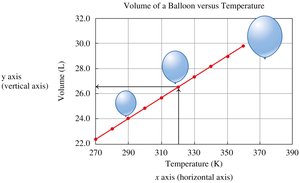
Graphs are used to visually represent relationships between variables in chemistry, such as temperature and volume. Understanding axes, labels, and trends is essential for data analysis.
Direct Relationship: As one variable increases, the other also increases (e.g., volume of a gas increases with temperature).
Axes: The vertical (y) axis typically represents the dependent variable, and the horizontal (x) axis represents the independent variable.
Scientific Notation
Scientific notation is used to express very large or very small numbers in a compact form, which is common in chemistry for measurements such as atomic sizes or Avogadro's number.
Format: , where and is an integer.
Example: The width of a human hair, 0.000008 m, is written as m.
Example: The number of hairs on a human scalp, 100,000, is written as .

Writing Numbers in Scientific Notation
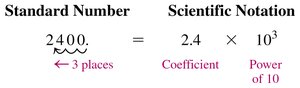
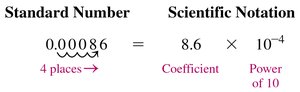
Move the decimal point to create a coefficient between 1 and 10. The number of places moved determines the exponent on 10.
Calculator Use with Scientific Notation
Many calculators use the EE or EXP key to enter numbers in scientific notation. For example, 4 × 10⁶ is entered as 4 EE 6.

Tables: Powers of 10 and Scientific Notation
Tables are often used to summarize powers of 10 and to compare standard numbers with their scientific notation equivalents.
Standard Number | Scientific Notation |
|---|---|
2,400 | 2.4 × 10³ |
0.00086 | 8.6 × 10⁻⁴ |
100,000 | 1 × 10⁵ |
0.000008 | 8 × 10⁻⁶ |
Additional info: See textbook for more examples. |
Summary
Mastering these key math skills—identifying place values, using positive and negative numbers, calculating percentages, solving equations, interpreting graphs, and using scientific notation—is essential for success in GOB Chemistry. These foundational skills enable students to accurately perform calculations, analyze data, and understand chemical concepts throughout the course.
