 Back
Mass and Mole Relationships, Energy, and Solution Calculations in GOB Chemistry
Study Guide - Smart Notes
 Tailored notes based on your materials, expanded with key definitions, examples, and context.
Mass and Mole Relationships
Mole Concept and Molar Mass
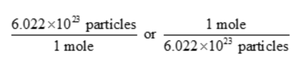
The mole is a fundamental unit in chemistry used to count particles such as atoms, molecules, or ions. One mole of any substance contains Avogadro’s number of particles, which is $6.022 \times 10^{23}$.
Molar mass is the mass of one mole of a substance, expressed in grams.
It is numerically equal to the molecular (formula) weight of the substance in grams.
Avogadro’s number ($6.022 \times 10^{23}$) links the number of particles to the amount in moles.

Calculating Molar Mass
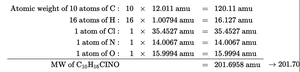
Molar mass is determined by summing the atomic masses of all atoms in a chemical formula.
For example, diethyl ether (C4H10O):
C: $4 \times 12.01 = 48.04$
H: $10 \times 1.008 = 10.08$
O: $1 \times 16.00 = 16.00$
Molar mass = 74.12 g/mol
To convert moles to grams: $\text{mass (g)} = \text{moles} \times \text{molar mass (g/mol)}$
To convert grams to moles: $\text{moles} = \frac{\text{mass (g)}}{\text{molar mass (g/mol)}}$
Stoichiometry and Limiting Reactant
Stoichiometry involves calculating the quantities of reactants and products in a chemical reaction using balanced equations.
Limiting reactant is the reactant that is completely consumed first, thus limiting the amount of product formed.
Example: If you have 14 slices of bread, 15 slices of ham, and 20 slices of cheese, and each sandwich requires 2 bread, 3 ham, and 1 cheese, ham is the limiting reactant.
Percent Yield
Percent yield measures the efficiency of a reaction by comparing the actual yield to the theoretical yield.
Formula: $\text{Percent Yield} = \frac{\text{Actual Yield}}{\text{Theoretical Yield}} \times 100$
Example: If 15.8 g of water is produced but the theoretical yield is 23.6 g, percent yield is $\frac{15.8}{23.6} \times 100 = 66.9\%$
Chemical Reactions: Energy, Rate, and Equilibrium
Energy Changes in Reactions
Chemical reactions involve energy changes, often in the form of heat.
Bond dissociation energy is the energy required to break a bond in a molecule.
Endothermic reactions absorb heat (bond breaking).
Exothermic reactions release heat (bond formation).
Law of conservation of energy: Energy cannot be created or destroyed.
Heat of reaction is the difference between energy absorbed and released.
Entropy and Free Energy
Entropy change (ΔS): Positive if disorder increases; negative if disorder decreases.
Exergonic processes release free energy and are spontaneous.
Endergonic processes require free energy and are nonspontaneous.
Le Châtelier’s Principle
When a stress is applied to a system at equilibrium, the system shifts to relieve the stress.
Reaction Rate and Rate Law
Rate law example: $\text{rate} = k[A]^3[B]^2$
If concentrations of A and B are doubled, the rate increases by a factor of 32.
Solutions and Concentration Calculations
Solution Concentration
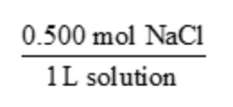
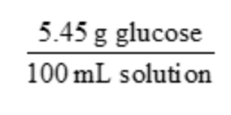
Concentration expresses the amount of solute in a given volume of solution.
Molarity (M): $\text{M} = \frac{\text{moles of solute}}{\text{liters of solution}}$
Percent (m/v): $\frac{\text{grams of solute}}{100 \text{ mL solution}}$
Percent (v/v): $\frac{\text{volume of solute}}{100 \text{ mL solution}}$
Solution Preparation and Dilution
To dilute a solution: $M_1V_1 = M_2V_2$
Example: To prepare 75.00 mL of 1.25 M solution from 4.00 M stock, $V_1 = \frac{1.25 \times 75.00}{4.00} = 23.4$ mL
Mass and Volume Calculations in Solutions
To find mass of solute: $\text{mass} = \text{moles} \times \text{molar mass}$
To find volume of solute in a percent (v/v) solution: $\text{volume} = \text{percent} \times \text{total volume}$
Additional info:
All equations are provided in LaTeX format for clarity.
Images included are directly relevant to the explanation of molar mass, Avogadro’s number, and solution concentration.
