 Back
Matter and Energy: Classification, States, and Properties
Study Guide - Smart Notes
 Tailored notes based on your materials, expanded with key definitions, examples, and context.
Ch.3 Matter and Energy
Classification of Matter
Chemistry is the study of matter and the changes it undergoes. Matter is anything that occupies space and has mass. It can be classified into three main types:
Element: The simplest type of matter, composed of one kind of atom. Examples include gold (Au) and oxygen (O2).
Compound: Matter composed of two or more different elements that are chemically bonded together, such as water (H2O) or carbon dioxide (CO2).
Mixture: Matter composed of elements and/or compounds that are physically mixed together but not chemically bonded. Mixtures can be homogeneous (uniform composition, e.g., air, saline solution) or heterogeneous (variable composition, e.g., salad, concrete).
Key Points:
Pure substances include elements and compounds.
Mixtures can be separated by physical means, while compounds require chemical means for separation.
Example: Classifying substances such as ammonia (NH3), gold bar, orange juice, wine, and saline solution helps reinforce the distinction between elements, compounds, and mixtures.
States of Matter
Matter exists in three primary states: solid, liquid, and gas. Each state has distinct physical properties related to particle arrangement, compressibility, and viscosity.
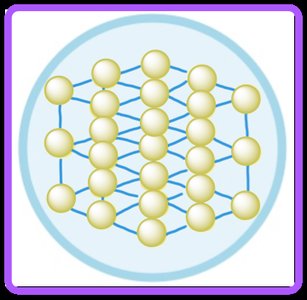
Solid: Maintains a fixed shape and volume, is not easily compressible, and has low viscosity. Particles are closely packed in a regular pattern.
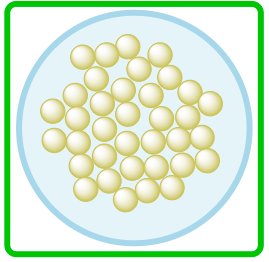
Liquid: Assumes the shape of its container but not its volume, is slightly compressible, and has moderate viscosity. Particles are close but can move past each other.
Gas: Assumes both the shape and volume of its container, is highly compressible, and has low viscosity. Particles are far apart and move freely.
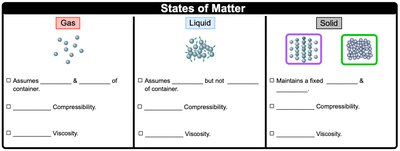
Additional info: Compressibility refers to the ability to decrease in volume under pressure, and viscosity is the resistance to flow.
Physical and Chemical Changes
Changes in matter can be classified as physical or chemical:
Physical Change: Alters the physical state or appearance without changing the chemical composition (e.g., melting, boiling, dissolving).
Chemical Change: Alters the chemical composition, resulting in new substances with different properties (e.g., burning, rusting, reacting with acids).
Reversible changes include phase changes and dissolving, while irreversible changes are typically chemical reactions.
Chemical and Physical Properties
Chemical properties describe a substance's ability to undergo chemical changes (e.g., flammability, reactivity, toxicity, radioactivity). Physical properties can be observed without changing the substance's identity (e.g., color, density, melting point, boiling point, mass, volume).
Example of chemical property: Hydrogen gas reacts explosively with oxygen.
Example of physical property: Mercury is a silvery liquid at 25ºC.


Temperature and Heat
Energy is the capacity to do work or produce heat. Thermal energy is the sum of kinetic and potential energies of all atoms in an object. Temperature measures the average kinetic energy, while heat is the flow of thermal energy from a hotter object to a cooler one.
Temperature units: Celsius (ºC), Fahrenheit (ºF), Kelvin (K).
Temperature conversions:



Nature of Energy and Energy Conversion
Thermochemistry studies the energy changes associated with chemical reactions and physical changes. The SI unit for energy is the joule (J).
1 calorie (cal) = 4.184 J
1 Calorie (Cal) = 4184 J
1 kilowatt-hour (kWh) = 3.60 × 10⁶ J
Energy can be classified as:
Kinetic energy: Energy of motion
Potential energy: Energy due to position or composition
Chemical energy: Stored in chemical bonds
Thermal energy: Related to temperature
Heat Capacity
Heat capacity (C): The amount of heat required to change the temperature of a substance. Specific heat capacity (c): The amount of heat required to change the temperature of 1 g of a substance by 1 K. Molar heat capacity: The amount of heat required to change the temperature of 1 mole of a substance by 1 K.
Formula:
q = heat (J), m = mass (g), c = specific heat (J/g·ºC), = temperature change (ºC)
Heating and Cooling Curves
Heating and cooling curves graphically represent the amount of heat absorbed or released during phase changes. Plateaus on the curve correspond to phase changes (e.g., melting, boiling), where temperature remains constant as energy is used to break or form intermolecular forces.
Specific heat of ice: 2.09 J/g·ºC
Specific heat of water: 4.184 J/g·ºC
Specific heat of steam: 1.84 J/g·ºC
ΔH fusion (melting): 334 J/g
ΔH vaporization (boiling): 2260 J/g
Example: Calculating the energy required to convert a substance from one phase to another involves using the specific heat and enthalpy values for each step.
