 Back
Matter and Energy: Classification, States, Properties, and Changes
Study Guide - Smart Notes
 Tailored notes based on your materials, expanded with key definitions, examples, and context.
Classification of Matter
Types of Matter
Matter is anything that occupies space and has mass. It is classified based on its composition and properties:
Element: The simplest type of matter, composed of one kind of atom. Examples include gold (Au) and oxygen (O2).
Compound: Matter composed of two or more different elements chemically bonded together. Examples include water (H2O) and ammonia (NH3).
Mixture: Matter composed of elements and/or compounds physically mixed together. Mixtures can be homogeneous (uniform composition, e.g., air, saline solution) or heterogeneous (variable composition, e.g., trail mix, salsa).
Key Point: Pure substances (elements and compounds) have a fixed composition, while mixtures have variable composition and can be separated by physical means.
Examples and Applications
Electrolyte water and crystalline sugar are pure substances.
Milk is a homogeneous mixture.
Concrete is a heterogeneous mixture.
States of Matter
Physical States and Their Properties
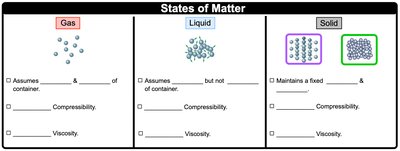
Substances can exist in three main states: solid, liquid, and gas. Each state has distinct physical properties related to shape, volume, compressibility, and viscosity.
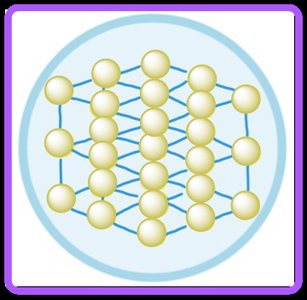
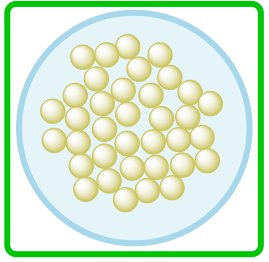
Solid: Maintains a fixed shape and volume. Solids are not compressible and have high viscosity.
Liquid: Assumes the shape but not the volume of its container. Liquids are slightly compressible and have moderate viscosity.
Gas: Assumes both the shape and volume of its container. Gases are highly compressible and have low viscosity.
Compressibility: The capacity to decrease in size by increasing pressure. Viscosity: The resistance to flow or to change in shape.
Example: If a substance's volume does not change when pressure is quadrupled, it is likely a solid.
Physical and Chemical Changes
Physical Changes
Physical changes alter the physical state or appearance of a substance without changing its composition. Examples include melting, boiling, dissolving, and tearing.
Reversible: Most physical changes, such as phase changes and dissolving, are reversible.
Example: Dissolving sugar in water is a physical change.
Chemical Changes
Chemical changes involve a change in chemical composition, resulting in new substances with new chemical bonds. Examples include burning, rusting, and cooking.
Irreversible: Most chemical changes are irreversible.
Example: Cooking an egg or burning wood are chemical changes.
Chemical and Physical Properties
Chemical Properties
Chemical properties describe how a substance reacts with other substances, forming new products. These are observed during chemical reactions.
Example: Hydrogen gas reacts explosively with oxygen gas.
Other examples: Radioactivity, reactivity with acids, rusting.
Physical Properties
Physical properties can be measured or observed without changing the chemical structure of a substance. These include color, density, melting point, boiling point, and state at room temperature.
Example: Mercury is a silvery liquid at 25ºC.
Other examples: Brittleness, density, color, solubility.
Temperature and Energy
Energy and Temperature
Energy is the capacity to do work or produce heat. Thermal energy is the sum of kinetic and potential energies of all atoms in an object. Temperature is the average kinetic energy, while heat is the flow of thermal energy from a higher to a lower temperature.
Temperature Units: Celsius (ºC), Fahrenheit (ºF), Kelvin (K).
Conversion formulas:
Nature of Energy and Heat Capacity
Types of Energy
Energy is classified as:
Potential Energy: Energy due to position or composition.
Kinetic Energy: Energy due to motion.
Chemical Energy: Energy stored in chemical bonds.
Thermal Energy: Energy generated by the motion of atoms.
Heat Capacity
Heat capacity is the amount of heat required to change the temperature of a substance. Specific heat capacity is the heat required to change the temperature of 1 g of a substance by 1 K. Molar heat capacity is the heat required to change the temperature of 1 mole of a substance by 1 K.
Specific Heat Formula:
Where: = heat (J) = mass (g) = specific heat capacity (J/g·ºC) = change in temperature (ºC)
Heating and Cooling Curves
Phase Changes and Energy
Heating and cooling curves represent the amount of heat absorbed or released during phase changes. Key values include:
Specific heat of ice: 2.09 J/g·ºC
ΔH fusion (melting): 334 J/g
Specific heat of water: 4.184 J/g·ºC
ΔH vaporization: 2260 J/g
Specific heat of steam: 1.84 J/g·ºC
Example: To calculate the energy required for a phase change, use the specific heat and enthalpy values for the relevant state and transition.
*Additional info: Academic context and formulas were expanded for completeness and clarity. Images included only where directly relevant to the explanation of states of matter.*
