 Back
BackMental Wellbeing: Stress, Anxiety, and Phobia – A Comparative Study Guide
Study Guide - Smart Notes
 Tailored notes based on your materials, expanded with key definitions, examples, and context.
Mental Wellbeing: Stress, Anxiety, and Phobia
Introduction
Mental wellbeing is a dynamic state influenced by a range of internal and external factors. Understanding the distinctions and relationships between stress, anxiety, and phobia is essential for recognizing mental health challenges and applying appropriate interventions. This section provides a comparative overview of these concepts, highlighting their characteristics, causes, and implications for mental health.
Comparing Stress, Anxiety, and Phobia
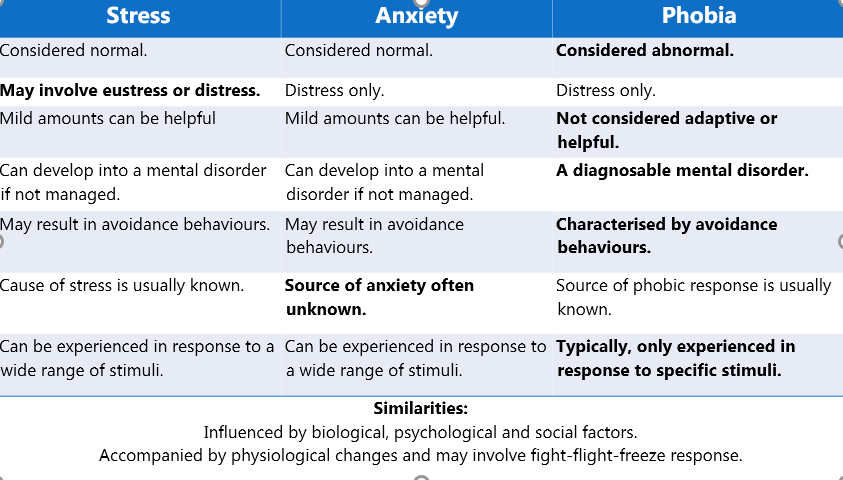
The following table summarizes the key differences and similarities between stress, anxiety, and phobia. These distinctions are crucial for identifying mental health conditions and understanding their management.
Stress | Anxiety | Phobia |
|---|---|---|
Considered normal. | Considered normal. | Considered abnormal. |
May involve eustress or distress. | Distress only. | Distress only. |
Mild amounts can be helpful. | Mild amounts can be helpful. | Not considered adaptive or helpful. |
Can develop into a mental disorder if not managed. | Can develop into a mental disorder if not managed. | A diagnosable mental disorder. |
May result in avoidance behaviours. | May result in avoidance behaviours. | Characterised by avoidance behaviours. |
Cause of stress is usually known. | Source of anxiety often unknown. | Source of phobic response is usually known. |
Can be experienced in response to a wide range of stimuli. | Can be experienced in response to a wide range of stimuli. | Typically, only experienced in response to specific stimuli. |
Similarities: Influenced by biological, psychological and social factors. Accompanied by physiological changes and may involve fight-flight-freeze response. | ||
Key Definitions
Stress: A normal response to perceived challenges or threats, which can be positive (eustress) or negative (distress). Mild stress can enhance performance, but chronic stress may lead to mental health issues.
Anxiety: A feeling of worry or unease, typically about an uncertain outcome. While normal in small amounts, excessive anxiety can interfere with daily functioning and may develop into an anxiety disorder.
Phobia: An intense, irrational fear of a specific object or situation, leading to avoidance behaviours. Phobias are considered mental disorders when they significantly impair functioning.
Examples and Applications
Stress Example: Preparing for an important exam may cause stress, motivating a student to study harder.
Anxiety Example: Feeling anxious before giving a public speech, even if there is no immediate threat.
Phobia Example: Avoiding elevators due to an intense, irrational fear of being trapped (claustrophobia), even when the risk is minimal.
Academic Context
Biopsychosocial Model: All three conditions are influenced by a combination of biological (e.g., genetics, neurotransmitter function), psychological (e.g., thought patterns, coping skills), and social (e.g., support networks, cultural factors) elements.
Fight-Flight-Freeze Response: This physiological reaction is common to stress, anxiety, and phobia, preparing the body to respond to perceived threats.
Additional info: Understanding these distinctions helps in identifying appropriate interventions, such as cognitive behavioural therapy for phobias, stress management techniques, and anxiety reduction strategies.
