 Back
Mini-Textbook Study Notes: Introduction to Organic Chemistry and Hydrocarbons
Study Guide - Smart Notes
 Tailored notes based on your materials, expanded with key definitions, examples, and context.
Organic Compounds: Introduction and Properties
Definition and Characteristics
Organic chemistry is the study of carbon compounds, which are essential to life and found in many everyday products. Organic compounds always contain carbon and hydrogen, and may also include other nonmetals such as oxygen, sulfur, nitrogen, phosphorus, or halogens. They are organized by functional groups, which determine their physical and chemical properties.
Organic compounds are typically covalent, have low melting and boiling points, are flammable, and are not soluble in water.
Examples include gasoline, medicines, shampoos, plastics, and perfumes.
Vegetable oil is an organic compound and is not soluble in water.
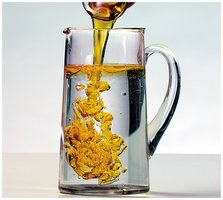
Comparison: Organic vs. Inorganic Compounds
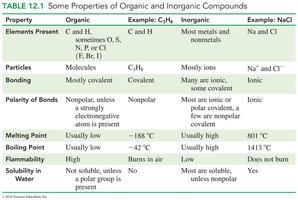
Inorganic compounds often have high melting and boiling points, are usually soluble in water if ionic, and most do not burn in air. For example, propane (C3H8) is organic, while sodium chloride (NaCl) is inorganic.
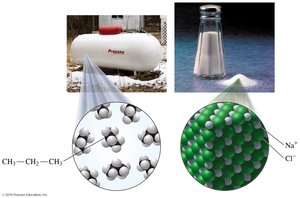
Property | Organic | Inorganic |
|---|---|---|
Elements Present | C and H, sometimes O, S, N, P, or Cl | Most metals and nonmetals |
Bonding | Mostly covalent | Mostly ionic |
Melting Point | Usually low | Usually high |
Flammability | High | Low |
Solubility in Water | Not soluble | Most are soluble |
Hydrocarbons: Structure and Types
Definition and Basic Structure
Hydrocarbons are organic compounds containing only carbon and hydrogen. Each carbon atom forms four bonds, and saturated hydrocarbons have only single bonds. Methane (CH4) is the simplest hydrocarbon, with a tetrahedral shape and bond angles of 109°.
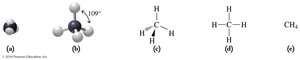
Structural Representations
Organic compounds can be represented in several ways:
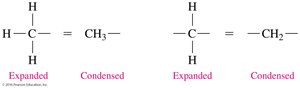
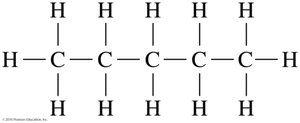
Expanded structural formula: Shows all atoms and bonds.
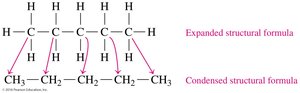
Condensed structural formula: Groups each carbon with its attached hydrogens.
Line-angle structural formula: Uses zigzag lines; ends and corners represent carbon atoms.
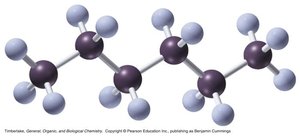
Example: Pentane Structural Formulas
Pentane (C5H12) can be drawn in expanded, condensed, and line-angle forms:
Step 1: Draw the carbon chain.
Step 2: Add hydrogen atoms for expanded formula.
Step 3: Group hydrogens with carbons for condensed formula.
Step 4: Draw zigzag line for line-angle formula.

Alkanes: Nomenclature and Structure
IUPAC Naming System
Alkanes are saturated hydrocarbons with only single bonds. They are named using the IUPAC system, with names ending in "-ane" and prefixes indicating the number of carbons: meth (1), eth (2), prop (3), but (4), pent (5), hex (6), hept (7), oct (8), non (9), dec (10).
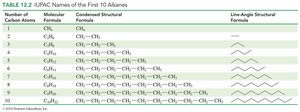
Number of Carbons | Name | Formula |
|---|---|---|
1 | Methane | CH4 |
2 | Ethane | C2H6 |
3 | Propane | C3H8 |
4 | Butane | C4H10 |
5 | Pentane | C5H12 |
6 | Hexane | C6H14 |
7 | Heptane | C7H16 |
8 | Octane | C8H18 |
9 | Nonane | C9H20 |
10 | Decane | C10H22 |
Conformations of Alkanes
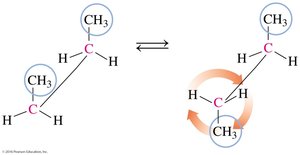
Alkanes can rotate about their single C–C bonds, resulting in different conformations. This flexibility allows for various spatial arrangements of the attached groups.
Structural Isomers
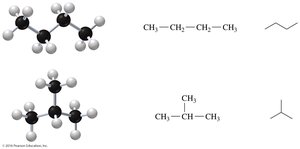
Structural isomers have the same molecular formula but different arrangements of atoms. For example, butane (C4H10) has both straight-chain and branched-chain isomers.
Cycloalkanes: Structure and Naming
Definition and Properties
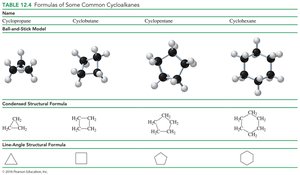
Cycloalkanes are cyclic alkanes with two fewer hydrogen atoms than their open-chain counterparts. They are named by adding the prefix "cyclo" to the alkane name.
Name | Ball-and-Stick Model | Condensed Formula | Line-Angle Formula |
|---|---|---|---|
Cyclopropane | Triangle | C3H6 | △ |
Cyclobutane | Square | C4H8 | □ |
Cyclopentane | Pentagon | C5H10 | ⬟ |
Cyclohexane | Hexagon | C6H12 | ⬢ |
Alkanes with Substituents
Substituents and Alkyl Groups
Branched-chain alkanes have side groups called substituents attached to the main carbon chain. Substituents include alkyl groups (carbon branches) and halo groups (halogen atoms).
Alkyl groups are named with an "-yl" ending (e.g., methyl, ethyl).
Halo substituents are named as fluoro, chloro, bromo, or iodo.
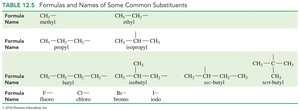
Formula | Name |
|---|---|
CH3- | methyl |
CH3CH2- | ethyl |
CH3CH2CH2- | propyl |
Cl- | chloro |
Br- | bromo |
F- | fluoro |
I- | iodo |
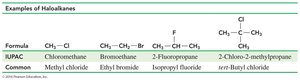
Naming Alkanes with Substituents
In the IUPAC system:
The longest chain is named as the parent.
Branches are named using their alkyl or halo names.
Number the chain from the end nearest the first substituent.
List branches in alphabetical order, separating numbers with commas and names with dashes.
Example: 2-chloro-3-methylpentane
Naming Cycloalkanes with Substituents
When a single substituent is attached to a cycloalkane, its name is placed in front of the cycloalkane name (e.g., ethylcyclohexane).
Structural Isomers of Pentane
Isomerism in Alkanes
Pentane (C5H12) has three structural isomers, each with a different arrangement of carbon atoms:
n-pentane: straight chain
isopentane: one branch
neopentane: two branches
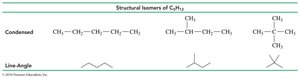
Summary: Organic chemistry focuses on carbon compounds, their structures, properties, and nomenclature. Understanding the differences between organic and inorganic compounds, the structural representations, and the naming conventions for alkanes and their derivatives is foundational for further study in GOB Chemistry.
