 Back
Modern Materials: Structure and Classification of Solids, Alloys, Polymers, Ceramics, and Composites
Study Guide - Smart Notes
 Tailored notes based on your materials, expanded with key definitions, examples, and context.
Modern Materials
Classification and Structure of Solids
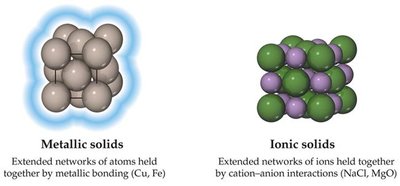
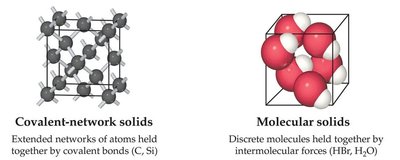
Solids are classified based on the nature of their bonding and structural organization. Understanding these classifications is fundamental to materials chemistry and engineering applications.
Metallic Solids: Held together by a 'sea' of collectively shared electrons, resulting in properties such as conductivity, ductility, and malleability.
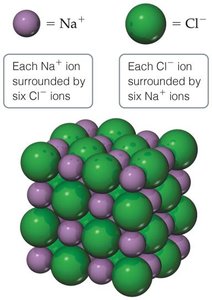
Ionic Solids: Composed of sets of cations and anions mutually attracted to one another, forming well-defined crystalline structures.
Covalent-Network Solids: Joined by an extensive network of covalent bonds, resulting in hard, often brittle materials.
Molecular Solids: Discrete molecules held together by weak intermolecular forces.
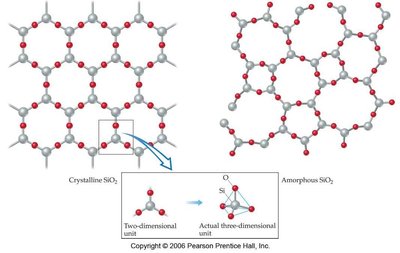
Crystalline solids have a regular repeating pattern of atoms, while amorphous solids lack such order.
Metallic Bonding
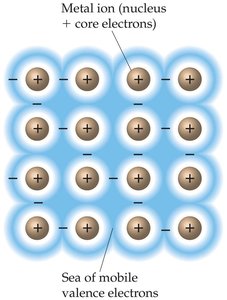
Metallic bonding is described by the electron-sea model, where metal cations are suspended in a sea of mobile valence electrons. This model explains the unique properties of metals.
Electrical and thermal conductivity: Due to free-moving electrons.
Ductility and malleability: Atoms can slide past each other without breaking bonds.
Alloys: Types and Properties
Alloys are metallic substances composed of two or more elements, classified as ferrous (iron-containing) or non-ferrous. Alloying alters mechanical and physical properties, often increasing strength and hardness but decreasing ductility.
Substitutional alloys: Metal atoms replaced by other metal atoms.
Interstitial alloys: Non-metal atoms inserted into holes in the metal structure.
Heterogeneous alloys: Components not dispersed uniformly.
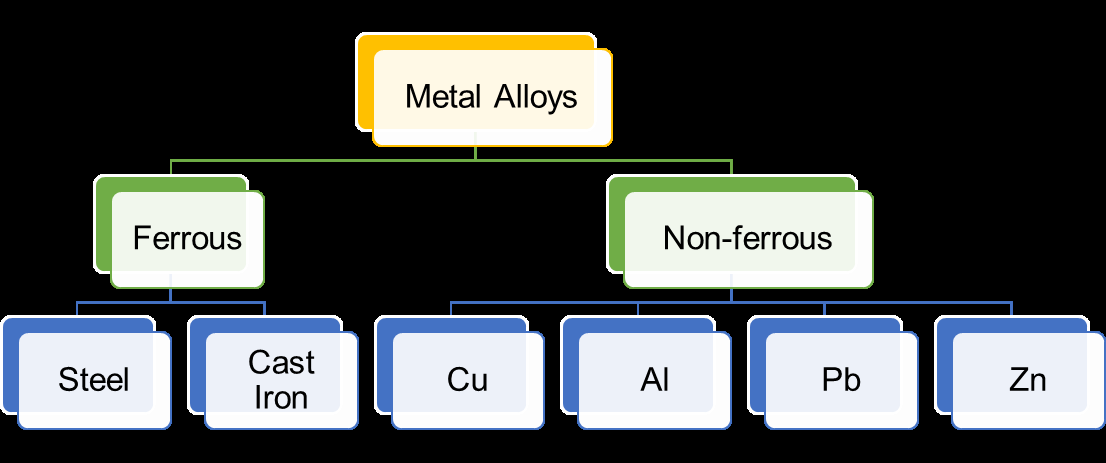
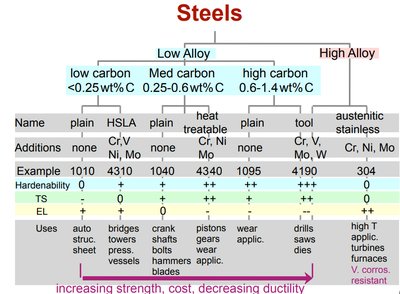
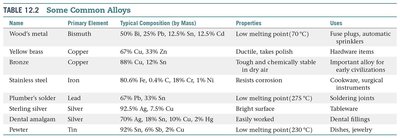
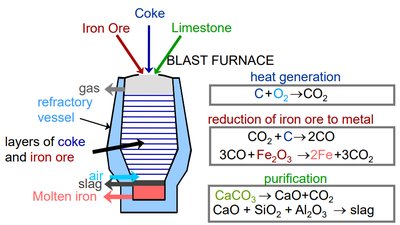
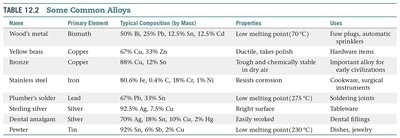

Table: Common Alloys
Name | Primary Element | Typical Composition (by Mass) | Properties | Uses |
|---|---|---|---|---|
Wood's metal | Bismuth | 50% Bi, 25% Pb, 12.5% Sn, 12.5% Cd | Low melting point (70°C) | Fuse plugs, automatic sprinklers |
Yellow brass | Copper | 68% Cu, 32% Zn | Ductile, tiles, pistachio | Hardware items |
Bronze | Copper | 88% Cu, 12% Sn | Tough, chemically stable | Important alloy for history, art |
Stainless steel | Iron | 80% Fe, 0.4% C, 18% Cr, 1% Ni | Resists corrosion | Cookware, surgical instruments |
Plumber's solder | Lead | 70% Pb, 30% Sn | Low melting point (235°C) | Soldering joints |
Dental amalgam | Silver | 50% Ag, 25% Sn, 25% Cu | Low melting point (230°C) | Dental fillings |
Pewter | Tin | 92% Sn, 6% Sb, 2% Cu | Low melting point (230°C) | Dishes, jewelry |
Polymers: Structure and Classification
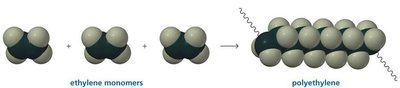
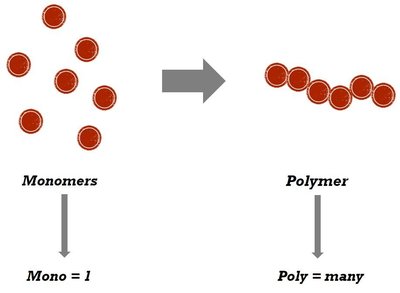
Polymers are large molecules made up of repeating units called monomers. They are essential in both natural systems (e.g., proteins, cellulose) and synthetic materials (e.g., plastics, fibers).
Composition: Most polymers are hydrocarbons, sometimes containing heteroatoms (N, S, O, halogens).
Formation: Polymers form via covalent bonds between monomers with reactive functional groups.
Types of Polymerization:
Addition polymerization: Monomers with multiple bonds form polymers without loss of small molecules.
Condensation polymerization: Monomers react, usually with loss of a small molecule (e.g., water).
Types of Polymers:
Thermoplastics: Reversibly cooled and reheated (e.g., polyethylene).
Thermosets: Irreversible process, degrades when heated (e.g., epoxy).
Elastomers: Cross-linked, stretchable materials (e.g., rubber).
Covalent Bonding
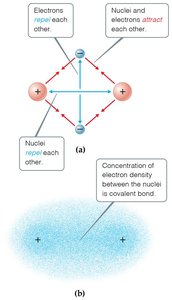
Covalent bonds involve the sharing of electrons between atoms. The bond forms when the attractions between electrons and nuclei outweigh the repulsions between electrons and nuclei.
Electrostatic interactions: Attractions between electrons and nuclei, repulsions between electrons, and repulsions between nuclei.
Bond formation: Occurs when net attraction is greater than repulsion.
Ceramics: Structure and Properties
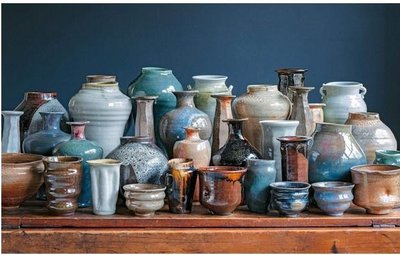
Ceramics are inorganic, non-metallic materials, often compounds between metallic and non-metallic elements (oxides, nitrides, carbides). They are hard, porous, and brittle, with predominantly ionic bonds.
Applications: Used for abrasive or grinding actions due to their hardness.
Ionic Bonding and Ionic Solids
Ionic bonding occurs between metals and nonmetals, involving electron transfer. Ionic solids are held together by electrostatic attractions between cations and anions, resulting in high melting and boiling points.
Electron transfer: One element gives up an electron (low ionization energy), another gains (high electron affinity).
Properties: Brittle, crystalline, high melting points, electronic insulators.

Ceramics: Silicates, Glass, and Cement
Silicates
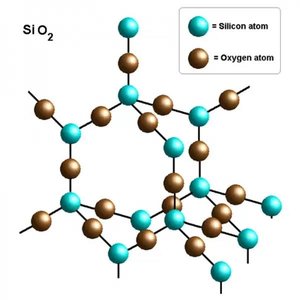
Silicates form the bulk of rocks, soils, clays, and sand. They are based on the [SiO4]4− ion, which combines with metal cations or with itself to form a variety of minerals. The network of silicate ions is known as silica (SiO2).
Glass
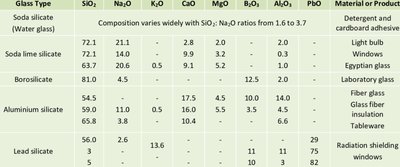
Glass is a dense form of amorphous silica, produced by heating raw materials to elevated temperatures. Other oxides are added to improve properties.
Cement
Cements are inorganic materials that form a set mass upon addition of water. Portland cement is the most important, made by heating a mixture of clay and chalk. Main constituents include Ca, Si, Al, and Fe.
Composites
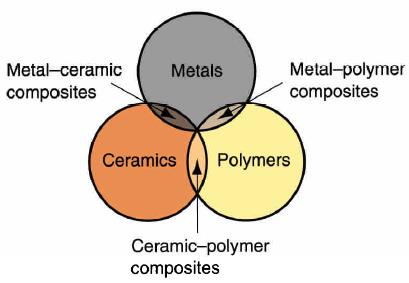
Composites combine materials to achieve a more desirable combination of properties, such as flexibility and weight of a polymer with the strength of a ceramic. They are multiphase materials, classified by the matrix: MMC (metal), CMC (ceramic), PMC (polymer).
Summary of Learning Outcomes
Explain the difference between types of solids.
Describe how solids are organized.
Describe metallic bonding and its properties.
Classify and explain alloys, including ferrous and non-ferrous types.
Explain the refinement of steel from ore.
Define polymers and classify their types.
Describe covalent bonding and polymerization mechanisms.
Explain ceramics and their applications.
Describe ionic bonding and properties of ionic solids.
Discuss applications of cement, glass, and silicates.
Explain the principles and classification of composites.
Additional info: Academic context was added to clarify definitions, examples, and applications for GOB Chemistry students.
