 Back
BackNuclear Chemistry: Radiation, Nuclear Equations, and Applications
Study Guide - Smart Notes
 Tailored notes based on your materials, expanded with key definitions, examples, and context.
Nuclear Chemistry
Types of Radiation
Nuclear chemistry involves the study of radioactive particles and their properties. The three main types of radiation encountered in nuclear reactions are alpha particles, beta particles, and positrons.
Alpha particle (\( \alpha \)): Contains two protons and two neutrons. Symbol: \( ^4_2\text{He} \) or \( \alpha \).
Beta particle (\( \beta \)): Has a mass number of 0 and a 1– charge. Symbol: \( ^0_{-1}\text{e} \) or \( \beta \).
Positron: Has a mass number of 0 and a 1+ charge. Symbol: \( ^0_{+1}\text{e} \).
Writing Nuclear Equations
Nuclear equations describe the transformation of nuclei during radioactive decay or bombardment. The process involves balancing mass numbers and atomic numbers to ensure conservation of nucleons and charge.
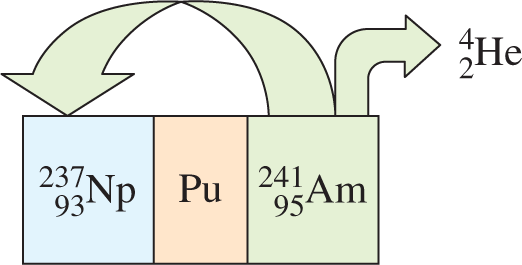
Alpha Decay Example: Americium-241
Americium-241 undergoes alpha decay, producing neptunium-237 and an alpha particle. The steps involve:
Write the incomplete nuclear equation.
Balance the mass number: \( 241 = ? + 4 \Rightarrow 237 \) (new nucleus).
Balance the atomic number: \( 95 = ? + 2 \Rightarrow 93 \) (new nucleus).
Identify the new element: Atomic number 93 is neptunium (Np).
Complete the equation: \( ^{241}_{95}\text{Am} \rightarrow ^{237}_{93}\text{Np} + ^4_2\text{He} \).

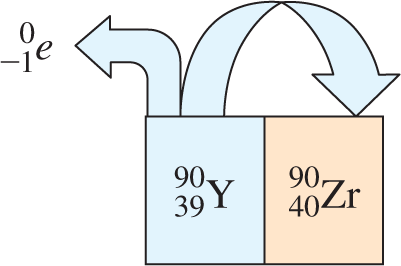
Beta Decay Example: Yttrium-90
Yttrium-90 undergoes beta decay, producing zirconium-90 and a beta particle. The steps involve:
Write the incomplete nuclear equation.
Balance the mass number: \( 90 = ? + 0 \Rightarrow 90 \) (new nucleus).
Balance the atomic number: \( 39 = ? - 1 \Rightarrow 40 \) (new nucleus).
Identify the new element: Atomic number 40 is zirconium (Zr).
Complete the equation: \( ^{90}_{39}\text{Y} \rightarrow ^{90}_{40}\text{Zr} + ^0_{-1}\text{e} \).


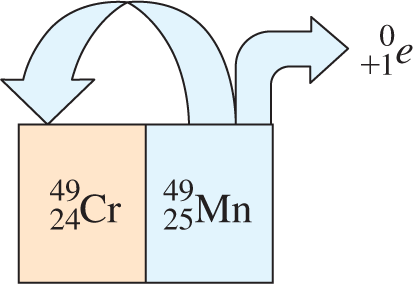
Positron Emission Example: Manganese-49
Manganese-49 decays by positron emission, producing chromium-49 and a positron. The steps involve:
Write the incomplete nuclear equation.
Balance the mass number: \( 49 = ? + 0 \Rightarrow 49 \) (new nucleus).
Balance the atomic number: \( 25 = ? + 1 \Rightarrow 24 \) (new nucleus).
Identify the new element: Atomic number 24 is chromium (Cr).
Complete the equation: \( ^{49}_{25}\text{Mn} \rightarrow ^{49}_{24}\text{Cr} + ^0_{+1}\text{e} \).

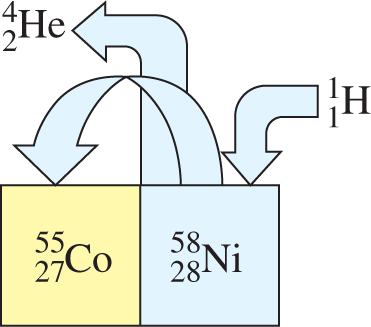
Bombardment Example: Nickel-58 with Proton
Nickel-58 is bombarded with a proton, producing cobalt-55 and an alpha particle. The steps involve:
Write the incomplete nuclear equation.
Balance the mass number: \( 1 + 58 = ? + 4 \Rightarrow 55 \) (new nucleus).
Balance the atomic number: \( 1 + 28 = ? + 2 \Rightarrow 27 \) (new nucleus).
Identify the new element: Atomic number 27 is cobalt (Co).
Complete the equation: \( ^{58}_{28}\text{Ni} + ^1_1\text{H} \rightarrow ^{55}_{27}\text{Co} + ^4_2\text{He} \).

Half-Life Calculations
The half-life of a radioisotope is the time required for half of the radioactive nuclei in a sample to decay. This concept is crucial in medicine, archaeology, and environmental science.
Example: Phosphorus-32 Decay
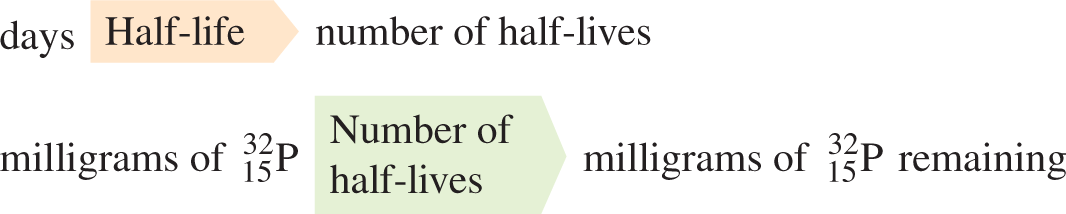
To determine the remaining mass of phosphorus-32 after a given time:
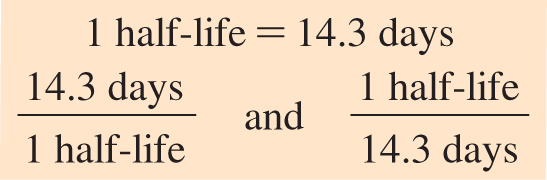
Given: 8.0 mg of P-32, elapsed time 42.9 days, half-life = 14.3 days.
Calculate number of half-lives:
After each half-life, the remaining mass is halved:


Radiocarbon Dating Example: Carbon-14
Radiocarbon dating uses the half-life of carbon-14 to estimate the age of organic materials. If a bone sample has 25% of the original C-14 activity, it has undergone two half-lives.
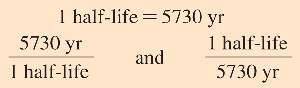
Given: Half-life of C-14 = 5730 years, 25% activity remaining.
Number of half-lives:
Years elapsed:




Medical Applications of Radioisotopes
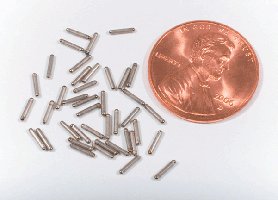
Radioisotopes are used in medicine for diagnosis and treatment. For example, gold-198 is used in the treatment of abdominal carcinoma by implanting radioactive "seeds" that emit beta particles.
Gold-198 undergoes beta decay: \( ^{198}_{79}\text{Au} \rightarrow ^{198}_{80}\text{Hg} + ^0_{-1}\text{e} \).
These radioactive seeds deliver targeted radiation to tumors.

Fission and Fusion
Fission is the splitting of a large nucleus into smaller nuclei, releasing energy. Fusion is the combining of small nuclei to form a larger nucleus, also releasing energy. Both processes are fundamental to nuclear chemistry and energy production.
Fission: Large nucleus breaks apart; used in nuclear reactors.
Fusion: Small nuclei combine; occurs in stars and hydrogen bombs.
Both: Release large amounts of energy.
Fusion: Requires extremely high temperatures.
Process | Description | Energy Released | Temperature Required |
|---|---|---|---|
Fission | Large nucleus splits | High | Moderate |
Fusion | Small nuclei combine | Very High | Extremely High |
Both | Energy released | High | Varies |
Example: Nuclear reactors use fission; stars use fusion.
