 Back
lec 12 Nucleic Acid Structure: DNA, RNA, and Their Biological Roles
Study Guide - Smart Notes
 Tailored notes based on your materials, expanded with key definitions, examples, and context.
Nucleotides: The Building Blocks of Nucleic Acids
Structural Components of Nucleotides
Nucleotides are the fundamental units that make up nucleic acids such as DNA and RNA. Each nucleotide consists of three main components:
Phosphate group: Provides the acidic character and is involved in forming the backbone of nucleic acids.
Pentose sugar: Either ribose (in RNA) or deoxyribose (in DNA).
Nitrogenous base: A heterocyclic amine, which can be a purine (adenine, guanine) or a pyrimidine (cytosine, thymine in DNA, uracil in RNA).
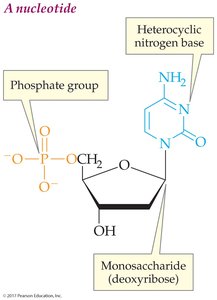
Nucleosides are similar but lack the phosphate group, consisting only of a sugar and a base.
Types of Nitrogenous Bases
Pyrimidines and Purines
Pyrimidines: Cytosine (C), Thymine (T, DNA only), Uracil (U, RNA only)
Purines: Adenine (A), Guanine (G)
These bases are aromatic, planar, and participate in hydrogen bonding, which is crucial for the structure and function of nucleic acids.
Formation of Nucleic Acids
Phosphodiester Bonds and Polymerization
Nucleotides are linked together by phosphodiester bonds, which connect the 3' hydroxyl group of one sugar to the 5' phosphate of the next. This forms the sugar-phosphate backbone of DNA and RNA.
Directionality: Nucleic acids are always synthesized and written from the 5' to 3' end.
Polynucleotides: Long chains of nucleotides form DNA and RNA molecules.
DNA and RNA: Structure and Differences
Key Differences Between DNA and RNA
Feature | DNA | RNA |
|---|---|---|
Sugar | Deoxyribose | Ribose |
Bases | A, G, C, T | A, G, C, U |
Strandedness | Double-stranded | Single-stranded |
DNA is typically double-stranded and forms a double helix, while RNA is usually single-stranded.
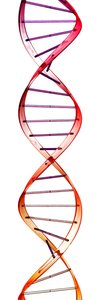
Three-Dimensional Structure of DNA
The Double Helix
The DNA double helix consists of two antiparallel strands twisted around each other. The sugar-phosphate backbones are on the outside, and the nitrogenous bases are on the inside, paired via hydrogen bonds.
Base pairing: Adenine pairs with thymine (A-T, 2 H-bonds), and guanine pairs with cytosine (G-C, 3 H-bonds).
Stabilization: The structure is stabilized by hydrogen bonds and stacking interactions (dispersion forces) between the aromatic bases.

DNA Packaging in Cells
Chromatin, Nucleosomes, and Chromosomes
In eukaryotic cells, DNA is highly compacted to fit within the nucleus. This is achieved through several levels of organization:
Chromatin: DNA wrapped around histone proteins, forming nucleosomes ("beads on a string").
Nucleosomes: Core units of DNA packaging, each consisting of DNA wound around a histone octamer.
Chromosomes: Highly condensed structures visible during cell division.
Histones are rich in basic amino acids (arginine, lysine) that interact with the negatively charged DNA backbone via salt bridges.
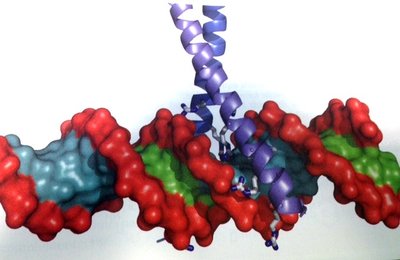
Base Pairing and Complementarity
Chargaff’s Rules and DNA Replication
Chargaff’s rules state that in double-stranded DNA, the amount of adenine equals thymine, and the amount of guanine equals cytosine. This complementarity allows for accurate DNA replication and information transfer.
Reverse complement: The sequence of one strand determines the sequence of the other, written in the opposite direction due to antiparallel orientation.
Mutations and the Central Dogma
DNA Mutation and Information Flow
A mutation is a change in the DNA sequence, often caused by mutagens such as radiation or chemicals. If not repaired, mutations are propagated during DNA replication. The Central Dogma of molecular biology describes the flow of genetic information:
Replication: DNA → DNA
Transcription: DNA → RNA
Translation: RNA → Protein
Each process involves initiation, elongation, and termination phases. DNA replication is semiconservative, meaning each new double helix contains one old and one new strand.
Summary Table: Key Features of Nucleic Acids
Component | DNA | RNA |
|---|---|---|
Sugar | Deoxyribose | Ribose |
Bases | A, G, C, T | A, G, C, U |
Strandedness | Double | Single |
Function | Genetic storage | Genetic transfer, catalysis |
