 Back
Nucleic Acid Synthesis: Replication and Transcription
Study Guide - Smart Notes
 Tailored notes based on your materials, expanded with key definitions, examples, and context.
Nucleic Acid Synthesis: Replication and Transcription
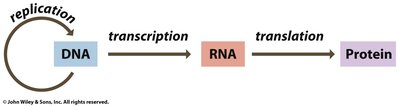
Central Dogma of Molecular Biology
The central dogma describes the flow of genetic information in cells: DNA is replicated, transcribed into RNA, and translated into protein. Each step is essential for the storage, transfer, and expression of genetic information.
Replication: DNA makes a copy of itself.
Transcription: DNA is used as a template to synthesize RNA.
Translation: RNA is used to synthesize proteins.
Energy of Nucleic Acid Synthesis
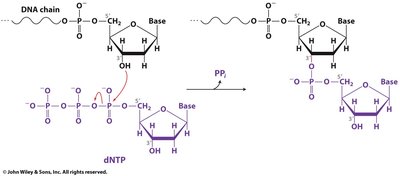
Nucleic acid synthesis is driven by the hydrolysis of phosphoanhydride bonds in nucleotides, which releases energy for polymerization reactions. This process is spontaneous and exergonic.
Phosphoanhydride hydrolysis: Hydrolysis of ATP or NTPs provides energy for DNA and RNA synthesis.
Key reactions:
ATP + H2O → ADP + Pi (1 ATP equivalent)
ATP + H2O → AMP + PPi (2 ATP equivalents)
PPi + H2O → 2 Pi (irreversible)
DNA polymerase reaction: dNTP → dNMP + PPi; 2 ATP equivalents are hydrolyzed per base added.
DNA Replication: Initiation
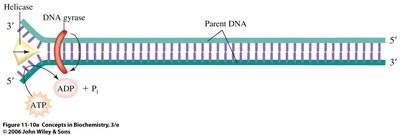
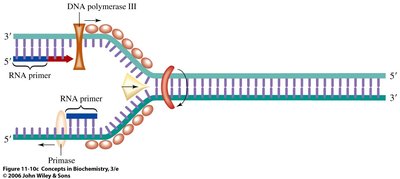
Replication begins at specific sites called origins of replication, which are rich in AT base pairs. Several proteins are required to initiate replication and create the replication fork.
Helicase: Unwinds the DNA double helix using ATP hydrolysis.
Topoisomerase: Relieves strain from supercoiled DNA ahead of the fork.
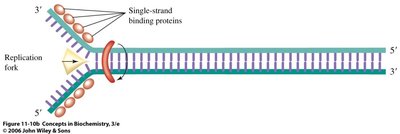
Single-stranded binding proteins: Stabilize unwound DNA and prevent reannealing.
Primase: Synthesizes a short RNA primer for DNA polymerase to extend.
Replication fork: The Y-shaped region where DNA is actively being unwound and replicated.
DNA Replication: Elongation and Termination
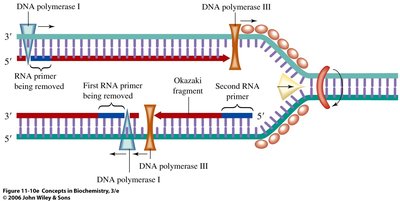
DNA polymerase synthesizes new DNA in the 5' to 3' direction. The leading strand is synthesized continuously, while the lagging strand is synthesized discontinuously in Okazaki fragments.
Leading strand: Synthesized continuously as the replication fork advances.
Lagging strand: Synthesized in short Okazaki fragments, each requiring a new RNA primer.
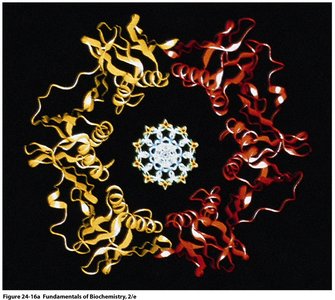
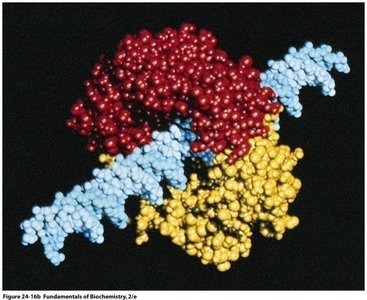
DNA clamp: Increases processivity of DNA polymerase, allowing rapid and accurate synthesis.
Proofreading: DNA polymerase has 3'→5' exonuclease activity to correct errors.
Termination: RNA primers are removed by endonucleases, and DNA ligase joins Okazaki fragments.
Telomeres: Repetitive DNA sequences at chromosome ends, extended by telomerase to prevent loss of genetic material.

Gene Structure and Transcription Initiation
Genes are segments of DNA that code for proteins. Transcription initiation requires promoter regions and transcription factors.
Gene: DNA sequence coding for a protein.
Genome: All genetic material in an organism.
Promoter: DNA sequence upstream of the gene, often rich in AT base pairs (e.g., TATA box), where transcription factors bind.
Transcription bubble: Region where DNA is unwound for transcription.
Transcription factors: Proteins that recruit helicase and RNA polymerase to the promoter.
Types of RNA in the Central Dogma
Three main types of RNA are involved in protein synthesis:
Messenger RNA (mRNA): Carries genetic information from DNA to the ribosome.
Transfer RNA (tRNA): Brings amino acids to the ribosome during translation.
Ribosomal RNA (rRNA): Forms the core of the ribosome and catalyzes protein synthesis.
Transcription Elongation
Transcription elongation begins when RNA polymerase is phosphorylated, allowing it to move away from the promoter and synthesize RNA. RNA polymerase is processive and has proofreading ability, though less accurate than DNA polymerase.
RNA polymerase: Catalyzes RNA synthesis from DNA template.
Energy: 2 ATP equivalents hydrolyzed per base added (NTP → NMP + PPi).
Hybrid helix: Temporary DNA-RNA hybrid forms during transcription.
Transcription Termination and mRNA Processing
Transcription termination occurs when a signal in the mRNA disrupts RNA polymerase, either by forming a short helix (RNA-dependent) or by protein binding (protein-dependent). Eukaryotic mRNAs are processed before translation.
Termination: RNA-dependent or protein-dependent mechanisms disrupt RNA polymerase.
mRNA processing: Modifications at 5' and 3' ends, and splicing to remove introns and retain exons.
Splicing: Only exons are translated; introns are removed.
Summary Table: Key Proteins and Functions in Replication and Transcription
Protein/Enzyme | Function |
|---|---|
Helicase | Unwinds DNA double helix |
Topoisomerase | Relieves supercoiling strain |
Single-stranded binding protein | Stabilizes unwound DNA |
Primase | Synthesizes RNA primer |
DNA polymerase | Synthesizes new DNA, proofreads |
DNA clamp | Increases processivity of DNA polymerase |
RNA polymerase | Synthesizes RNA from DNA template |
DNA ligase | Joins Okazaki fragments |
Telomerase | Extends telomeres |
Key Equations
Phosphoanhydride hydrolysis:
DNA polymerase reaction:
RNA polymerase reaction:
Additional info:
DNA replication is semiconservative: each new DNA molecule contains one old strand and one new strand.
Telomerase is an RNA-dependent enzyme that extends telomeres in dividing cells.
mRNA processing includes capping, polyadenylation, and splicing.
