 Back
Nucleic Acid Synthesis: Replication and Transcription (Study Guide)
Study Guide - Smart Notes
 Tailored notes based on your materials, expanded with key definitions, examples, and context.
Nucleic Acid Synthesis: Replication and Transcription
Central Dogma of Molecular Biology
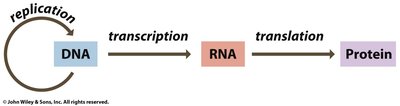
The central dogma describes the flow of genetic information in cells: DNA is replicated, transcribed into RNA, and translated into protein. Each step is essential for the storage, transfer, and expression of genetic information.
Replication: DNA is copied to produce identical DNA molecules.
Transcription: DNA is used as a template to synthesize RNA.
Translation: RNA is used to synthesize proteins.
Each process has three phases: Initiation, Elongation, and Termination.
Energy of Nucleic Acid Synthesis
Nucleic acid synthesis is driven by the hydrolysis of phosphoanhydride bonds in nucleotides, which releases energy for polymerization reactions.
Phosphoanhydride hydrolysis: Exergonic reaction (spontaneous, negative ΔG).
ATP + H2O → ADP + Pi: Releases 1 ATP equivalent.
ATP + H2O → AMP + PPi: Releases 2 ATP equivalents.
PPi + H2O → 2 Pi: Irreversible hydrolysis, drives reactions forward.
NTP: Any base as a triphosphate ribonucleotide.
dNTP: Any base as a triphosphate deoxyribonucleotide.
DNA Polymerase Reaction
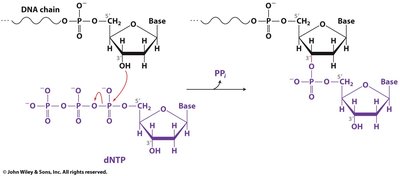
DNA polymerase catalyzes the synthesis of new DNA during replication, using the energy from hydrolysis of two phosphoanhydride bonds per nucleotide added.
Reaction: DNAn-OH (3') + dNTP → DNAn+1 + PPi
Energy: 2 ATP equivalents per base added.
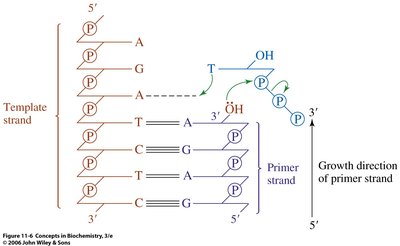
Base complementarity: Template strand determines which base is added.
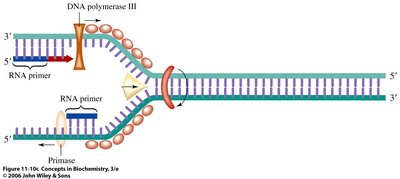
Direction: DNA polymerase adds nucleotides to the 3' OH of the primer strand.
Replication Initiation
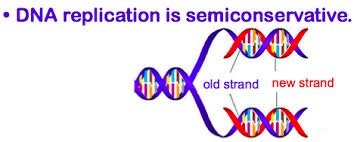
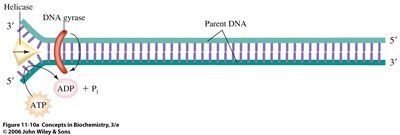
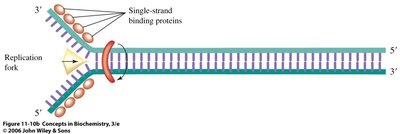
Replication begins at specific sites called origins of replication, where the DNA is unwound and held open for polymerase activity. Several proteins are involved in this process.
Helicase: Unwinds DNA using ATP hydrolysis.
Topoisomerase: Relieves strain from overwound DNA.
Single-stranded binding protein: Prevents reannealing of DNA strands.
Primase: Synthesizes RNA primer for DNA polymerase.
Origin of replication: AT-rich regions, easier to separate.
Replication Elongation and Termination
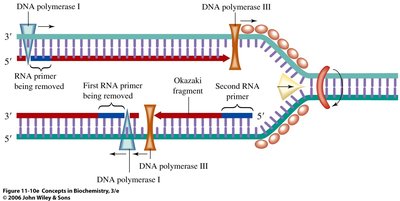
DNA polymerase synthesizes both strands at the replication fork. The leading strand is synthesized continuously, while the lagging strand is synthesized discontinuously in Okazaki fragments.
Leading strand: Synthesized continuously in 5'→3' direction.
Lagging strand: Synthesized discontinuously in Okazaki fragments.
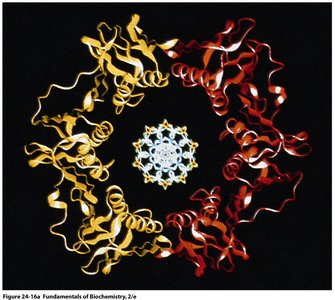
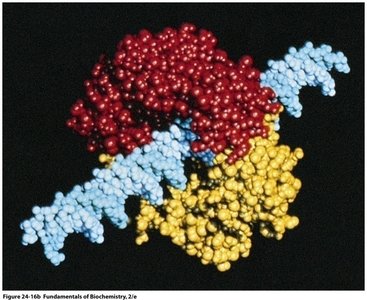
DNA clamp: Promotes processivity, allowing polymerase to add many nucleotides before dissociating.
Proofreading: DNA polymerase has 3'→5' exonuclease activity to correct errors.
Termination: RNA primers are removed by endonucleases, and DNA ligase joins fragments.
Telomeres: Repetitive DNA sequences at chromosome ends, extended by telomerase.

Gene Structure and Transcription Initiation
Genes are DNA sequences that code for proteins. Transcription initiation requires promoter regions and transcription factors.
Gene: DNA sequence coding for a protein.
Genome: All genetic material of an organism.
Promoter: Sequence in 5' flanking region (often AT-rich, e.g., TATA box).
Transcription factors: Bind promoter, recruit helicase, and regulate initiation.
DNA must be unpacked: Acetylation of histones removes positive charge, loosening DNA-histone interaction.
Types of RNA in the Central Dogma
Three main types of RNA are involved in gene expression:
Messenger RNA (mRNA): Carries genetic information for translation.
Transfer RNA (tRNA): Brings amino acids to the ribosome.
Ribosomal RNA (rRNA): Forms the ribosome and catalyzes protein synthesis.
Transcription Elongation
Transcription elongation begins when RNA polymerase is phosphorylated, allowing it to move away from the promoter and synthesize RNA.
RNA polymerase: Adds nucleotides to the 3' end of RNA strand, hydrolyzing 2 ATP equivalents per base.
Processivity: RNA polymerase can synthesize long RNA molecules without dissociating.
Proofreading: RNA polymerase has proofreading function, but less accurate than DNA polymerase.
Hybrid helix: DNA-RNA hybrid forms inside RNA polymerase during transcription.
Transcription Termination and mRNA Processing
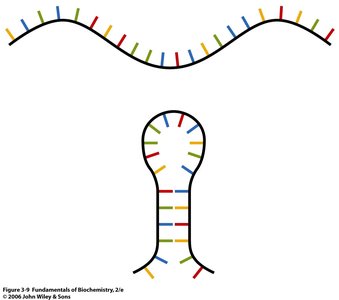
Transcription termination occurs when a signal in the mRNA disrupts RNA polymerase, either by forming a short helix or by protein binding. Eukaryotic mRNAs are processed before translation.
Termination: Can be RNA-dependent (helix formation) or protein-dependent (Rho factor).
mRNA processing: Modifications at 5' and 3' ends, and splicing to remove introns.
Splicing: Exons are retained and translated; introns are removed.
All RNAs: mRNA, tRNA, and rRNA are processed before participating in translation.
Summary Table: Key Proteins and Functions in Replication and Transcription
Protein/Enzyme | Function |
|---|---|
Helicase | Unwinds DNA double helix |
Topoisomerase | Relieves strain from overwound DNA |
Single-stranded binding protein | Prevents reannealing of DNA strands |
Primase | Synthesizes RNA primer |
DNA polymerase | Synthesizes new DNA, proofreads |
DNA clamp | Promotes processivity of DNA polymerase |
DNA ligase | Joins Okazaki fragments |
Telomerase | Extends telomeres |
RNA polymerase | Synthesizes RNA from DNA template |
Transcription factors | Regulate transcription initiation |
Rho factor | Protein-dependent transcription termination |
Key Equations
Phosphoanhydride hydrolysis:
DNA polymerase reaction:
RNA polymerase reaction:
Additional info: This study guide covers the essential concepts of nucleic acid synthesis, including the energy requirements, enzymatic mechanisms, and structural features of replication and transcription. It is suitable for GOB Chemistry students preparing for exams on molecular biology and biochemistry.
