Back
Nucleic Acid Synthesis: Replication and Transcription (GOB Chemistry Study Guide)
Study Guide - Smart Notes
 Tailored notes based on your materials, expanded with key definitions, examples, and context.
Nucleic Acid Synthesis: Replication and Transcription
Central Dogma of Molecular Biology
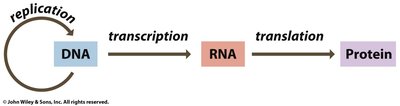
The central dogma describes the flow of genetic information in cells: DNA is replicated, transcribed into RNA, and then translated into protein. Each step is essential for the storage, transfer, and expression of genetic information.
Replication: DNA makes a copy of itself.
Transcription: DNA is used as a template to synthesize RNA.
Translation: RNA is used to synthesize proteins.
Each process has three phases: Initiation, Elongation, and Termination.
Structure and Function of Nucleic Acids
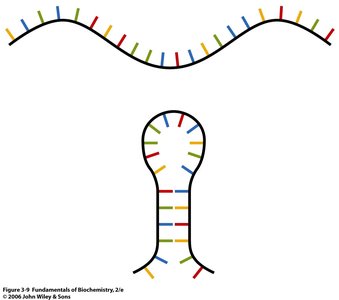
Nucleic acids (DNA and RNA) are polymers of nucleotides. Their structure enables the storage and transfer of genetic information through complementary base pairing.
DNA: Double-stranded helix, bases are C, G, A, T, sugar is 2'-deoxyribose.
RNA: Usually single-stranded, bases are C, G, A, U, sugar is ribose.
Complementarity: Enables accurate replication and transcription.
Energy of Nucleic Acid Synthesis
Phosphoanhydride Hydrolysis
The energy required for nucleic acid synthesis comes from the hydrolysis of phosphoanhydride bonds in nucleoside triphosphates (NTPs for RNA, dNTPs for DNA). This reaction is exergonic and drives the polymerization process.
General reaction: NTP + H2O → NDP + Pi
ATP hydrolysis: ATP + H2O → ADP + Pi (1 ATP equivalent)
ATP + H2O → AMP + PPi: (2 ATP equivalents)
PPi hydrolysis: PPi + H2O → 2 Pi (irreversible)
DNA Polymerase Reaction
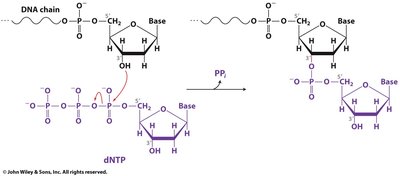
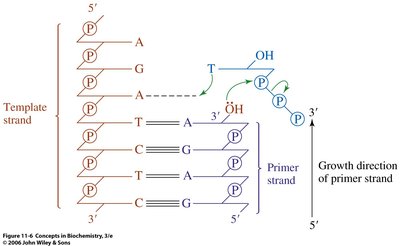
DNA polymerase catalyzes the addition of nucleotides to the growing DNA strand during replication. The reaction uses two ATP equivalents per nucleotide added.
Reaction: DNAn-OH (3') + dNTP → DNAn+1 + PPi
PPi + H2O → 2 Pi
DNA polymerase only adds nucleotides to the 3' OH of the primer strand.
Template strand determines which base is added via complementarity.
Replication Initiation
Proteins and Structural Features
Several proteins are required to initiate DNA replication at the replication fork:
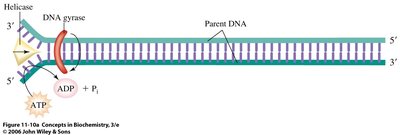
Helicase: Unwinds the DNA double helix using ATP hydrolysis.
Topoisomerase: Relieves strain from overwound DNA ahead of the fork.
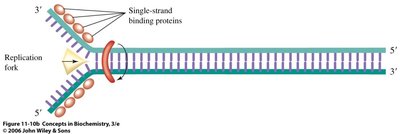
Single-stranded binding protein: Stabilizes single-stranded DNA to prevent reannealing.
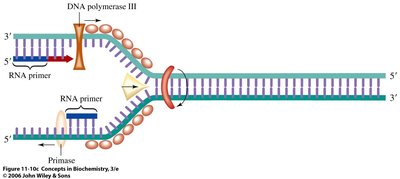
Primase: Synthesizes a short RNA primer for DNA polymerase to extend.
Replication Fork and Origin of Replication
Replication begins at origins of replication, which are rich in A-T base pairs due to weaker hydrogen bonding. Each replication bubble has two forks, and DNA polymerase can only extend from an existing 3' OH.
Replication Elongation and Termination
Elongation: Leading and Lagging Strands
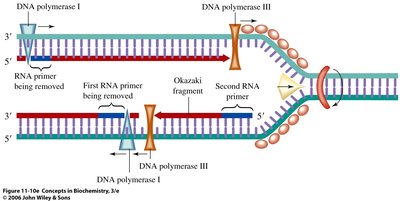
DNA polymerase synthesizes both strands simultaneously, but only in the 5'→3' direction:
Leading strand: Synthesized continuously.
Lagging strand: Synthesized discontinuously in Okazaki fragments (1000–2000 bp).
RNA primers are pushed aside and removed by nucleases.

Processivity and Proofreading
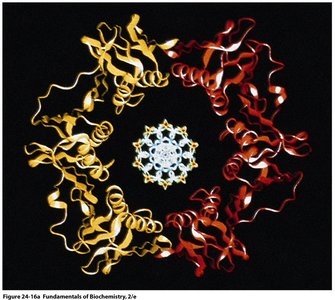
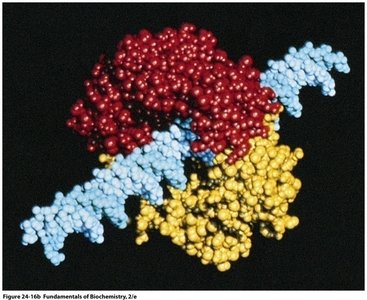
DNA polymerase is highly processive due to the DNA clamp, which allows it to add thousands of nucleotides before dissociating. It also has 3'→5' exonuclease activity for proofreading, ensuring high fidelity (1 error per 1 billion base pairs).
Replication Termination and Telomeres
At the end of replication, RNA primers are removed, and Okazaki fragments are joined by DNA ligase. Linear chromosomes have telomeres, repetitive DNA sequences extended by telomerase to allow complete replication.
DNA ligase reaction: DNA ligase + ATP → DNA ligase-AMP + PPi
Telomerase is active in dividing cells; telomere length decreases with cell age.
Gene Structure and Transcription Initiation
Types of RNA
Three main types of RNA are involved in translation:
Messenger RNA (mRNA): Carries genetic information for protein synthesis.
Transfer RNA (tRNA): Brings amino acids to the ribosome.
Ribosomal RNA (rRNA): Forms the ribosome and catalyzes protein synthesis.
DNA vs. RNA Structure
DNA: C, G, A, T; 2'-deoxyribose; double-stranded.
RNA: C, G, A, U; ribose; single-stranded.
Transcription Initiation and Gene Structure
Gene: DNA sequence coding for a protein.
Genome: All genetic material of an organism.
Promoter: Region upstream of the gene (often AT-rich, e.g., TATA box) where transcription factors bind to initiate transcription.
Transcription bubble: DNA is unwound for RNA polymerase to access the template strand.
Transcription Elongation
RNA Polymerase Function
RNA polymerase synthesizes RNA from a DNA template, adding nucleotides to the 3' end. The reaction is driven by hydrolysis of 2 ATP equivalents per nucleotide added.
Reaction: RNAn-OH (3') + NTP → RNAn+1 + PPi
PPi + H2O → 2 Pi
RNA polymerase is processive and has proofreading ability, though less accurate than DNA polymerase.
Transcription Termination and mRNA Processing
Termination Mechanisms
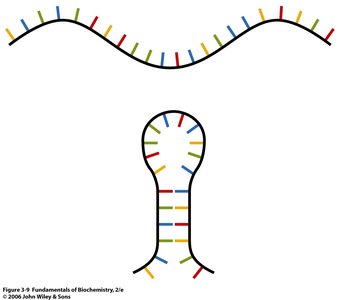
RNA-dependent: Short helix forms in RNA, disrupting RNA polymerase.
Protein-dependent: Rho protein binds RNA and disrupts RNA polymerase.
mRNA Processing
End modifications: 5' cap and 3' poly-A tail added.
Splicing: Introns are removed, exons are retained and translated.
All types of RNA are processed before translation.
Summary Table: Key Proteins and Functions in Replication
Protein | Function |
|---|---|
Helicase | Unwinds DNA double helix |
Topoisomerase | Relieves strain from overwound DNA |
Single-stranded binding protein | Stabilizes single-stranded DNA |
Primase | Synthesizes RNA primer |
DNA polymerase | Synthesizes new DNA strand |
DNA clamp | Promotes processivity of DNA polymerase |
Exonuclease | Proofreads and removes incorrect bases |
DNA ligase | Joins Okazaki fragments |
Telomerase | Extends telomeres |
Key Equations
Additional info:
Telomeres are essential for maintaining chromosome integrity during replication of linear chromosomes.
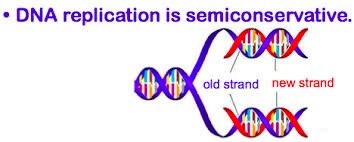
DNA replication is semiconservative: each new DNA molecule contains one old strand and one new strand.