 Back
Organic Chemistry: Functional Groups, Reactions, and Nomenclature – GOB Chemistry Study Guidance
Study Guide - Smart Notes
 Tailored notes based on your materials, expanded with key definitions, examples, and context.
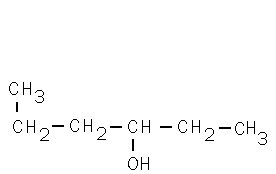
Q1. Name the following compound:
Background
Topic: Organic Nomenclature (Alcohols)
This question tests your ability to apply IUPAC rules to name alcohols, including identifying the longest carbon chain, numbering the chain to give the substituents the lowest possible numbers, and naming substituents.
Key Terms and Concepts:
Alcohol: An organic compound with a hydroxyl (-OH) group attached to a saturated carbon atom.
Substituent: An atom or group of atoms attached to the main carbon chain.
IUPAC Naming Steps:
Identify the longest continuous carbon chain containing the -OH group.
Number the chain so the -OH group gets the lowest possible number.
Name and number any alkyl substituents.
Combine the names, listing substituents alphabetically, and indicate the position of the -OH group.
Step-by-Step Guidance
Identify the longest continuous carbon chain that contains the -OH group. This will determine the parent name (e.g., hexanol for a six-carbon chain).
Number the carbon chain from the end nearest the -OH group, so the -OH group gets the lowest possible number.
Identify and name any alkyl substituents (e.g., methyl groups), and assign their position based on the numbering.
Combine the substituent name(s) and the parent name, placing the substituent(s) in alphabetical order and indicating the position of the -OH group.
Try solving on your own before revealing the answer!
Final Answer: 2-Methyl-4-hexanol
The longest chain is six carbons (hexanol), the -OH group is on carbon 4, and there is a methyl group on carbon 2. The correct IUPAC name is 2-methyl-4-hexanol.
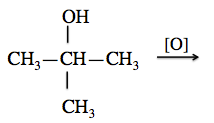
Q2. What is the product of the oxidation of the following alcohol?
Background
Topic: Oxidation of Alcohols
This question tests your understanding of how primary, secondary, and tertiary alcohols react with oxidizing agents, and what products are formed.
Key Terms and Concepts:
Oxidation: In organic chemistry, oxidation often means increasing the number of bonds from carbon to oxygen (or decreasing the number of bonds to hydrogen).
Tertiary Alcohol: An alcohol in which the carbon bearing the -OH group is attached to three other carbons.
Oxidizing Agent: A substance that can accept electrons and bring about oxidation (e.g., [O] in the reaction).
Step-by-Step Guidance
Identify the type of alcohol (primary, secondary, or tertiary) by examining the carbon attached to the -OH group.
Recall the general rules for oxidation of alcohols: primary alcohols oxidize to aldehydes (and then to carboxylic acids), secondary alcohols to ketones, and tertiary alcohols generally do not oxidize under normal conditions.
Consider whether the structure allows for the removal of hydrogen atoms from the carbon with the -OH group (necessary for oxidation to occur).
Try solving on your own before revealing the answer!
Final Answer: No reaction (tertiary alcohols do not oxidize under normal conditions)
2-methyl-2-propanol is a tertiary alcohol, and tertiary alcohols are resistant to oxidation because there is no hydrogen atom on the carbon bearing the -OH group. Therefore, no reaction occurs under typical oxidation conditions.
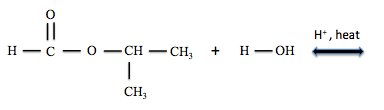
Q3. Write the products of acid hydrolysis of the following ester:
Background
Topic: Acid Hydrolysis of Esters
This question tests your ability to predict the products when an ester reacts with water in the presence of acid and heat (acid hydrolysis).
Key Terms and Concepts:
Ester: An organic compound derived from a carboxylic acid and an alcohol.
Acid Hydrolysis: The reaction of an ester with water and acid to produce a carboxylic acid and an alcohol.
General Reaction:
Step-by-Step Guidance
Identify the ester functional group in the molecule (the COO linkage).
Break the ester bond between the carbonyl carbon and the oxygen attached to the alkyl group.
Assign the -OH from water to the carbonyl carbon (forming a carboxylic acid) and the H to the alkoxy group (forming an alcohol).
Write the structures of the resulting carboxylic acid and alcohol, making sure to match the original alkyl and acyl groups.
Try solving on your own before revealing the answer!
Final Answer: Methanoic acid (formic acid) and 2-butanol
Acid hydrolysis of the given ester produces methanoic acid (from the acyl part) and 2-butanol (from the alkoxy part).
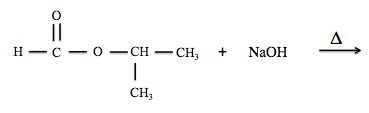
Q4. Write the products of base hydrolysis (saponification) of the following ester:
Background
Topic: Base Hydrolysis (Saponification) of Esters
This question tests your understanding of how esters react with strong bases to form carboxylate salts and alcohols.
Key Terms and Concepts:
Saponification: The base-catalyzed hydrolysis of an ester, producing a carboxylate salt and an alcohol.
General Reaction:
Step-by-Step Guidance
Identify the ester functional group in the molecule.
Break the ester bond between the carbonyl carbon and the oxygen attached to the alkyl group.
Assign the O⁻ from NaOH to the carbonyl carbon (forming a carboxylate salt) and the H to the alkoxy group (forming an alcohol).
Write the structures of the resulting carboxylate salt (sodium salt of the acid) and alcohol.
Try solving on your own before revealing the answer!
Final Answer: Sodium methanoate (formate) and 2-butanol
Base hydrolysis of the given ester with NaOH produces sodium methanoate (the salt of methanoic acid) and 2-butanol.
