 Back
BackOverview of Chemistry Course Modules and Due Dates
Study Guide - Smart Notes
 Tailored notes based on your materials, expanded with key definitions, examples, and context.
Course Module Overview
Introduction
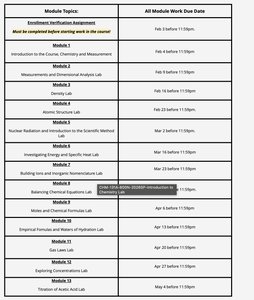
This syllabus outlines the sequence of modules and their due dates for a college-level chemistry course. The topics covered align closely with foundational and advanced concepts in chemistry, as listed in the provided chapter titles. The schedule includes both theoretical and laboratory components, ensuring a comprehensive understanding of chemistry principles.
Module Topics and Due Dates
Module Topic | All Module Work Due Date |
|---|---|
Enrollment Verification Assignment Must be completed before starting work in the course! | Feb 4 before 11:59pm |
Module 1: Introduction to the Course, Chemistry and Measurement | Feb 4 before 11:59pm |
Module 2: Measurements and Dimensional Analysis Lab | Feb 4 before 11:59pm |
Module 3: Matter and Energy | Feb 11 before 11:59pm |
Module 4: Atoms and Elements | Feb 18 before 11:59pm |
Module 5: Atomic Structure Lab | Feb 18 before 11:59pm |
Module 6: Nuclear Radiation and Measurements: The Scientific Method | Mar 3 before 11:59pm |
Module 7: Intermolecular Forces and Scientific Method Lab | Mar 3 before 11:59pm |
Module 8: Building and Naming Compounds | Mar 17 before 11:59pm |
Module 9: Building and Naming Compounds Lab | Mar 17 before 11:59pm |
Module 10: Balancing Chemical Equations | Apr 7 before 11:59pm |
Module 11: Moles and Stoichiometry | Apr 7 before 11:59pm |
Module 12: Empirical Formulas and Hydration Lab | Apr 7 before 11:59pm |
Module 13: Solutions and Solution Preparation Lab | Apr 21 before 11:59pm |
Module 14: Titration of Acetic Acid Lab | May 4 before 11:59pm |
Key Chemistry Topics Covered
Chemistry and Measurements: Introduction to fundamental concepts, units, and measurement techniques.
Matter and Energy: Classification of matter, energy types, and their interactions.
Atoms and Elements: Structure of atoms, periodic table, and properties of elements.
Nuclear Chemistry: Nuclear radiation, scientific method, and measurement techniques.
Chemical Compounds: Building, naming, and classifying ionic and molecular compounds.
Chemical Reactions: Balancing equations, stoichiometry, and mole calculations.
Solutions: Preparation, concentration calculations, and titration methods.
Laboratory Components
Measurements and Dimensional Analysis Lab: Practice in measurement accuracy and unit conversions.
Atomic Structure Lab: Exploration of atomic models and properties.
Intermolecular Forces Lab: Investigation of forces between molecules.
Building and Naming Compounds Lab: Hands-on experience with compound formation and nomenclature.
Empirical Formulas and Hydration Lab: Determination of empirical formulas and hydration levels.
Solutions and Titration Labs: Preparation of solutions and quantitative analysis via titration.
Example: Module Sequence and Due Dates
Students are expected to complete each module by the specified due date. For example, "Matter and Energy" is due by Feb 11, while "Titration of Acetic Acid Lab" is due by May 4. This structured timeline ensures steady progress through the course material.
Additional info: The module topics correspond directly to the chapters listed in the gob college course, covering essential chemistry concepts and laboratory skills.
