 Back
Periodic Properties of the Elements: Structure, Trends, and Applications
Study Guide - Smart Notes
 Tailored notes based on your materials, expanded with key definitions, examples, and context.
Periodic Properties of the Elements
The Development of the Periodic Table
The periodic table is a fundamental tool in chemistry, organizing elements according to their properties and atomic structure. Its development was guided by the discovery of periodic law and the recognition of repeating patterns among elements.
Periodic Law: When elements are arranged by increasing atomic mass, recurring patterns in their properties emerge.
Early Periodic Table: Elements with similar properties were grouped in columns, but some inconsistencies arose when ordering strictly by mass.
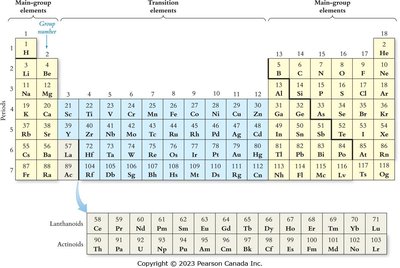
Modern Periodic Table: Arranged by atomic number, not mass, resolving earlier inconsistencies.
Quantum Theory: Explains why the periodic table works, as electron configurations dictate chemical behavior.
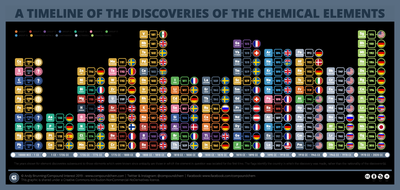
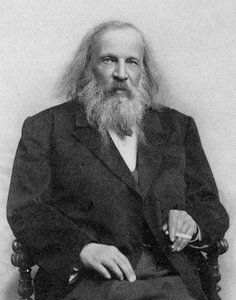
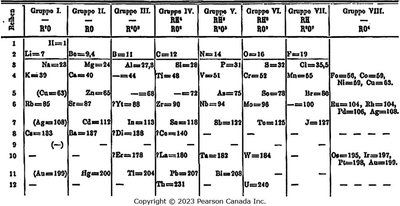
Example: Mendeleev predicted the properties of gallium and germanium before their discovery, demonstrating the power of the periodic table.
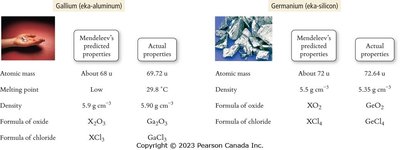
Additional info: Mendeleev's predictions were based on gaps in his table and the observed periodicity of properties.
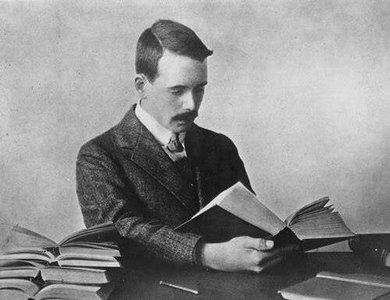
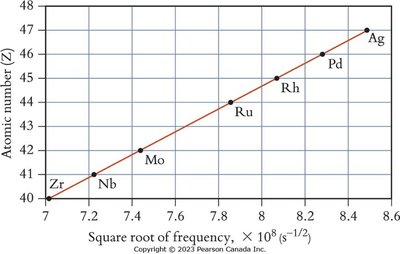
Henry Moseley: Demonstrated that atomic number, not mass, determines element order by measuring X-ray frequencies.
Electron Configurations, Valence Electrons, and the Periodic Table
Electron configurations describe the arrangement of electrons in an atom. The periodic table reflects these configurations, especially for the first 18 elements.
Valence Electrons: Electrons in the outermost principal energy level (highest n); responsible for chemical properties.
Core Electrons: Electrons in lower energy levels; shield valence electrons from nuclear charge.
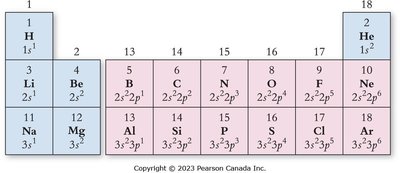
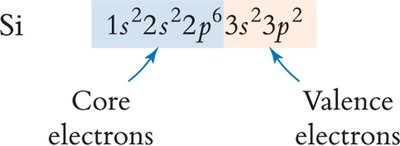
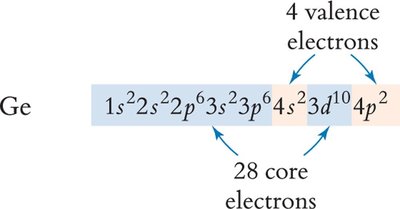
Example: Magnesium (Mg) has the electron configuration 1s22s22p63s2, with 2 valence electrons.
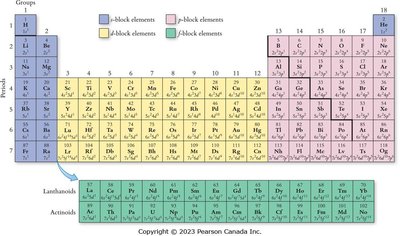
Periodic Table Blocks: The table is divided into s, p, d, and f blocks, which provide shortcuts for determining electron configurations.
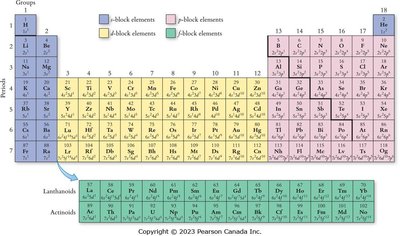
Example: Condensed electron configurations for Mg: [Ne]3s2; for Cl: [Ne]3s23p5.
Additional info: Noble gas configurations are especially stable, and elements tend to form ions to achieve these configurations.
Periodic Trends in Atomic Size and Effective Nuclear Charge
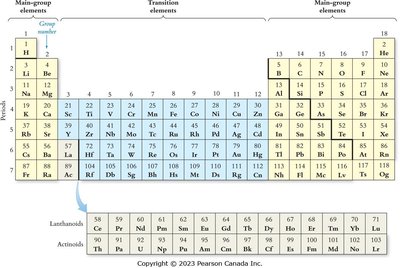
The periodic table allows prediction of element properties based on position, including atomic radius, ionization energy, electron affinity, and metallic character. These trends are governed by effective nuclear charge (Zeff).
Effective Nuclear Charge (Zeff): The net positive charge felt by valence electrons, accounting for shielding by core electrons.
Formula: (where Z is nuclear charge, S is shielding constant)
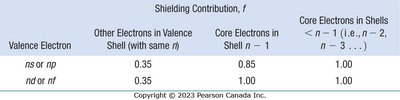
Slater's Rules: Provide a more accurate calculation of S by assigning different shielding contributions.


Atomic Radius: The covalent radius is half the bond length between two identical atoms.
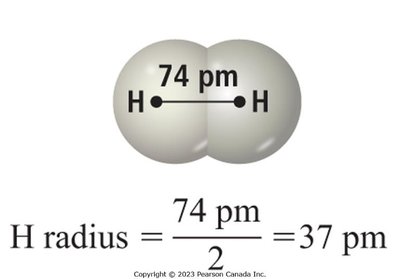
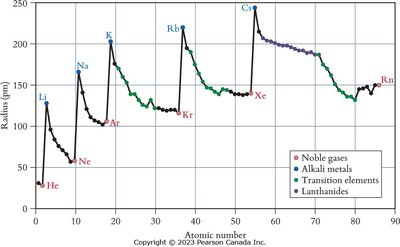
Trend Across a Period: Atomic radius decreases from left to right due to increasing Zeff.
Trend Down a Group: Atomic radius increases due to additional energy levels.
Ionic Radii
Ions are formed when atoms gain or lose electrons. The size of ions differs from their parent atoms due to changes in electron-electron repulsion and Zeff.
Cations: Positively charged ions (lost electrons); smaller than parent atoms.
Anions: Negatively charged ions (gained electrons); larger than parent atoms.
Isoelectronic Series: Group of ions with the same number of electrons and electron configuration.
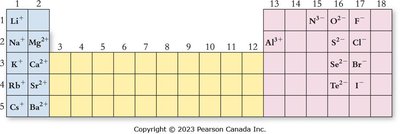
Example: Br- is larger than Cl-; K+ is smaller than Ca2+.
Ionization Energy
Ionization energy (IE) is the minimum energy required to remove an electron from an atom or ion in the gas phase. The first ionization energy (IE1) is influenced by Zeff and atomic radius.
Trend Across a Period: IE1 increases from left to right.
Trend Down a Group: IE1 decreases due to increased atomic size.
Exceptions: Some elements deviate from the trend due to subshell stability.
Successive Ionization Energies: Each successive IE is larger; a big jump occurs after all valence electrons are removed.
Example: Na (g) → Na+ (g) + e-; IE1 = 496 kJ/mol
Additional info: Filled shells are very stable, explaining the large jump in IE after valence electrons are removed.
Electron Affinities and Metallic Character
Electron affinity (EA) is the energy released when an electron is added to an atom or ion in the gas phase. Metallic character describes the tendency of elements to lose electrons and conduct heat/electricity.
Trend Across a Period: EA increases (becomes more positive) from left to right; metallic character decreases.
Trend Down a Group: EA remains constant; metallic character increases.
Exceptions: Some elements deviate from the general EA trend.
Example: Cl (g) + e- → Cl- (g); EA = +349 kJ/mol
Summary of Periodic Trends
The periodic table enables prediction of element properties based on position:
Valence Electron Configuration: Elements in the same group have similar configurations (e.g., ns2np3 for group 15).
Atomic Radius: Decreases across a period, increases down a group.
Ionization Energy: Increases across a period, decreases down a group.
Electron Affinity: Increases across a period, remains constant down a group.
Metallic Character: Decreases across a period, increases down a group.
Additional info: Understanding these trends is essential for predicting chemical behavior and reactivity.
