 Back
Periodic Properties of the Elements: Structured Study Notes for GOB Chemistry
Study Guide - Smart Notes
 Tailored notes based on your materials, expanded with key definitions, examples, and context.
Periodic Properties of the Elements
Introduction to Periodicity
The periodic properties of elements are fundamental to understanding chemical behavior and trends in the periodic table. These properties include atomic and ionic sizes, ionization energy, electron affinity, and electronegativity. The concept of periodicity refers to the recurring pattern of these properties as a function of atomic number.
Periodicity: The repetitive pattern of element properties based on atomic number.
Main properties discussed: Sizes of atoms and ions, ionization energy, electron affinity, group chemical property trends.
Effective nuclear charge (Zeff): A fundamental property influencing many periodic trends.
Mendeleev and the Periodic Table
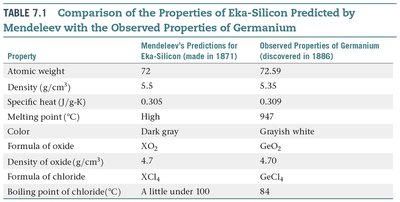
Dmitri Mendeleev is credited with organizing the periodic table based on both atomic mass and chemical properties, predicting the existence and properties of elements such as germanium before their discovery.
Prediction: Mendeleev predicted properties of "eka-silicon" (germanium) with remarkable accuracy.
Application: The periodic table allows chemists to predict element properties and reactivity.
Property | Mendeleev's Prediction (Eka-Silicon) | Observed Germanium |
|---|---|---|
Atomic weight | 72 | 72.59 |
Density (g/cm3) | 5.5 | 5.35 |
Specific heat (J/g·K) | 0.305 | 0.320 |
Melting point (°C) | High | 947 |
Color | Dark gray | Grayish white |
Formula of oxide | XO2 | GeO2 |
Density of oxide (g/cm3) | 4.7 | 4.70 |
Formula of chloride | XCl4 | GeCl4 |
Boiling point of chloride (°C) | A little under 100 | 84 |
Effective Nuclear Charge (Zeff)
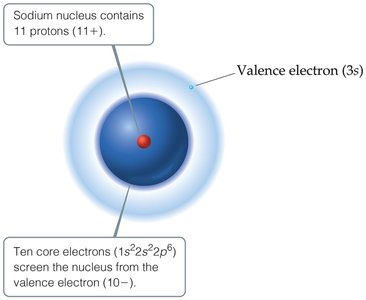
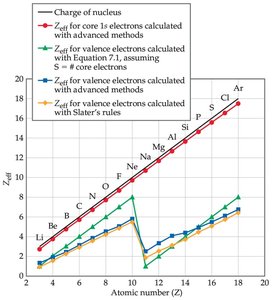
Effective nuclear charge is the net positive charge experienced by valence electrons, accounting for both attraction to the nucleus and repulsion by inner electrons. It is a key factor in determining atomic and ionic properties.
Formula: (where Z is atomic number, S is the screening constant).
Trend: Increases across a period and slightly down a group.
Impact: Influences atomic size, ionization energy, and electron affinity.
Atomic Size and Radii
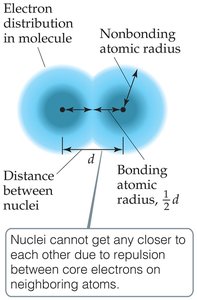
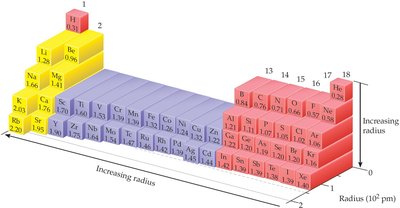
The size of an atom can be described by its nonbonding (van der Waals) radius and bonding (covalent) radius. These radii are determined by the distances between nuclei in molecules or collisions.
Nonbonding atomic radius: Half the shortest distance between nuclei during atomic collisions.
Bonding atomic radius: Half the distance between nuclei in a bond.
Trend: Atomic radius decreases across a period (Zeff increases), increases down a group (n increases).
Sizes of Ions
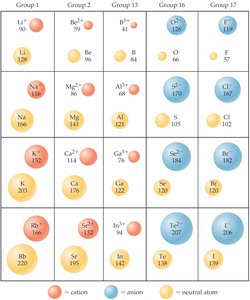
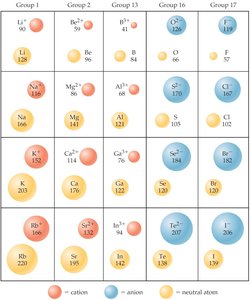
Ionic size is determined by interatomic distances in ionic compounds and depends on nuclear charge, number of electrons, and electron orbitals. Cations are smaller than their parent atoms, while anions are larger.
Cations: Smaller than parent atoms due to loss of outermost electron and reduced electron repulsion.
Anions: Larger than parent atoms due to addition of electrons and increased repulsion.
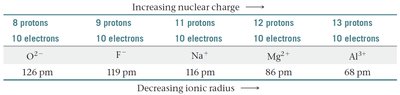
Isoelectronic series: Ions with the same number of electrons; size decreases with increasing nuclear charge.
Ion | Protons | Electrons | Ionic Radius (pm) |
|---|---|---|---|
O2– | 8 | 10 | 126 |
F– | 9 | 10 | 119 |
Na+ | 11 | 10 | 116 |
Mg2+ | 12 | 10 | 86 |
Al3+ | 13 | 10 | 68 |
Ionization Energy
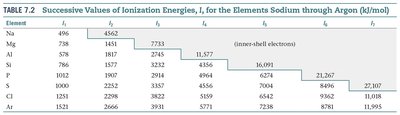
Ionization energy is the minimum energy required to remove an electron from a gaseous atom or ion. Successive ionization energies increase as more electrons are removed, especially after all valence electrons are gone.
First ionization energy (I1): Energy to remove the first electron.
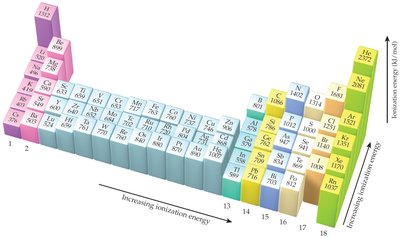
Trend: I1 increases across a period, decreases down a group.
Factors: Effective nuclear charge and distance from nucleus.
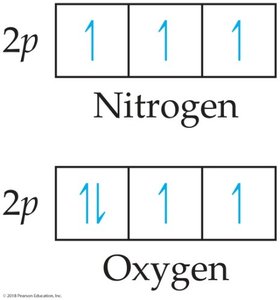
Irregularities: Occur when electrons enter new sublevels or pair in orbitals.
Electron Configurations of Ions
The electron configuration of ions is determined by the removal or addition of electrons. Cations lose electrons from the highest energy level, while anions gain electrons to fill their outermost shell.
Cations: Electrons are lost from the highest n value.
Anions: Electrons are added to fill ns2np6 configuration.
Example: Li+ is 1s2; F– is 1s22s22p6.
Electron Affinity
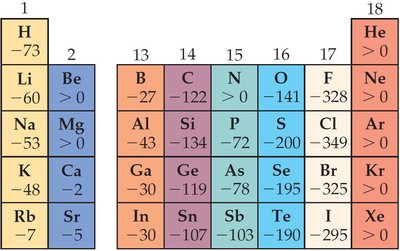
Electron affinity is the energy change when an electron is added to a gaseous atom. It is typically exothermic (negative), but some elements have positive electron affinity due to instability.
Trend: Generally increases across a period; little change down a group.
Exceptions: Group 2A (s sublevel full), Group 5A (p sublevel half-full), Group 8A (p sublevel full).
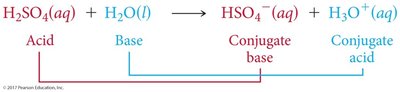
Equation:
Electronegativity
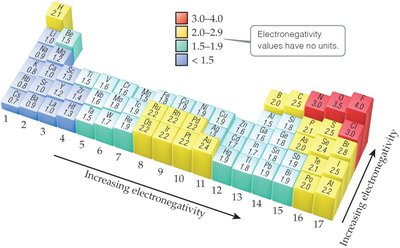
Electronegativity is the ability of an atom in a molecule to attract electrons to itself. It increases from left to right across a period and from bottom to top of a group.
Trend: Highest in fluorine, lowest in alkali metals.
Application: Determines bond polarity and molecular properties.
Polar Covalent Bonds and Dipoles
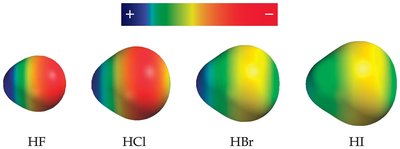
When two atoms share electrons unequally, a polar covalent bond forms, resulting in partial charges (δ– and δ+). The greater the difference in electronegativity, the more polar the bond. Dipole moments quantify the separation of charge.
Dipole moment (μ): (Q = charge, r = distance).
Measured in: Debyes (D).
Example: Hydrogen halides (HF, HCl, HBr, HI) show increasing bond length and decreasing dipole moment.
Compound | Bond Length (pm) | Electronegativity Difference | Dipole Moment (D) |
|---|---|---|---|
HF | 92 | 1.9 | 1.82 |
HCl | 127 | 0.9 | 1.08 |
HBr | 141 | 0.7 | 0.82 |
HI | 161 | 0.4 | 0.44 |
Summary Table: Key Periodic Properties
Property | Trend Across Period | Trend Down Group |
|---|---|---|
Atomic Radius | Decreases | Increases |
Ionization Energy | Increases | Decreases |
Electron Affinity | Generally increases | Little change |
Electronegativity | Increases | Decreases |
