 Back
BackPhotosynthesis and Cellular Respiration Study Guide with Step-by-Step Guidance
Study Guide - Smart Notes
 Tailored notes based on your materials, expanded with key definitions, examples, and context.
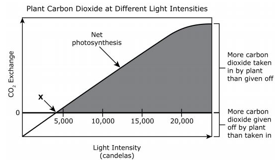
Q8. Label the portion of the graph where cell respiration is occurring and the portion where photosynthesis is occurring.
Background
Topic: Photosynthesis vs. Cellular Respiration (CO2 Exchange)
This question tests your understanding of how plants exchange carbon dioxide during photosynthesis and cellular respiration, and how this exchange changes with varying light intensities.
Key Terms and Concepts:
Photosynthesis: The process by which plants use light energy to convert CO2 and water into glucose and oxygen.
Cellular Respiration: The process by which cells break down glucose to produce energy, releasing CO2 as a byproduct.
CO2 Exchange: The net movement of carbon dioxide into or out of the plant.
Light Intensity: The amount of light available for photosynthesis.
Step-by-Step Guidance
Examine the graph's axes: The x-axis shows light intensity, and the y-axis shows CO2 exchange.
Notice the region below the x-axis (negative CO2 exchange): This indicates more CO2 is being released than taken in—this is where cellular respiration dominates.
Identify the region above the x-axis (positive CO2 exchange): Here, more CO2 is being taken in than released—this is where photosynthesis dominates.
Find the point where the curve crosses the x-axis: This is the light compensation point, where the rates of photosynthesis and respiration are equal.
Try solving on your own before revealing the answer!
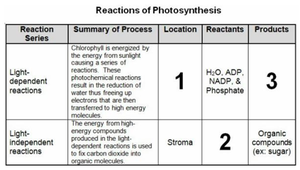
Q9. List the information that should be used to fill boxes 1-3 in the photosynthesis reactions table.
Background
Topic: Photosynthesis Reactions (Light-dependent and Light-independent)
This question tests your knowledge of the locations, reactants, and products of the two main stages of photosynthesis.
Key Terms and Concepts:
Light-dependent reactions: Occur in the thylakoid membranes and require light to produce ATP and NADPH.
Light-independent reactions (Calvin Cycle): Occur in the stroma and use ATP and NADPH to fix carbon dioxide into organic molecules.
Step-by-Step Guidance
Box 1: Consider where the light-dependent reactions occur within the chloroplast (think about the structure where chlorophyll is found).
Box 2: For the light-independent reactions, identify the main reactant that is fixed into organic compounds (hint: it's a gas from the atmosphere).
Box 3: For the light-dependent reactions, determine the main products that are used in the next stage (think about energy carriers).
Try solving on your own before revealing the answer!
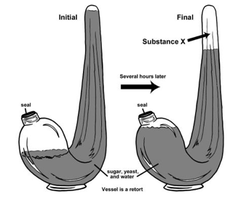
Q34. Analyze the setup below, what is substance “X”? Explain.
Background
Topic: Fermentation and Gas Production
This question tests your understanding of fermentation in yeast and the identification of gases produced during this process.
Key Terms and Concepts:
Fermentation: An anaerobic process by which cells release energy from glucose without using oxygen.
Yeast: A microorganism that can perform fermentation, producing ethanol and a gas as byproducts.
Gas Collection: The setup shows a vessel with sugar, yeast, and water, and a tube collecting a gas (substance X) over time.
Step-by-Step Guidance
Recall what happens when yeast ferments sugar in the absence of oxygen (think about the products of alcoholic fermentation).
Consider what gas is commonly produced and collected in such an experimental setup (think about what causes bread to rise).
Look at the change in the tube over time—what does the accumulation of substance X indicate about the metabolic process?
Try solving on your own before revealing the answer!
Final Answer for Q8:
The portion below the x-axis (negative CO2 exchange) is where cell respiration is occurring. The portion above the x-axis (positive CO2 exchange) is where photosynthesis is occurring.
Final Answer for Q9:
Box 1: Thylakoid membrane
Box 2: CO2
Box 3: ATP and NADPH
Final Answer for Q34:
Substance X is carbon dioxide (CO2). It is produced as yeast ferments sugar anaerobically, releasing CO2 as a byproduct.
