 Back
BackPractice Problems: Gas Laws, Changes of State, and Intermolecular Forces
Study Guide - Smart Notes
 Tailored notes based on your materials, expanded with key definitions, examples, and context.
Q1. A pilot undergoes altitude training. He starts his training at an atmospheric pressure of 762 mmHg, where his lungs hold 6.00 L of air. He changes altitude, and his lungs expand to hold 6.25 L of air. What is the new atmospheric pressure in mmHg?
Background
Topic: Gas Laws (Boyle's Law)
This question tests your understanding of Boyle's Law, which describes the relationship between pressure and volume for a fixed amount of gas at constant temperature.
Key formula:
Where:
= initial pressure (762 mmHg)
= initial volume (6.00 L)
= final pressure (unknown)
= final volume (6.25 L)
Step-by-Step Guidance
Identify the known values: mmHg, L, L.
Write Boyle's Law equation: .
Rearrange the equation to solve for : .
Set up the calculation by plugging in the values, but do not compute the final answer yet.
Try solving on your own before revealing the answer!

Final Answer: 731 mmHg
The pressure decreases as the volume increases, consistent with Boyle's Law.
Q2. A child's balloon containing 8.5 L of helium gas at sea level is released and floats away. What will the volume of the helium be when the balloon rises to the point where the atmospheric pressure is 380 mmHg?
Background
Topic: Gas Laws (Boyle's Law)
This question also tests your ability to use Boyle's Law to predict how the volume of a gas changes as pressure changes, assuming constant temperature.
Key formula:
Where:
= initial pressure (760 mmHg)
= initial volume (8.5 L)
= final pressure (380 mmHg)
= final volume (unknown)
Step-by-Step Guidance
Identify the known values: mmHg, L, mmHg.
Write Boyle's Law equation: .
Rearrange the equation to solve for : .
Set up the calculation by plugging in the values, but do not compute the final answer yet.
Try solving on your own before revealing the answer!

Final Answer: 17 L
The volume increases as the pressure decreases, as predicted by Boyle's Law.
Q3. Name the change of state occurring for each:
a. ice forming on a puddle of water during the winter
b. dew forming on grass
c. water boiling
Background
Topic: Changes of State
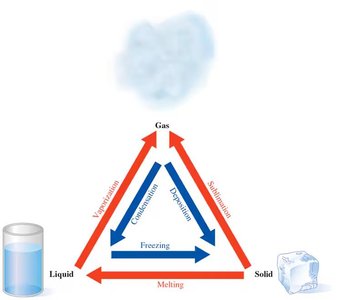
This question tests your knowledge of the terminology for phase changes between solid, liquid, and gas.
Key Terms:
Freezing: Liquid to solid
Condensation: Gas to liquid
Vaporization (Boiling): Liquid to gas
Step-by-Step Guidance
For part (a), identify the initial and final states (liquid to solid).
For part (b), identify the initial and final states (gas to liquid).
For part (c), identify the initial and final states (liquid to gas).
Match each process to the correct term from the list above.
Try solving on your own before revealing the answer!
Final Answers:
a. Freezing
b. Condensation
c. Vaporization (Boiling)
Each process corresponds to a specific change of state as shown in the diagram.
Q4. Identify the strongest attractive force present in the pure substances shown.
a. one of the first anesthetics, diethyl ether, CHCHOCHCH
b. rubbing alcohol, isopropanol, CHCH(OH)CH
c. the ozone-depleting substance trichloroethane, CClCH
Background
Topic: Intermolecular Forces
This question tests your ability to identify the strongest type of intermolecular force present in different molecules based on their structure and functional groups.
Key Terms:
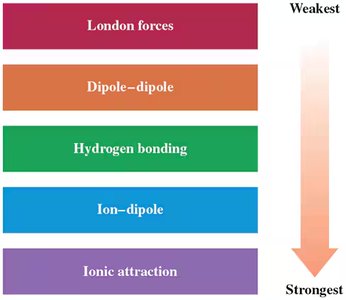
London Dispersion Forces: Present in all molecules, especially nonpolar.
Dipole-Dipole: Present in polar molecules.
Hydrogen Bonding: Present when H is bonded to N, O, or F.
Step-by-Step Guidance
For each molecule, determine if it is polar or nonpolar.
Check if hydrogen bonding is possible (look for H bonded to N, O, or F).
Identify the strongest force present based on the molecule's structure.
Use the chart to compare the relative strengths of the forces.
Try solving on your own before revealing the answer!
Final Answers:
a. Dipole-dipole
b. Hydrogen bonding
c. London dispersion
Hydrogen bonding is the strongest among these when present, followed by dipole-dipole and then London dispersion.
