 Back
Properties of Solutions – GOB Chemistry Study Notes
Study Guide - Smart Notes
 Tailored notes based on your materials, expanded with key definitions, examples, and context.
Properties of Solutions
Introduction to Solutions
Solutions are homogeneous mixtures composed of two or more pure substances. In a solution, the solute is the substance present in the smaller amount, while the solvent is present in the larger amount. The solute is uniformly dispersed throughout the solvent, resulting in a single phase.
Homogeneous mixture: Uniform composition throughout.
Solute: Substance dissolved (smaller amount).
Solvent: Substance doing the dissolving (larger amount).
Example: In a soft drink, sugar and CO2 are solutes, water is the solvent.

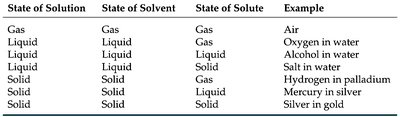
Solutions can exist in different states depending on the physical states of the solute and solvent.
State of Solution | State of Solvent | State of Solute | Example |
|---|---|---|---|
Gas | Gas | Gas | Air |
Liquid | Liquid | Gas | Oxygen in water |
Liquid | Liquid | Liquid | Alcohol in water |
Liquid | Liquid | Solid | Salt in water |
Solid | Solid | Gas | Hydrogen in palladium |
Solid | Solid | Liquid | Mercury in silver |
Solid | Solid | Solid | Silver in gold |
The Solution Process
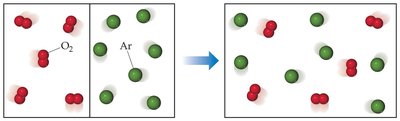
The formation of solutions is driven by two main factors: the natural tendency toward mixing (increasing entropy) and the effect of intermolecular forces. Mixing increases randomness (entropy), which is thermodynamically favored.
Entropy: A measure of disorder or randomness. Mixing increases entropy.
Intermolecular forces: Attractions between solute and solvent molecules must be strong enough to allow mixing.
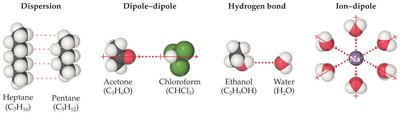
Types of intermolecular forces include dispersion, dipole-dipole, hydrogen bonding, and ion-dipole interactions.
Saturated, Unsaturated, and Supersaturated Solutions
Solubility is the maximum amount of solute that can dissolve in a given amount of solvent at a specific temperature. Solutions can be classified as:
Saturated: Contains the maximum amount of dissolved solute at equilibrium. Additional solute will not dissolve.
Unsaturated: Contains less solute than the maximum amount; more solute can dissolve.
Supersaturated: Contains more solute than is normally possible at that temperature; unstable and can crystallize easily.
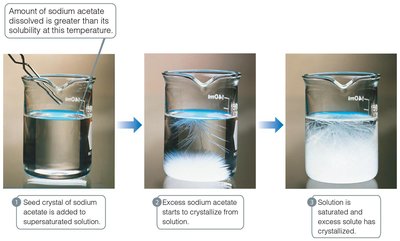
Dynamic equilibrium exists in saturated solutions between dissolved and undissolved solute.
Factors Affecting Solubility
Solubility depends on the nature of the solute and solvent, temperature, and pressure (for gases). The principle "like dissolves like" applies: polar solutes dissolve in polar solvents, nonpolar in nonpolar.
Solute-solvent interactions: The more similar the intermolecular attractions, the greater the solubility.
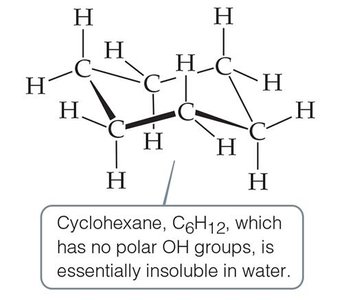
Examples: Glucose (hydrogen bonding) is very soluble in water; cyclohexane (dispersion forces only) is not.
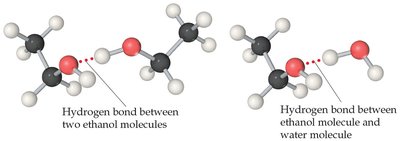
Vitamins illustrate solubility differences: Vitamin A (nonpolar) dissolves in fats, Vitamin C (polar) dissolves in water.
Solubility of Gases
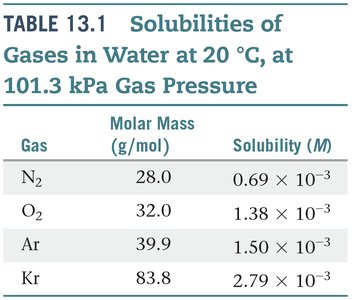
Solubility of gases in water increases with molecular mass due to stronger dispersion forces.
Solubility of gases decreases with increasing temperature.
Solubility of gases increases with increasing pressure (Henry's Law).
Gas | Molar Mass (g/mol) | Solubility (M) |
|---|---|---|
N2 | 28.0 | 0.69 × 10⁻³ |
O2 | 32.0 | 1.38 × 10⁻³ |
Ar | 39.9 | 1.50 × 10⁻³ |
Kr | 83.8 | 2.79 × 10⁻³ |
Henry's Law
The solubility of a gas in a liquid is directly proportional to the partial pressure of the gas above the solution:
Sg: Solubility of the gas (usually in molarity)
k: Henry's Law constant (depends on gas, solvent, temperature)
Pg: Partial pressure of the gas
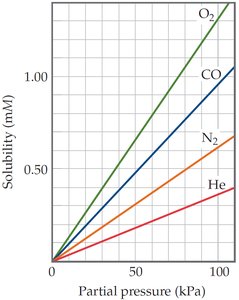
Applications include carbonated beverages and scuba diving safety.


Temperature Effects
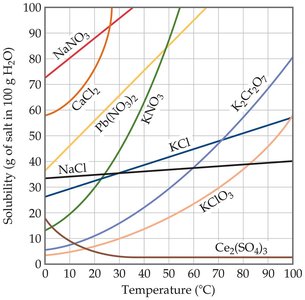
Solubility of most solid solutes in liquid solvents increases with temperature.
Solubility of gases in liquids decreases with increasing temperature.
Concentration Units
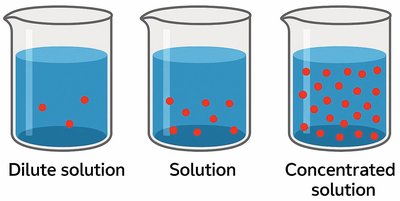
Concentration expresses the amount of solute in a given quantity of solvent or solution. Common units include:
Molarity (M): Moles of solute per liter of solution.
Molality (m): Moles of solute per kilogram of solvent.
Mass percent (%):
Parts per million (ppm):
Parts per billion (ppb):
Mole fraction (χ):
Preparation of Standard Solutions
Calculate required mass of solute using molarity equation.
Weigh solute, dissolve in water, transfer to volumetric flask, dilute to mark, mix thoroughly.
Dilution
To prepare a dilute solution from a concentrated stock:
M1, V1: Initial concentration and volume
M2, V2: Final concentration and volume
Colligative Properties
Colligative properties depend only on the number of solute particles, not their identity. These include:
Vapor-pressure lowering
Boiling-point elevation
Freezing-point depression
Osmosis
Vapor Pressure Lowering (Raoult's Law)
The vapor pressure of a solution is lower than that of the pure solvent. Raoult's Law quantifies this:
PA: Vapor pressure of solvent A in solution
XA: Mole fraction of solvent A
PA∘: Vapor pressure of pure solvent A
Boiling-Point Elevation
The boiling point of a solution is higher than that of the pure solvent:
ΔTb: Boiling point elevation
Kb: Molal boiling-point elevation constant
m: Molality of solution
i: van 't Hoff factor (number of particles per formula unit)
Freezing-Point Depression
The freezing point of a solution is lower than that of the pure solvent:
ΔTf: Freezing point depression
Kf: Molal freezing-point depression constant
m: Molality of solution
i: van 't Hoff factor
Osmosis and Osmotic Pressure
Osmosis is the movement of solvent through a semipermeable membrane from a region of lower solute concentration to higher solute concentration. The pressure required to stop osmosis is the osmotic pressure (π):
π: Osmotic pressure
M: Molarity of solution
R: Gas constant
T: Temperature in Kelvin
In biological systems, osmotic pressure differences can cause cells to shrink (crenation) or burst (hemolysis).
Determination of Molar Mass Using Colligative Properties
Colligative properties such as osmotic pressure, freezing-point depression, and boiling-point elevation can be used to determine the molar mass of an unknown solute. By measuring the effect and knowing the amount of solute and solvent, the molar mass can be calculated using the relevant equations above.
