 Back
Radioactivity and Radioisotopes: Forms, Effects, and Protection
Study Guide - Smart Notes
 Tailored notes based on your materials, expanded with key definitions, examples, and context.
Radioactivity and Radioisotopes
Definition and Nature of Radioactivity
Radioactivity is the spontaneous emission of energy from the nucleus of an unstable atom, a process known as nuclear radiation. Elements that emit this energy are termed radioactive. Radiation can originate from both natural sources (such as sunlight and cosmic rays) and human-made sources (such as microwave ovens and communication devices).
Nuclear radiation: Energy released from the nucleus of unstable atoms.
Radioactive elements: Elements that emit nuclear radiation.
Radioisotopes: Isotopes with unstable nuclei that emit radiation to become stable.
All isotopes of elements with atomic number 83 or higher are radioactive; some lighter elements also have radioisotopes.
Forms of Nuclear Radiation
There are several types of nuclear radiation, each with distinct properties and symbols. The main forms are:
Alpha (α) particles: Positively charged, represented as or ; consists of two protons and two neutrons (a helium nucleus).
Beta (β) particles: Negatively charged, represented as or ; high-energy electrons emitted when a neutron converts to a proton.
Gamma (γ) rays: Neutral, represented as ; high-energy electromagnetic radiation emitted during nuclear rearrangement, with no mass or charge.
Positrons: Positively charged, represented as ; same mass as beta particles but with a positive charge, emitted when a proton converts to a neutron.
Neutrons: Neutral, represented as ; can be used to induce radioactive decay in other nuclei.
Emission | Symbol | Charge |
|---|---|---|
Alpha | or | 2+ |
Beta | or | 1- |
Gamma | 0 | |
Positron | 1+ | |
Neutron | 0 |
Penetrating Power and Shielding of Radiation
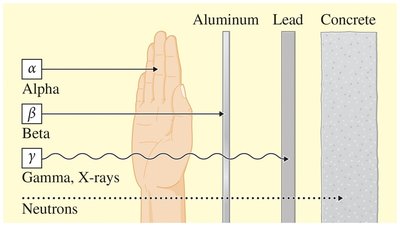
The ability of different types of radiation to penetrate materials and biological tissues varies significantly. Understanding these differences is crucial for safety and medical applications.
Type | Travel Distance Through Air | Tissue Penetration | Protective Shielding |
|---|---|---|---|
Alpha (α) | A few centimeters | Stops at skin surface; dangerous only if inhaled or ingested | Paper, clothing |
Beta (β) | A few meters | Will not penetrate past skin layer | Heavy clothing, plastic, aluminum foil, gloves |
Gamma (γ) | Several hundred meters | Fully penetrates body | Thick lead, concrete, water layer |
X-ray | Several meters | Penetrates tissues but not bone | Lead apron, concrete barrier |
Neutron (n) | Hundreds to thousands of meters | Fully penetrates body | Concrete barrier, water layer |
Biological Effects of Radiation
Ionizing radiation (alpha, beta, gamma, positrons, neutrons, and X-rays) can remove electrons from atoms, making them more reactive and less stable. In living organisms, this can damage cells and genetic material, potentially leading to cancer and other health issues. The depth of tissue penetration depends on the type and energy of the radiation.
High-energy radiation penetrates deeper into tissues, affecting cells located further from the surface.
Protective measures include lab coats, gloves, lead shields, and film badges to monitor exposure.
Measuring Radiation Exposure
The sievert (Sv) is the SI unit for measuring the biological effect of radiation. The average annual dose is about 6.2 millisieverts (mSv). One millirem (mrem) is equal to 1/100,000 Sv. Everyday exposure comes from cosmic rays, radon gas, and naturally occurring radioactive elements. Medical procedures have increased average exposure in recent decades.
Radiation Sickness and Clinical Effects
The effects of radiation depend on both the dose and the duration of exposure. Short-term, high-dose exposure is more dangerous than long-term, low-dose exposure. Rapidly dividing cells are more susceptible to damage.
Exposure (mrem) | Clinical Effect |
|---|---|
5,000–20,000 | Cannot be detected |
20,000–50,000 | Temporary decrease in white blood cells (WBCs) |
50,000–100,000 | Mild radiation sickness: large decrease in WBCs, nausea, vomiting |
100,000–200,000 | Light radiation poisoning: delayed appetite loss, nausea, diarrhea, hair loss, spontaneous abortion in pregnant women; recovery in 3 months |
200,000–300,000 | Moderate radiation poisoning: hair loss, fatigue, general illness, possible permanent sterility; recovery takes several months |
300,000–400,000 | LD50: Lethal dose for half the population after 30 days |
Summary of Key Concepts
Radioactivity is the emission of energy from unstable atomic nuclei.
There are several forms of ionizing radiation, each with different properties and biological effects.
Penetrating power and required shielding vary by radiation type.
Radiation exposure is measured in sieverts (Sv) or millirems (mrem), and effects depend on dose and exposure time.
Understanding these concepts is essential for safe handling and medical applications of radioactive materials.
