 Back
BackRates of Reaction and Collision Theory Study Guidance
Study Guide - Smart Notes
 Tailored notes based on your materials, expanded with key definitions, examples, and context.
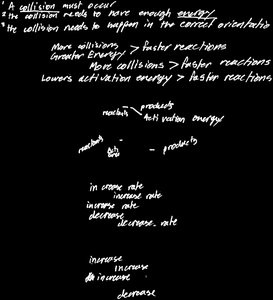
Q1. Describe the three conditions required for a collision to occur.
Background
Topic: Collision Theory and Rates of Reaction
This question tests your understanding of the fundamental requirements for a chemical reaction to occur, according to collision theory. Collision theory explains how and why chemical reactions happen at the molecular level.
Key Terms:
Collision Theory: A model that explains how chemical reactions occur and why reaction rates differ for different reactions.
Activation Energy: The minimum energy required for a reaction to occur.
Orientation: The spatial arrangement of molecules during collision.
Step-by-Step Guidance
Recall that for a reaction to occur, reactant particles must collide. Not all collisions result in a reaction—only those that meet certain criteria.
Think about the energy involved in collisions. The particles must have enough kinetic energy to overcome the activation energy barrier. If the energy is too low, the particles will simply bounce off each other.
Consider the orientation of the colliding particles. Even if they have enough energy, the collision must occur in a way that allows the correct atoms to interact and form new bonds.
Try to list and describe these three conditions in your own words, focusing on the importance of each for a successful reaction.
Try solving on your own before revealing the answer!
Final Answer:
A collision must occur between reactant particles.
The collision must have enough energy (activation energy) to break bonds and form new ones.
The particles must collide with the correct orientation for the reaction to take place.
These three conditions ensure that only certain collisions lead to product formation, explaining why not every collision results in a chemical reaction.
