Back
Scientific Notation, Significant Figures, and Measurement in Chemistry
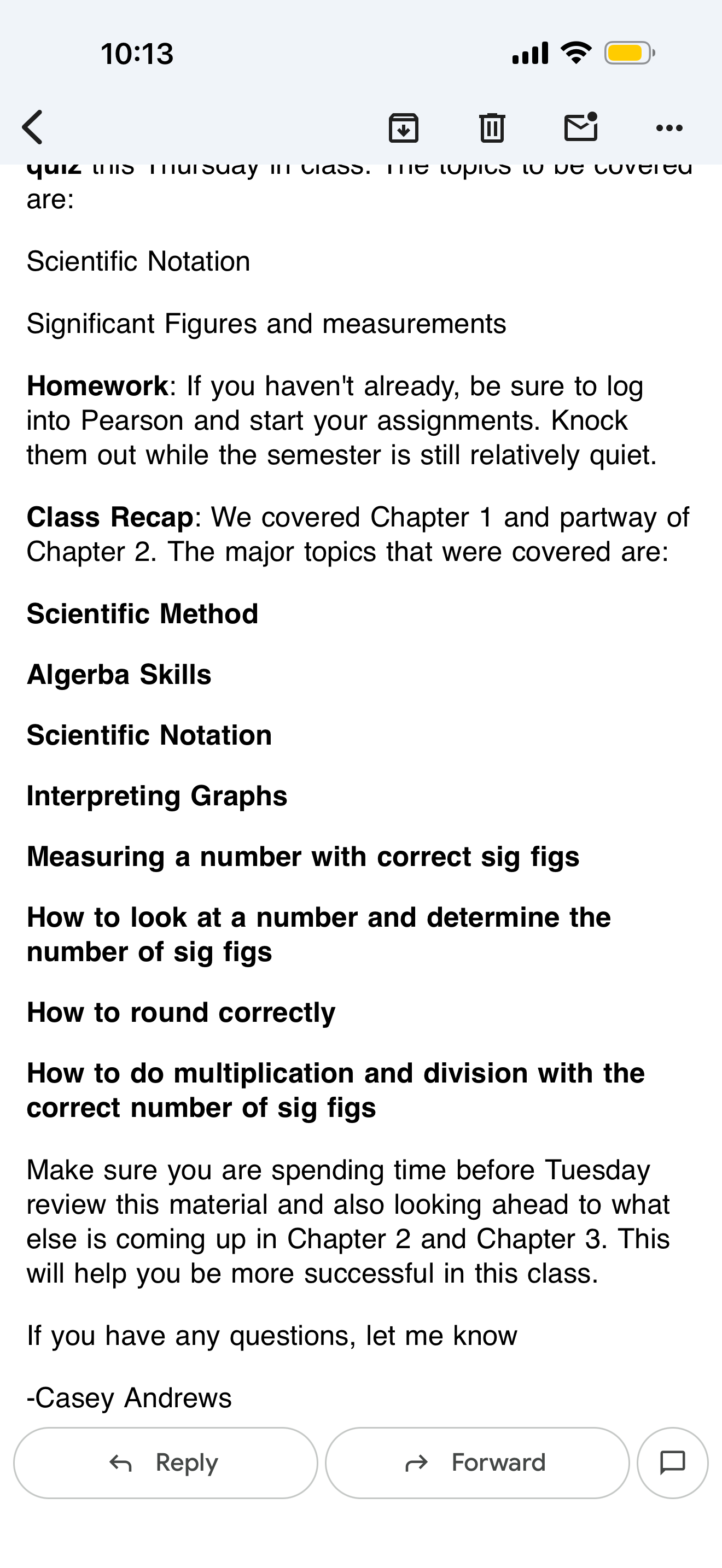
Study Guide - Smart Notes
 Tailored notes based on your materials, expanded with key definitions, examples, and context.
Scientific Method and Measurement in Chemistry
Scientific Method
The scientific method is a systematic approach used by scientists to explore observations, answer questions, and solve problems. It ensures that scientific inquiry is logical, repeatable, and based on evidence.
Steps of the Scientific Method:
Observation: Gathering data and noticing phenomena.
Question: Formulating a question based on observations.
Hypothesis: Proposing a testable explanation.
Experiment: Testing the hypothesis through controlled experiments.
Analysis: Interpreting data and drawing conclusions.
Conclusion: Accepting, rejecting, or modifying the hypothesis.
Example: Observing that a plant grows faster in sunlight, hypothesizing that sunlight increases growth, and testing this with two groups of plants.
Algebra Skills in Chemistry
Basic algebra is essential for solving chemical equations, converting units, and manipulating formulas. Students should be comfortable with rearranging equations and solving for unknowns.
Example: Solving for mass in the equation , where d is density, m is mass, and v is volume.
Scientific Notation
Definition and Purpose
Scientific notation is a way to express very large or very small numbers in a compact form, making calculations easier and reducing errors.
Format: , where and is an integer.
Example: 0.00056 = ; 120,000 =
Application: Used for measurements in chemistry, such as Avogadro's number ().
Significant Figures and Measurements
Significant Figures (Sig Figs)
Significant figures are the digits in a measurement that are known with certainty plus one digit that is estimated. They reflect the precision of a measurement.
Rules for Counting Significant Figures:
All nonzero digits are significant (e.g., 123 has 3 sig figs).
Zeros between nonzero digits are significant (e.g., 1002 has 4 sig figs).
Leading zeros are not significant (e.g., 0.0045 has 2 sig figs).
Trailing zeros after a decimal point are significant (e.g., 2.300 has 4 sig figs).
Trailing zeros in a whole number with no decimal shown are ambiguous (e.g., 1500 could have 2, 3, or 4 sig figs).
Example: 0.070 has 2 significant figures; 1.0050 has 5 significant figures.
Measuring with Correct Significant Figures
When recording a measurement, include all certain digits plus one estimated digit. The number of significant figures reflects the instrument's precision.
Example: If a ruler measures to the nearest millimeter, 12.34 cm is recorded (4 sig figs).
Determining the Number of Significant Figures
To determine the number of significant figures in a number, apply the rules above. This is crucial for reporting results accurately in chemistry.
Example: 0.00340 has 3 significant figures (3, 4, and the trailing zero).
Rounding Numbers
Rounding is used to adjust the number of significant figures in a result. The rules depend on the digit following the last significant figure to be retained.
If the next digit is less than 5, round down.
If the next digit is 5 or greater, round up.
Example: Rounding 2.346 to 3 sig figs gives 2.35.
Multiplication and Division with Significant Figures
When multiplying or dividing, the result should have the same number of significant figures as the measurement with the fewest significant figures.
Example: (but should be reported as 8.6, since 2.5 has 2 sig figs).
Interpreting Graphs
Graphs are used to visually represent data in chemistry. Understanding how to read and interpret graphs is essential for analyzing trends and relationships between variables.
Key Points:
Identify axes and units.
Determine the relationship (direct, inverse, etc.).
Extract data points accurately.
Example: A graph showing temperature vs. solubility can reveal how solubility changes with temperature.
Additional info: These foundational skills are essential for success in GOB Chemistry, as they underpin accurate measurement, data analysis, and scientific communication throughout the course.