 Back
Solutions and Solubility in GOB Chemistry
Study Guide - Smart Notes
 Tailored notes based on your materials, expanded with key definitions, examples, and context.
Solutions
Definition and Properties
A solution is a homogeneous mixture composed of at least one solute uniformly dissolved in a solvent. The physical state of the solution is determined by the state of the solvent. Solutions can involve solutes and solvents in any phase (solid, liquid, or gas).
Solute: The substance dissolved in the solvent.
Solvent: The substance in which the solute is dissolved; determines the phase of the solution.
Types of Liquid Mixtures
Liquid mixtures can be classified based on their uniformity and particle size:
Solution: Homogeneous, transparent, not easily separable (e.g., salt in water).
Colloid: Heterogeneous, opaque, not easily separable (e.g., milk, mayonnaise).
Suspension: Heterogeneous, opaque, easily separable (e.g., blood, matcha).
Dissolving and Solubility
Dissolving Process
Dissolving is a physical process where a solute in any phase dissolves in a solvent to form a solution. For ionic compounds, this involves ion-dipole interactions.
Example: Dissolving NaCl in water:
Writing Dissociation Equations:
Solubility Rules
Solubility depends on the nature of the solute and solvent. The rule of thumb is "like dissolves like": polar solutes dissolve in polar solvents, nonpolar in nonpolar.
Polar + Polar: Soluble (e.g., sugar in water)
Nonpolar + Nonpolar: Soluble (e.g., oil in hexane)
Polar + Nonpolar: Insoluble (e.g., oil in water)
Hydrogen bonding is a special interaction between H and N, O, or F atoms, increasing solubility in water.
Controlling Solubility
Increasing temperature typically increases solubility of solids in liquids.
Solubility can be affected by pressure (especially for gases).
Saturation Levels
Unsaturated Solution: Can dissolve more solute.
Saturated Solution: Cannot dissolve more solute; equilibrium reached.
Supersaturated Solution: Contains more solute than can normally be dissolved; unstable and may form crystals.
Electrolytes and Conductivity
Electrolyte Classification
Electrolytes are substances that produce ions when dissolved in water, allowing the solution to conduct electricity. They are classified as strong, weak, or nonelectrolytes.
Strong Electrolyte: Dissociates completely into ions; conducts electricity well.
Weak Electrolyte: Partially dissociates; conducts electricity weakly.
Nonelectrolyte: Does not dissociate; does not conduct electricity.
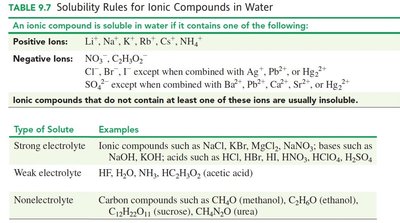
Solubility Rules for Ionic Compounds in Water
Solubility rules help predict whether an ionic compound will dissolve in water:
Soluble if contains: Li+, Na+, K+, Rb+, Cs+, NH4+, NO3-, C2H3O2-
Cl-, Br-, I-: Soluble except with Ag+, Pb2+, Hg22+
SO42-: Soluble except with Ba2+, Pb2+, Ca2+, Sr2+, Hg22+
Compounds not containing these ions: Usually insoluble
Concentration of Solutions
Concentration Expressions
The concentration of a solution is the amount of solute per amount of solution. Common expressions include:
Mass Percent (m/m):
Volume Percent (v/v):
Mass/Volume Percent (m/v):
Molarity (M):
Dilution
Dilution reduces the concentration of a solute by adding more solvent. The relationship is:
Where and are initial concentration and volume, and are final concentration and volume.
Osmosis
Osmosis and Solution Types
Osmosis is the movement of water through a semipermeable membrane from low solute concentration to high solute concentration. It only occurs with true solutions, not colloids or suspensions.
Isotonic: Equal solute concentration inside and outside the cell.
Hypotonic: Lower solute concentration outside; cell swells.
Hypertonic: Higher solute concentration outside; cell shrinks.
Equivalents (Eq)
Definition and Calculation
An equivalent (Eq) is a unit measuring the chemical activity and electrical charge of ions in solution.
1 mol Na+ = 1 Eq
1 mol Ca2+ = 2 Eq
1 mol Fe3+ = 3 Eq
1 mol CO32- = 2 Eq
Example: To find equivalents, multiply moles by the ion charge.
