 Back
BackSolutions and Solubility: Molecular Interactions and Effects
Study Guide - Smart Notes
 Tailored notes based on your materials, expanded with key definitions, examples, and context.
Solutions and Solubility
Definition and Types of Solutions
Solutions are homogeneous mixtures with particle sizes smaller than 2.0 nm, allowing light to pass through without scattering. This transparency distinguishes solutions from colloids and suspensions, which have larger particles and appear cloudy or opaque. Solutions cannot be separated by centrifugation, unlike suspensions.
Solvent: The substance in which other materials are dissolved (usually the liquid).
Solute: The substance dissolved in the solvent.
Solvolysis: The molecular process by which a solute dissolves in a solvent.
Types of solutions: Can be solid, liquid, or gas dissolved in a liquid. Examples include saltwater (solid in liquid), rubbing alcohol (liquid in liquid), air (gas in gas), and alloys (solid in solid).
Example: In saltwater, NaCl is the solute and water is the solvent. In rubbing alcohol (70% alcohol, 30% water), alcohol is the solvent.
Why Solutions Form: Molecular Interactions
The formation of solutions depends on favorable interactions between solvent and solute molecules. These interactions are primarily based on the attraction between opposite charges, such as ions or dipoles. Ionic compounds dissolve well in polar solvents due to ion-dipole interactions, while nonpolar compounds dissolve in nonpolar solvents due to London Dispersion Forces.
Ionic compounds: Dissolve in polar solvents (e.g., NaCl in water).
Polar molecules: Dissolve in polar solvents due to dipole-dipole or hydrogen bonding.
Nonpolar molecules: Dissolve in nonpolar solvents due to London Dispersion Forces.
Example: Methyl alcohol (CH3OH) is polar and dissolves in water. Butane (C4H10) is nonpolar and does not dissolve in water.
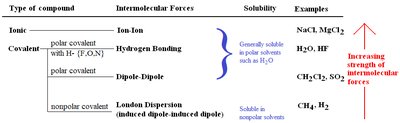
Additional info: The table above summarizes the relationship between compound type, intermolecular forces, solubility, and examples. It shows that ionic and polar covalent compounds are generally soluble in polar solvents, while nonpolar covalent compounds are soluble in nonpolar solvents.
Solubility Examples: Polar vs. Nonpolar Molecules
Solubility depends on molecular polarity and the type of intermolecular forces present. Polar molecules, such as methyl alcohol, interact favorably with water and dissolve in all proportions. Nonpolar molecules, such as butane, are excluded from polar solvents and form separate layers.
Polar gases: Ammonia (NH3) and hydrochloric acid (HCl) dissolve readily in water.
Nonpolar gases: Oxygen (O2) and carbon dioxide (CO2) dissolve to some extent in water, but are more soluble in nonpolar solvents.

Additional info: The image above shows the structural formulas of methyl alcohol (polar) and butane (nonpolar), illustrating their solubility differences in water.
External Effects on Solubility
Solubility is not absolute; compounds can be slightly soluble or mostly insoluble. External factors such as temperature and pressure can affect solubility:
Temperature: Increasing temperature generally increases the solubility of solids in liquids due to greater entropy (disorder).
Pressure: Increasing the pressure of a gas above a liquid increases the solubility of the gas in the liquid (e.g., carbonated beverages).
Thermodynamics: The spontaneity of dissolving depends on both enthalpy (heat energy) and entropy (disorder). For solids, increasing temperature favors dissolution. For gases, increasing pressure favors dissolution.
Example: Carbonating fruit by exposing it to dry ice in a closed container increases the pressure and dissolves CO2 in the fruit.
Bridging the Gap: Surfactants and Emulsifiers
Some compounds, such as detergents, surfactants, and emulsifiers, can bridge the gap between polar and nonpolar substances, allowing them to interact. These compounds are important in biological systems (e.g., phospholipids and lipoproteins) and everyday applications (e.g., cleaning agents).
Surfactants: Lower the surface tension between two substances, enabling mixing.
Emulsifiers: Stabilize mixtures of oil and water.
Biological importance: Phospholipids form cell membranes, allowing cells to interact with both polar and nonpolar environments.
Additional info: Research and discussion on these compounds can help understand their mechanisms and uses in both industrial and biological contexts.
